
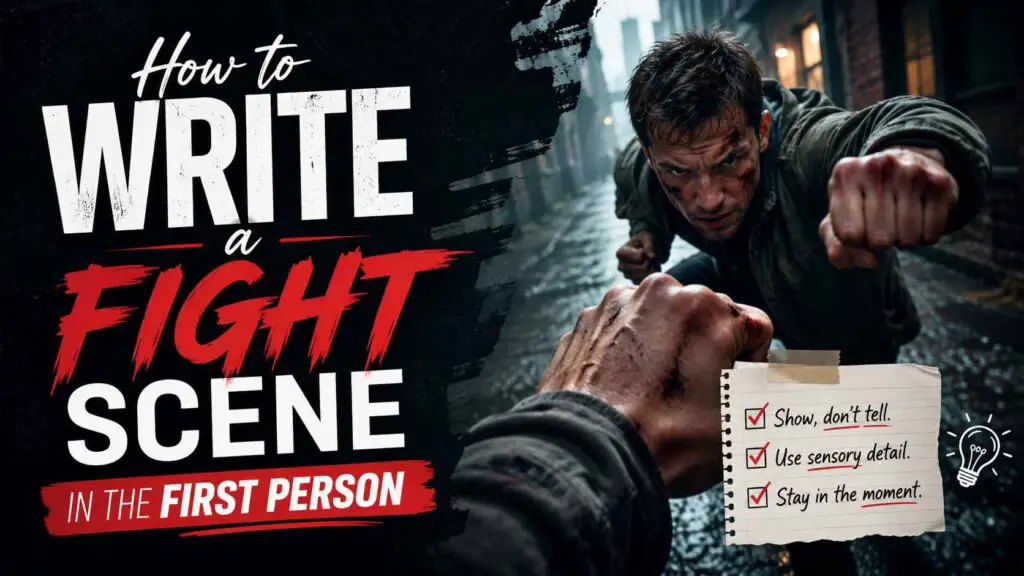
First person traps the reader inside a single body during a fight, which is exactly what makes it so effective — and so limiting. The narrator can only report what they perceive, meaning a first-person fight scene has to work harder to convey chaos, injury, and strategy through one filtered, often unreliable point of view. That constraint, used well, produces some of the most visceral action writing available. Below are the techniques for making a first-person fight scene feel immediate and convincing, each with examples you can study and adapt.
How to Write a Fight Scene in the First Person
#1. Limit the Narrator to What They Can Actually Perceive
A first-person narrator can’t know what’s happening behind them, what an opponent is thinking, or details outside their immediate sightline. Respecting this limitation rather than breaking it for narrative convenience keeps the perspective honest and often heightens tension through what the narrator can’t see.
I never saw the second guy. I only felt the floor come up to meet me and understood, too late, that there’d been two of them the whole time.
I had no idea what he was planning. I just knew his weight had shifted, and that was usually enough warning to move.
Something moved at the edge of my vision. I didn’t have time to find out what before my arms were already reacting to it.
#2. Use Fragmented Thought to Mirror Panic
Under real physical threat, thought rarely arrives in complete, orderly sentences. Breaking the narration into short, disjointed fragments during the most intense moments of a fight mimics how panic actually structures — or fails to structure — a person’s thinking.
Move. Don’t think. His fist. My arm up. Too slow.
The door. Get to the door. Forget the door. He’s between you and the door.
Block. Breathe. Block again. I couldn’t remember the last time I’d actually landed one.
#3. Let Physical Sensation Interrupt the Narration
Pain, adrenaline, and exhaustion can be written as literal interruptions to the narrator’s train of thought — a sentence cut short by a sudden jolt of pain, or attention hijacked mid-description by an injury. This technique makes the physical stakes of the fight impossible for the reader to ignore.
I was already planning my next move when the pain in my ribs arrived, sharp enough to erase the plan entirely.
I tried to track where he’d gone, but my hand had started throbbing loud enough to drown out the thought.
My lungs were burning too badly to finish the sentence in my head, let alone say anything out loud.
#4. Show Tunnel Vision and Selective Focus
Under extreme stress, attention often narrows dramatically, fixating on a single detail while everything else blurs into background noise. Rendering that narrowed focus in first person makes the danger feel physically real rather than intellectually described.
I couldn’t have told you what was happening anywhere else in that room. All I could see was the knife.
Everything else went soft and distant. The only thing in focus was his hand closing into a fist.
The crowd noise disappeared entirely. There was just his shoulder, and the half-second before it moved.
#5. Use Present Tense for Immediacy (When It Fits)
Shifting into present tense for a fight scene, even within a past-tense narrative, can heighten the sense that events are unfolding in real time rather than being recounted after the fact. This technique works best sparingly, reserved for the most intense or pivotal fights rather than every physical altercation.
He swings and I duck and the world narrows to exactly this — his fist, my shoulder, the half-second I have to decide what happens next.
I don’t think. I just move, and somehow my body already knows this dance better than I do.
There’s no time to plan. There’s only this punch, and the next one, and whatever’s left of me after that.
#6. Let the Narrator’s Skill Level Shape the Description
A trained narrator will process a fight in tactical, almost technical terms, while an untrained one will experience it as pure chaos and instinct. Matching the narration’s vocabulary and clarity to the character’s actual competence keeps the first-person voice consistent and believable.
His stance told me everything before he’d even committed to the swing — weight too far forward, chin exposed. An easy read, if I could just get my body to cooperate.
I had no idea what I was doing. I just knew that ducking seemed statistically better than not ducking.
Ten years of training kicked in before conscious thought did, my hands already up before I’d registered the threat.
#7. Show the Internal Monologue Racing Ahead of the Body
A first-person narrator’s mind can move faster than their body actually can, planning several moves ahead while physically still stuck on the current one. Capturing that gap between thought and execution adds tension and realism to a fight scene’s internal experience.
I’d already planned the next three moves before my fist had even finished the first one.
My brain kept insisting I get to the stairs, though my legs, for reasons I didn’t have time to interrogate, had other plans.
I knew exactly what I needed to do. Knowing and doing turned out to be two very different problems.
#8. Use Aftermath to Process What Happened Too Fast to Narrate
Some moments of a fight happen too quickly for a first-person narrator to fully register in real time, and acknowledging that gap — piecing events together afterward — can be more honest than pretending to have witnessed everything clearly. This technique also gives the aftermath its own narrative purpose.
I still don’t know exactly how I ended up on the ground. One second I was standing, and then I wasn’t.
Someone told me later I’d been the one to throw the first punch. I have no memory of deciding to.
It was only afterward, hands shaking, that I understood how close the whole thing had actually come to going differently.
Closing Thoughts
A first-person fight scene earns its intensity by respecting the narrator’s limits — what they can see, process, and remember — rather than pretending to omniscient clarity. Use fragmented thought and tunnel vision to mirror real panic, match the narration to the character’s actual skill level, and let the aftermath fill in what happened too fast to catch, and readers will feel the fight from the inside rather than simply watching it happen.