
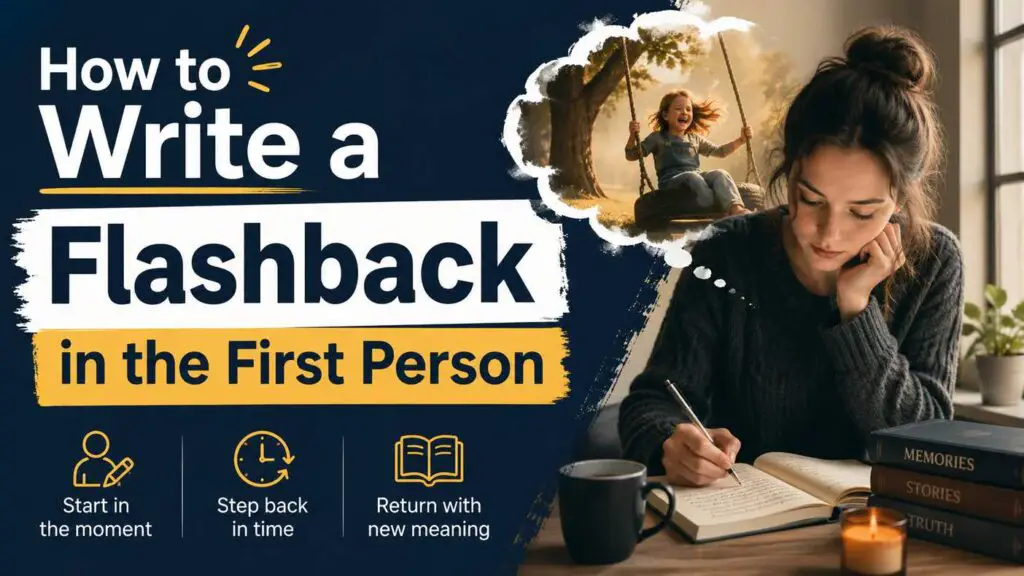
First person makes memory personal in a way third person can’t quite replicate — a flashback isn’t just a scene the reader visits, it’s something the narrator is actively reliving, filtered through everything they’ve learned or lost since. That intimacy is powerful, but it also means the flashback has to sound like it’s coming from inside the same voice that’s been narrating the present all along, not a separate, borrowed one. Below are the techniques for writing a first-person flashback that feels seamless and earned, each with examples you can study and adapt.
How to Write a Flashback in the First Person
#1. Use a Vivid Sensory Trigger
Grounding the entry into a flashback in a specific present-tense sensation — a smell, a sound, a texture — makes the transition feel involuntary rather than a convenient narrative device. This mirrors the way memory actually intrudes on the present, uninvited and sudden.
The smell of chlorine hit me the second I walked in, and just like that I was fourteen again, standing at the edge of that pool.
Her perfume passed by on someone else entirely, and my whole body reacted before my mind caught up to why.
The creak of that specific stair sent me straight back to the night I’d tried so hard not to make a sound.
#2. Shift Tense to Signal the Jump
Moving briefly into past perfect at the start of the memory — “I had been,” “we had gone” — before settling into simple past for the remembered scene gives the reader a clear grammatical cue that time has shifted, without an intrusive “I remembered” tag breaking the voice.
I had been seventeen that summer, and the house had still smelled like fresh paint. We hadn’t known yet how little time we had left in it.
We had promised each other nothing would change. For a while, impossibly, it hadn’t.
I had never told him the truth, not once, not even after everything that came later.
#3. Let the Narrator’s Present Voice Color the Past
A first-person flashback benefits from carrying the narrator’s current knowledge and judgment into the retelling — regret, irony, or hard-won clarity the narrator didn’t have at the time. This layering distinguishes a first-person flashback from a simple scene transplanted from the past.
I thought I understood everything that mattered back then. I understand now how little of it I actually did.
I remember being so sure I was right. I still cringe a little, thinking about how sure I was.
Looking back, I can see exactly where it started going wrong. At the time, it just felt like an ordinary Tuesday.
#4. Keep the Flashback Emotionally Selective
First-person memory is naturally partial and emotionally weighted, rarely a comprehensive record of events. Letting the narrator forget or gloss over details that don’t matter, while dwelling on the one image or line that does, feels more psychologically honest than a fully reconstructed scene.
I couldn’t tell you what either of us was wearing that day, or even exactly what started the argument. I remember his hand on the doorknob, though. I remember that perfectly.
Most of that year has gone soft and blurred in my memory. That one dinner, though, I could still walk you through course by course.
I’ve forgotten what we fought about a hundred times since. I have never forgotten the sound of the door.
#5. Use Present-Tense Immediacy for Traumatic Memory
Shifting into present tense for a particularly intense or traumatic flashback can convey how vividly and involuntarily the memory replays for the narrator, as though it’s happening again rather than simply being recalled. This technique should be reserved for the most significant memories to preserve its impact.
I’m standing in the hallway again. The phone is ringing. I already know, somehow, before I pick it up, exactly what I’m about to hear.
The car is spinning. I can’t remember deciding to close my eyes, but they’re closed, and none of this feels like the past anymore.
She’s saying my name from the other room, and some part of me is still eight years old, still waiting to find out if I’m in trouble.
#6. Interrupt the Flashback With the Present Moment
Briefly cutting back to the present mid-flashback — a sound in the room, a physical sensation — before returning to the memory can heighten the sense that the narrator is being pulled between two moments at once. This technique works especially well for showing a memory the narrator is actively struggling against.
The phone was still ringing in my memory — and then, distantly, in my actual kitchen too, until I couldn’t tell which one I was answering.
Someone touched my shoulder — in the memory, or now, I genuinely couldn’t say which — and for a second both years existed at once.
I was back in that hallway when my coffee went cold in my actual hand, and the small, present-tense fact of it was somehow what finally pulled me out.
#7. Show What the Narrator Didn’t Understand at the Time
Part of what makes first-person retrospection powerful is the gap between what the narrator knew then and knows now. Naming that gap directly — the misread signal, the missed warning — adds dramatic irony that first-person present action can’t achieve on its own.
I thought his silence meant he was fine. I know now it meant the opposite, and I’ve spent a long time wishing I’d known it then.
I read the whole thing as an overreaction at the time. It wasn’t until years later that I understood exactly how much restraint that conversation had actually taken.
I didn’t notice she’d stopped asking me to come along. I noticed everything else that year except that.
#8. Return to the Present With a Deliberate Transition
Just as the flashback needs a clear entry point, it needs an equally clear exit — a sound, a physical sensation, a direct acknowledgment of returning to the present. This prevents the reader from losing track of which timeline they’re currently in.
The kettle screamed behind me, and just like that, I was back in my own kitchen, twenty years and one very different life away.
Someone said my name — my actual name, in the actual present — and the pool deck dissolved beneath me.
I blinked, and the hallway was gone, replaced by the far less dramatic reality of my own living room.
#9. Avoid Explaining the Memory’s Meaning Too Directly
Stating outright what a flashback “means” or “taught” the narrator often flattens its emotional impact. Trusting the reader to draw the connection between the memory and the present situation, rather than spelling it out, keeps the reflection feeling earned rather than lectured.
I didn’t need to explain why the sound of that door still bothered me. Anyone who’d heard the story once already understood.
I let the memory sit there, unexplained, and moved on with the rest of my morning as if it hadn’t just rearranged something in me.
I didn’t say what it meant that I’d finally remembered his face without flinching. I just noticed that I had.
Closing Thoughts
A first-person flashback works when it feels like an involuntary intrusion of memory rather than a scheduled detour — triggered by a specific sensation, colored by the narrator’s present-day knowledge, and selective in what it chooses to remember clearly. Let the past and present occasionally blur at the edges, and trust the reader to feel the memory’s weight without being told what it means, and your flashbacks will carry the same intimacy as the rest of your first-person narration.