
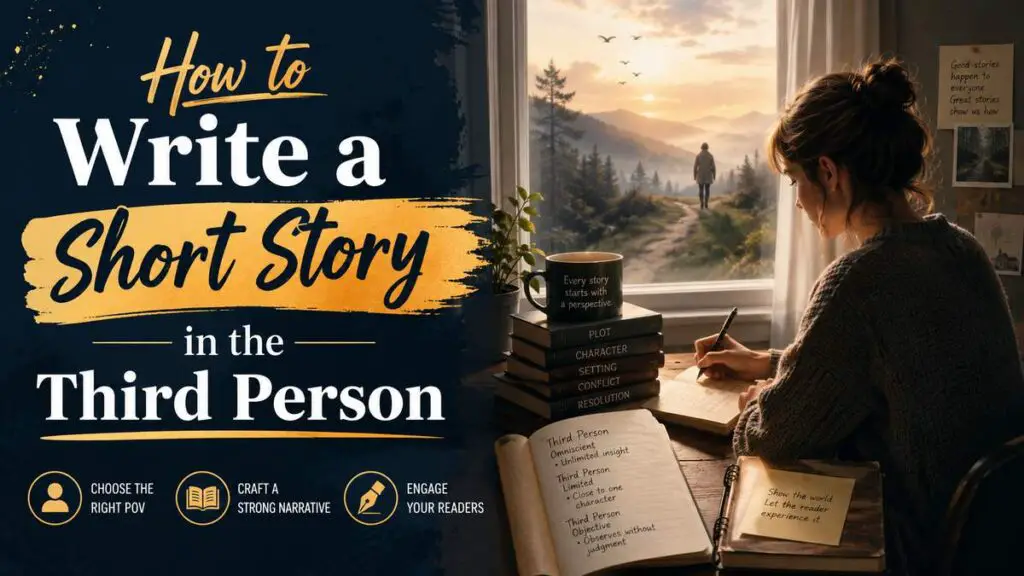
A short story has no room for wasted motion, and third person gives a writer precise control over how much distance to keep from a character while still working within that tight space. Too much narrative remove and the story reads as a summary; too much interiority and a short piece can drown in reflection it doesn’t have the length to support. The best third-person short stories calibrate that distance from the first line and hold it with discipline all the way through. Below are the techniques for making that calibration work, each with examples you can study and adapt.
How to Write a Short Story in the Third Person
#1. Choose the Right Narrative Distance for the Story’s Scope
A story built around a single quiet decision usually calls for close third person, tracking a character’s thoughts almost as intimately as first person would. A story spanning more time or more characters can benefit from a slightly more distant third, one that observes rather than inhabits. Deciding this before drafting keeps the whole piece consistent.
She stood at the sink a full minute after the water had gone cold, unable to explain to herself why she hadn’t turned it off.
Over the course of that autumn, the Alvarez family sold the house, split the furniture three ways, and stopped, gradually, calling each other on Sundays.
He couldn’t have said what made him turn back at the gate, only that something in him had already decided before the rest of him caught up.
#2. Establish the Protagonist’s Desire Early
A short story doesn’t have the length to slowly reveal what a character wants — that desire, stated or strongly implied, needs to surface within the first page or two. Establishing it early gives every subsequent scene a clear question the reader is tracking toward an answer.
All she wanted, that whole difficult year, was for someone to ask her a question she hadn’t already answered a hundred times.
He’d driven four hours for one specific sentence, and he wasn’t leaving until he heard it.
What she wanted, more than the promotion itself, was for her father to hear about it from someone other than her.
#3. Use a Single, Focused Point-of-View Character
Short fiction rarely has room to develop multiple points of view without diluting its impact. Anchoring the entire story to one character’s perspective, even in a more distant third person, keeps the emotional throughline sharp and the reader’s investment concentrated in a single place.
He never learned what his sister had actually said to their mother that night, only the version that reached him secondhand, already softened.
She could only guess at what the other passengers made of her, sitting there dry-eyed while everyone around her cried at the film.
Whatever calculation his boss was making behind that closed door, he wasn’t going to find out until Monday.
#4. Ground the Opening in Scene, Not Summary
Opening a short story with background information delays the reader’s entry into the actual narrative. Starting instead in a live, specific scene — action already underway — pulls the reader in immediately and lets any necessary context arrive later, woven into the story rather than front-loaded.
The casserole dish was still warm when Marta set it down on the porch railing, though nobody had answered the door in almost a minute.
By the time the tow truck arrived, David had already decided this was somehow going to be his fault.
The interview had been going fine until the woman across the desk asked a question nobody had prepared her for.
#5. Let Action and Dialogue Carry Characterization
A short story has limited space for extended character description, so what a character does and says has to do most of the work of revealing who they are. Trusting behavior over exposition keeps the pacing tight while still delivering a fully realized character.
He tipped the delivery driver twice what the app suggested, then spent the rest of the night worrying he’d embarrassed the guy by doing it.
“I’m not upset,” she said, refolding the same shirt for the third time.
He answered every question with another question, a habit that had outlasted three different jobs and one marriage.
#6. Build Toward One Central Turning Point
Unlike a novel, a short story typically has room for only one major shift — a single decision, revelation, or reversal that the entire piece is structured around. Identifying that turning point early and building every scene toward it keeps the story from feeling scattered across too many competing threads.
Everything up to that phone call had been ordinary; nothing after it would be.
She said yes before she’d finished thinking it through, and by the time she had, it was already too late to take it back.
The letter had been sitting unopened for a week, and the moment he finally read it, the rest of the story became inevitable.
#7. Use Third Person to Control Dramatic Irony
Third person allows a writer to let the reader sense something the point-of-view character hasn’t noticed yet, creating tension through the gap between what’s known and what’s felt. This technique works especially well in short fiction, where a single well-placed piece of dramatic irony can carry an entire story’s tension.
He kept talking about their future plans, unaware that she’d already made a different one.
She thanked the doctor for the good news, not yet understanding which part of it he’d actually meant.
He was so relieved to have found the ring that he didn’t notice, right away, that she’d already stopped wearing rings entirely.
#8. Trim Anything That Doesn’t Serve the Central Conflict
Short stories reward ruthless editing more than almost any other form — a scene, a character, or a subplot that doesn’t directly serve the central conflict usually needs to go, no matter how well it’s written. This discipline keeps the piece feeling inevitable rather than padded.
The subplot about the neighbor’s dog had been charming, but it added nothing to what the story was actually about, and it was the first thing cut.
An entire flashback to college was trimmed down to a single line, since the reader only needed to know that they’d once been close.
The final draft removed three secondary characters entirely, leaving only the two people the story had always really been about.
#9. End on an Image or Moment, Not an Explanation
Short stories tend to land harder when they close on a concrete, resonant image or action rather than a summary of what the story meant. Trusting the reader to draw the meaning from that final moment keeps the ending from feeling over-explained or sentimental.
She left the porch light on that night, and every night after, though she could no longer have said exactly who she was leaving it on for.
He folded the letter back into its envelope, unread a second time, and put the kettle on.
The two of them stood at the edge of the field a while longer, neither one making the first move toward the car.
Closing Thoughts
A short story in third person succeeds when its narrative distance is chosen deliberately and held consistently — close enough to feel intimate, disciplined enough to stay economical. Anchor the piece to one character’s desire, build toward a single turning point, and trust a concrete final image over an explained ending, and the story will feel complete despite its length rather than limited by it.