
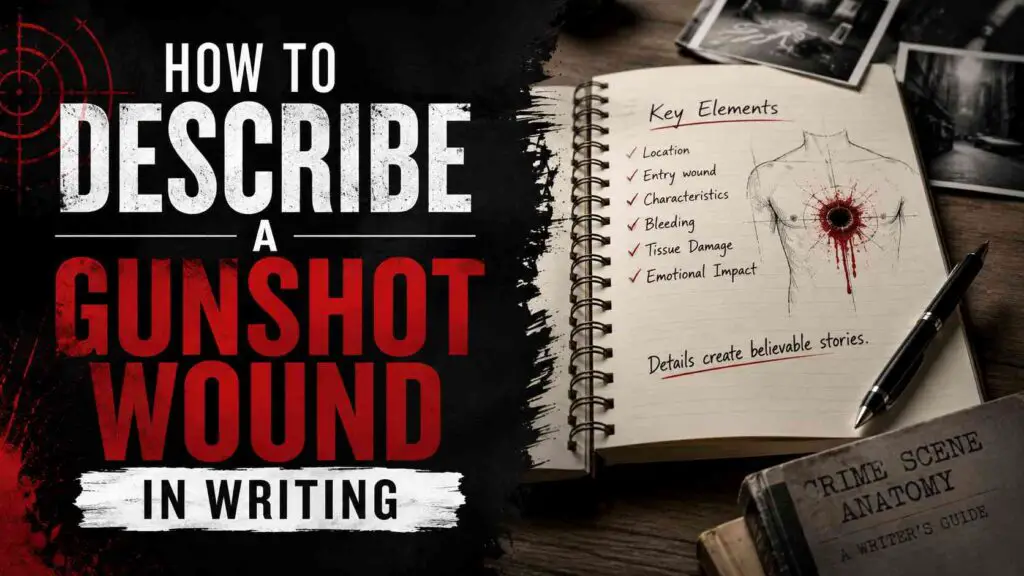
A gunshot wound has become such a familiar image in fiction and film that it’s easy to reach for shorthand instead of specifics — a character clutches their side and staggers, and the scene moves on. Real gunshot wounds behave differently depending on caliber, distance, and location, and paying attention to that variation is what separates a wound that feels researched from one that feels borrowed from a hundred other stories. Below are the techniques for writing a gunshot wound with real physical credibility, each with examples you can study and adapt.
How to Describe a Gunshot Wound in Writing
#1. Show the Impact Before the Pain
Many gunshot survivors describe the initial sensation as a hard impact or push rather than sharp pain, with the actual pain arriving a beat later. Showing this sequence — impact, confusion, then pain — mirrors real accounts more convincingly than an immediate scream of agony.
It felt like being shoved, hard, by someone who wasn’t there, and it took a full second to understand it hadn’t been a shove at all.
He staggered back a step, more confused than hurt, and looked down at his own shirt like it belonged to someone else.
The pain arrived late, almost apologetically, a full three seconds after the impact itself.
#2. Use Specific, Grounded Physiological Detail
Naming the wound’s specific characteristics — entry point, exit or lack thereof, immediate visible damage — grounds the description in credible detail without needing exhaustive medical jargon.
The entry wound was small, almost neat, nothing like the damage she could feel spreading underneath it.
There was no exit wound, which the paramedic seemed to consider both good news and bad news at once.
Blood had already soaked through two layers of fabric by the time anyone got a clear look at it.
#3. Differentiate Wound Types by Location and Caliber
A gunshot to a limb behaves very differently than one to the torso, and a small-caliber handgun round leaves different damage than a rifle round. Reflecting these differences, even in general terms, keeps the wound feeling specific to the weapon and situation rather than interchangeable.
The round had passed clean through his calf, painful but nowhere near anything vital.
It had caught her low in the abdomen, close enough to the center that everyone in the room understood, without saying so, how serious that was.
The rifle round had done considerably more damage than the small handgun wound he’d survived the year before.
#4. Track Shock as Distinct From Pain
Shock can delay or blunt pain in the immediate aftermath of a gunshot, sometimes allowing a character to remain functional or eerily calm for a short window. Showing this gap adds a layer of unsettling realism many action scenes skip past.
She managed to keep walking for nearly a block before her legs finally understood what had happened to them.
He felt strangely calm, almost detached, right up until the moment his body decided otherwise.
The adrenaline held the worst of it back just long enough for him to get everyone else to cover.
#5. Use Sound and Ringing to Convey the Moment
The sound of the shot itself, along with the ringing or muffled hearing that often follows, adds an auditory dimension to the wound that pure visual description misses. This sensory detail also conveys proximity and intensity.
Her ears rang so loudly afterward that she barely heard herself hit the ground.
The world went muffled and distant, voices reaching him as if through water.
He didn’t fully register the shot until the ringing in his ears finally started to fade.
#6. Show Blood Loss Progressing Realistically
Blood loss from a gunshot wound typically progresses over minutes rather than seconds, with symptoms escalating from lightheadedness to disorientation to full collapse. Tracking that escalation gives the scene realistic urgency without exaggerating the timeline.
She felt lightheaded first, then increasingly unable to focus on any single point in the room.
His skin had gone gray and clammy by the time the ambulance finally arrived.
Her vision narrowed at the edges, the room tunneling down to a single, unhelpfully small point of focus.
#7. Use Other Characters’ Reactions to Convey Severity
How bystanders respond — the urgency in their voices, whether they call for help immediately or hesitate — helps the reader gauge how serious the wound actually is without an explicit statement of prognosis.
His partner’s voice had gone tight and fast, the specific tone reserved for genuine emergencies.
Nobody was joking anymore. That, more than anything, told her how bad it actually was.
The paramedic’s hands moved faster than her calm voice suggested they needed to.
#8. Use Restraint for Maximum Impact
Pulling back from exhaustive graphic detail at the most intense moment and trusting a single precise image or reaction to carry the scene often lands harder than an extended, clinical description of the wound.
She didn’t look down again. She didn’t need to.
He kept his eyes fixed on the ceiling tiles, counting them, refusing to look anywhere else.
Someone was already applying pressure before she’d fully understood what she was looking at.
#9. Show the Wound’s Long-Term Physical Consequence
A gunshot wound rarely resolves without leaving something behind — a scar, a limp, chronic pain, a metal fragment that can’t safely be removed. Showing this lasting effect gives the injury narrative weight beyond the immediate crisis scene.
He still favored that leg slightly, especially in cold weather, a habit that had outlasted every other visible sign of the injury.
The scar was small, almost neat, nothing like the damage it had actually taken to close.
The doctors had left the fragment where it was, too close to the nerve to risk removing it, and she’d learned to live around it.
Closing Thoughts
A gunshot wound convinces the reader when it reflects the real physiology behind it — the delayed pain, the specific location and caliber, the realistic pace of blood loss and shock — rather than a generic clutch-and-stagger. Use restraint at the most intense moments, and let the wound’s consequences echo past the immediate scene, and the injury will carry credible, lasting weight in your story.