
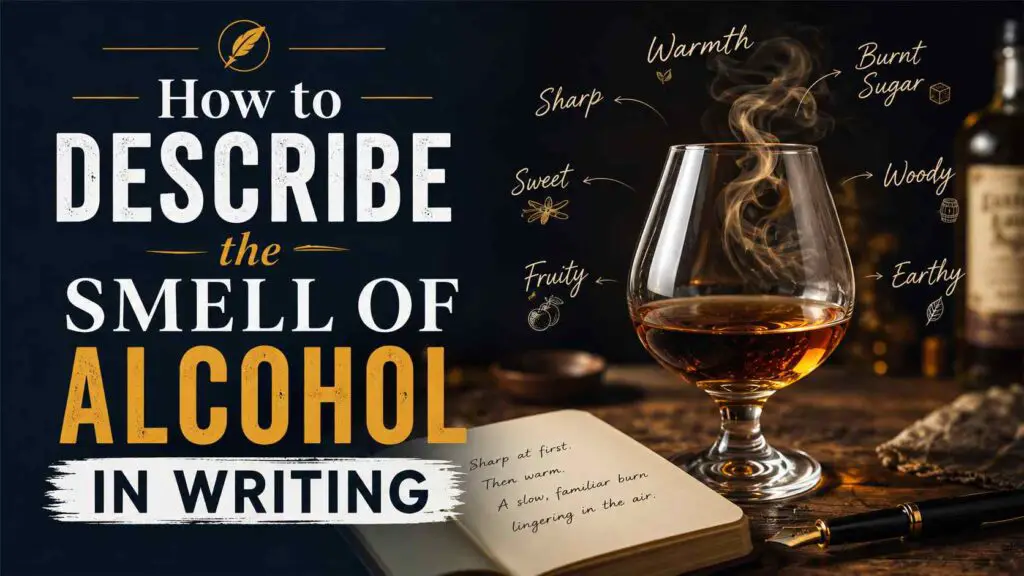
The smell of alcohol carries more information than almost any other scent a character can walk into a room with — it can signal celebration, warning, relapse, or grief, often before a single word is spoken. “Reeked of alcohol” gets the basic fact across but tells the reader nothing about what kind of night, or what kind of person, they’re actually encountering. Below are the techniques for describing alcohol’s smell with real specificity, each with examples you can study and adapt.
How to Describe the Smell of Alcohol in Writing
#1. Distinguish Between Types of Alcohol by Scent
Whiskey, wine, beer, and vodka each carry distinct smells, and naming the specific one tells the reader something about the scene — a working-class bar versus a wine cellar, a college party versus a quiet, private drink. This precision does more narrative work than the generic phrase “smelled like alcohol.”
The sharp, peaty smell of whiskey clung to his collar, unmistakable even from across the room.
Wine had left its particular sour-sweet smell on her breath, faint but impossible to mistake for anything else.
The stale, yeasty smell of beer hung over the whole apartment, evidence of a party that had ended hours ago.
#2. Use Alcohol’s Smell to Characterize Before Dialogue
Letting a character’s scent announce something about them before they speak — a controlled, occasional drinker versus someone whose smell suggests a pattern — establishes character efficiently and lets the reader draw conclusions the narration doesn’t need to spell out.
A single, faint trace of wine followed her into the room, the kind that suggested one glass rather than several.
The smell that came off him wasn’t recent — it was the deeper, settled kind that suggested days rather than hours.
She caught the smell before he’d said a word and understood, instantly, exactly what kind of conversation this was going to be.
#3. Show the Smell Clinging to More Than the Breath
Alcohol’s smell doesn’t stay confined to a person’s mouth — it seeps into clothing, hair, and skin, lingering long after the drinking itself has stopped. Describing this broader presence conveys a more complete, embodied sense of intoxication or its aftermath.
It had soaked into his shirt overnight, sour and unmistakable, no matter how much cologne he’d layered over it.
Her hair still carried the faint smell of the bar, smoke and beer mixed together in a way that clung stubbornly to everything.
The couch had absorbed it by now, a permanent, faint reminder of every night he’d spent exactly here.
#4. Use Alcohol’s Smell to Signal a Relapse or Pattern
For a character in recovery, or one whose family has learned to recognize the signs, the smell of alcohol can function as a specific, dreaded signal rather than a neutral fact. Showing another character’s reaction to detecting it conveys history and stakes without exposition.
She smelled it the second he walked in, and her whole body went still in a way she recognized from years of practice.
He caught the faintest trace under her mouthwash and said nothing, though something in his chest sank all the same.
Nobody had to say anything out loud. The smell alone told the whole room exactly what year it apparently was again.
#5. Contrast Fresh Drink With Stale, Old Alcohol
A freshly poured drink smells sharper and more vivid than the flat, stale residue left behind hours or days later. Distinguishing between the two lets a writer signal how recently drinking occurred without stating a timestamp directly.
The whiskey in his glass smelled sharp and rich, nothing like the stale, flat version he’d find in that same glass tomorrow morning.
The bottles on the counter had gone flat and sticky-sweet overnight, their smell entirely different from what it had been the night before.
What lingered now was duller, staler, the ghost of a smell rather than the thing itself.
#6. Use Smell to Convey Intoxication Level
The intensity of alcohol’s smell can imply, indirectly, how much a character has actually consumed — a faint trace suggesting one drink, an overwhelming presence suggesting far more. This detail lets a reader gauge intoxication without a direct statement of how many drinks were involved.
Just a faint trace on her breath, barely noticeable, the kind that suggested a single glass with dinner.
It rolled off him in waves by the time he reached the doorway, thick enough that she stepped back without meaning to.
The smell alone told her this wasn’t his first drink of the afternoon, not even close.
#7. Use the Smell in Charged Emotional Scenes
Introducing the smell of alcohol at a specific, emotionally loaded moment — an argument, a reunion, a funeral — ties the sensory detail directly to the scene’s stakes, rather than existing as neutral background description.
She could smell it on him even from across the room, which told her exactly how this argument was going to go.
He hugged her hello, and the familiar smell of bourbon on his breath hit her harder than the hug itself did.
The wine at the reception smelled exactly like the kind her mother used to drink, and she had to leave the room for a minute.
#8. Avoid Generic “Reeked of Alcohol” — Get Specific
The phrase carries almost no sensory information, leaving the reader to imagine a vague, unspecified smell. Naming the specific drink and its particular quality gives the description far more texture and believability.
It wasn’t just “reeking of alcohol” — it was specifically gin, sharp and juniper-bitter, unmistakable at close range.
Calling it a smell of alcohol undersold it; it was tequila, distinctly, the kind that clung to everything it touched.
There was nothing generic about it at all — she could have named the brand of rum from three feet away.
Closing Thoughts
The smell of alcohol works hardest on the page when it’s specific enough to carry information — which drink, how much, how recently — rather than reduced to a generic reek. Let it characterize before dialogue does, tie it to the emotional stakes of the scene, and reach past the obvious phrase for the exact drink and its particular quality, and the detail will do far more narrative work than a single vague adjective ever could.