
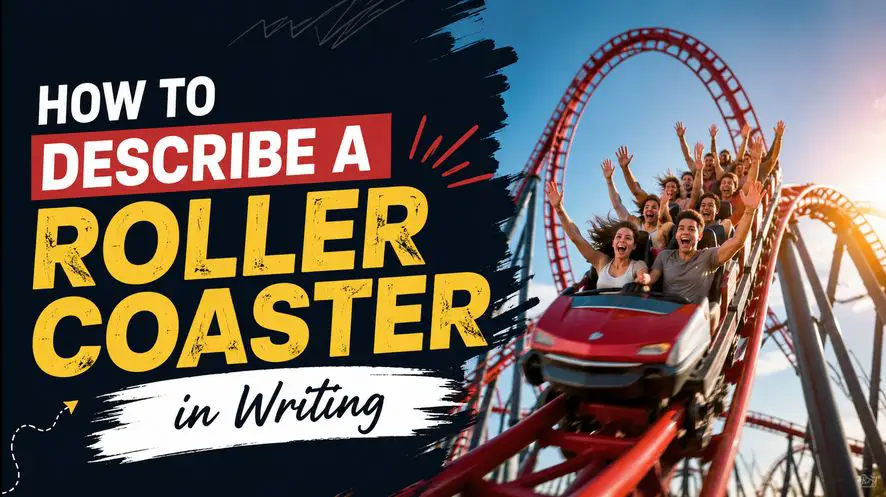
A roller coaster is a complete narrative in ninety seconds — dread in the queue, mounting tension on the climb, surrender at the crest, and chaos until the brakes — which makes it one of the most naturally structured experiences a writer can describe. The craft is capturing the body’s honest reactions at each stage rather than summarizing the whole ride as “thrilling.” Below are the techniques for describing a roller coaster with real visceral force, each with examples you can study and adapt.
How to Describe a Roller Coaster in Writing
#1. Use the Queue as the Dread Chapter
The line is where the ride actually begins — the structure looming overhead, screams arriving on schedule, the bargaining as the front gets closer — and this slow approach builds tension the drop will spend. Characters reveal themselves in a queue: who jokes, who goes quiet, who almost leaves.
Every ninety seconds a trainload of screams passed over the queue, a scheduled reminder of what they were all voluntarily walking toward.
She got quieter with every switchback of the line, her jokes thinning out around the halfway sign.
There was an exit gate at the loading platform, labeled and final, and he looked at it the way drowning men look at shores.
#2. Write the Climb as Stretching Time
The lift hill is deliberate psychological architecture — the chain’s ratcheting clank, the park shrinking below, the crest approaching tooth by tooth — and it should be written slowly, stretching the sentences as the climb stretches the seconds. The ride’s whole dread is stored in this patient ascent.
The chain hauled them up at a walking pace, clank by patient clank, giving everyone ample time to reconsider their decisions.
The park assembled itself below — paths, then people, then just colors — and still the crest kept not arriving.
Near the top the clanking slowed, and the front car began, horribly, to disappear.
#3. Give the Crest Its Suspended Moment
The instant at the top — the view snapping open, the track vanishing, the half-second of floating balance before physics takes over — deserves its own beat, written in suspension. It’s the ride’s hinge between dread and surrender, and slowing the prose there mirrors what every rider’s stomach does.
For one suspended second they hung at the top with the whole county spread out below, and nobody wanted the view.
The track simply ended in sky, and her body understood the arithmetic a heartbeat before it happened.
There was a pause at the crest — brief, ceremonial, the ride clearing its throat.
#4. Write the Drop in the Body, Not the Scenery
The drop happens in the stomach — the lift and float of organs, the involuntary scream, hands cracking tight on the bar, eyes forced shut or streaming — and the body’s reactions are the description. Scenery blurs past uselessly at that speed; the interior sensations are the only honest report available.
Her stomach stayed at the top without her, and the scream that came out was nobody’s decision.
The world became wind and track-roar and his own voice, doing something he would deny later.
His hands had welded themselves to the bar sometime during the fall; he discovered this afterward, unpeeling them finger by finger.
#5. Use the Ride’s Full Physical Vocabulary
A coaster is more than its drop — loops that press blood downward, corkscrews that scramble the horizon, airtime hills that float riders against the restraints, brutal sideways snaps — and naming each force keeps the middle of the ride from blurring into generic speed. Each element does something different to a body.
The loop pressed her down into the seat, heavy as two of herself, the sky rotating politely past her feet.
The little hill near the end lifted them all off their seats for one floating instant — the ride’s single moment of mercy, or its best trick.
The corkscrew took the horizon and wrung it out; for two full seconds, down was a rumor.
#6. Layer the Sound of the Ride
Coasters are loud in layers — the wheels’ roar on the track, wind at speed, a train of overlapping screams, the wooden coaster’s rattle or the steel one’s hum — and the sound carries the ride’s violence honestly. The sudden quiet of the brake run afterward lands like surfacing from underwater.
The old wooden coaster didn’t glide — it thundered, every joint in the structure shouting along with the passengers.
Her own scream vanished into the general roar, one instrument in a very committed orchestra.
Then the brakes caught, and the sudden hissing quiet was almost as loud as the ride had been.
#7. Write the Aftermath on the Platform
The ride ends in bodies — wobbling legs, windburned faces, helpless laughter, the immediate vote on going again — and the platform aftermath shows what the experience did to each character differently. Who’s exhilarated, who’s green, and who’s already rejoining the line is characterization delivered in thirty seconds.
They came down the exit ramp on borrowed legs, laughing at nothing, hair rearranged by physics.
“Again,” said the eight-year-old instantly, while her father stood very still and renegotiated with his stomach.
The ride photo caught all four of them mid-scream, and they bought it, because it was the truest picture anyone had ever taken of the family.
#8. Avoid Generic “Thrilling Ride” — Get Specific
“It was a thrilling, stomach-churning ride” summarizes an experience the reader was never given, collapsing ninety structured seconds into a brochure blurb. Walking the reader through the stages — queue, climb, crest, drop, aftermath — with the body reporting at each one delivers the thrill instead of asserting it.
It wasn’t “thrilling” as a summary — it was the specific sequence of clank, hang, fall, scream, float, and wobble, in that order, twice.
Calling it stomach-churning skipped the details that mattered: which hill did it, and how long her stomach took to forgive her.
There was nothing generic about the ride’s signature move — locals could name it, brace for it, and still never quite beat it.
Closing Thoughts
A roller coaster describes best as the story it already is — dread built in the queue, tension stretched up the climb, one suspended crest, and a drop reported from inside the body. Name the forces, layer the sound, and land the aftermath on wobbling legs, and ninety seconds of track becomes a complete narrative arc your reader rides rather than reads about.