
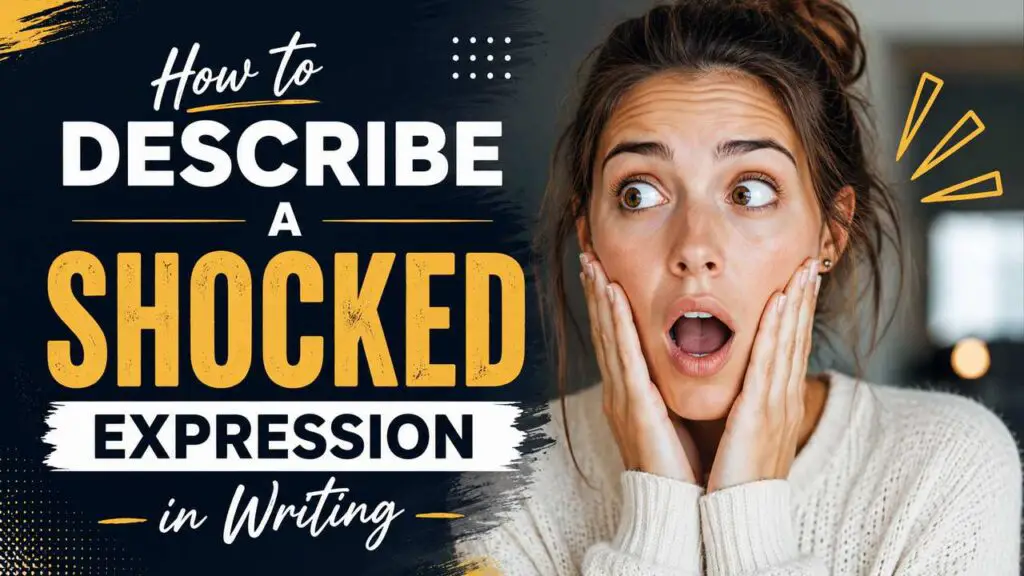
Shock is the face caught off guard — the one expression nobody rehearses — and that makes it both revealing and hard to write, since fiction’s defaults (“her jaw dropped,” “his eyes widened”) have been worn smooth by a century of use. Real shock has stages, stillness, and a delay while the mind catches up to the news. Below are the techniques for describing a shocked expression with real precision, each with examples you can study and adapt.
How to Describe a Shocked Expression in Writing
#1. Write the Freeze Before the Reaction
Real shock often begins with stillness — the face simply stopping, mid-expression, while the brain processes — and that blank pause reads as more genuine than instant theatrics. Writing the freeze first, then the reaction arriving late, mirrors the actual sequence and gives the moment a beat of suspense.
Her face didn’t do anything at all for a full second — it just stopped, mid-smile, like paused footage.
He went completely still with the coffee halfway to his mouth, and the coffee waited there with him.
The news landed and nothing happened — and it was the nothing, stretching on, that told them she’d heard it.
#2. Track the Delay While the Mind Catches Up
Shock has processing lag — the face holding its previous expression while the eyes go somewhere else, the smile lingering wrongly after the sentence that killed it — and writing that mismatch between old expression and new information captures shock’s specific, uncanny texture better than any single feature can.
The smile stayed on his face a few seconds past its expiration, abandoned there while the rest of him dealt with the sentence.
She kept nodding along, a beat behind, the way you nod before the words have actually been unpacked.
His face tried several expressions in quick succession — polite interest, confusion, something else — and settled on none of them.
#3. Use the Whole Face, Not Just Eyes and Jaw
Shock recruits more than the famous features — color draining, lips parting slightly, brows pulling together rather than up, the small muscles around the eyes going slack — and these quieter details read as observed rather than inherited. The subtle version is usually truer than the cartoon.
The color left her face in real time, top to bottom, like someone had opened a drain.
His lips parted slightly — not a gasp, just a seal breaking — and stayed that way.
Everything around her eyes went slack at once, the small muscles giving up their posts.
#4. Add the Body Below the Face
Shock travels below the neck — a step backward, a hand finding a chair or a doorframe, objects set down slowly or dropped outright — and the body’s reactions extend the expression into the whole frame. A dropped spoon or a grabbed counter often testifies more loudly than the face.
Her hand went out and found the counter without being sent, and some of her weight quietly transferred to it.
He set the phone down with enormous care, as if it had become fragile, or he had.
She took one step back from the letter on the table, putting distance between herself and the information.
#5. Wreck the Voice and the Words
Shock disrupts speech — the flat automatic “what,” the repeated word, the question asked twice because the answer wouldn’t file — and broken dialogue conveys the state from inside the scene. The shocked person’s first words are rarely dramatic; they’re small, stalled, and administrative, which is exactly the tell.
“What?” she said — not loud, not dramatic, just the word itself, requesting the sentence again.
“When,” he said, and then, having used his whole vocabulary, said it again.
She asked what time the accident happened, twice, forty seconds apart, and didn’t notice she had.
#6. Calibrate the Shock to Its Cause
A surprise party, a betrayal, and a death notification produce different shocks — delight breaking through, cold stillness, collapse — and matching the expression’s flavor to the trigger keeps the reaction honest. Happy shock and terrible shock share one second of blankness and then go entirely different directions.
For one second her face was pure blank — and then the delight broke through all at once, both hands coming up to her mouth.
This shock didn’t move at all; it settled, cold and still, the face of a woman recalculating ten years of her marriage.
At the uniformed men on the porch, his knees understood before his face did.
#7. Show Shock Being Managed or Hidden
Some characters fight their shock — poker players, professionals, people who can’t afford to react in this room — and the near-miss of concealment is its own rich description. The tell that escapes a controlled face measures both the shock’s force and the character’s discipline in one detail.
Her face held, professionally, completely — except for the pen, which had stopped moving mid-word and never resumed.
He received the number without expression, and then blinked several more times than the moment required.
Only her oldest friend caught it — the half-second where the hostess smile went hollow before refilling.
#8. Avoid “Jaw Dropped” and “Eyes Widened” — Get Specific
The two stock phrases have described every shocked face in fiction for a century, and they now register as notation rather than image. Replacing them with this character’s particular reaction — the frozen coffee cup, the abandoned smile, the doubled question — produces a moment that belongs to your scene alone.
Her jaw did not drop; her face simply emptied, the way a room empties when the fire alarm is real.
Nothing widened. If anything he narrowed — pulled in, condensed, a man bracing around new information.
The specific detail everyone remembered was the fork: she held it upright, loaded, for the entire minute it took to absorb the news.
Closing Thoughts
A shocked expression convinces when it follows shock’s real sequence — the freeze, the processing lag, the whole face and body arriving late to the news, the small stalled words. Calibrate the reaction to its cause, let controlled characters leak one tell, and retire the dropped jaws, and the least rehearsed expression on the human face will read exactly as unrehearsed.