
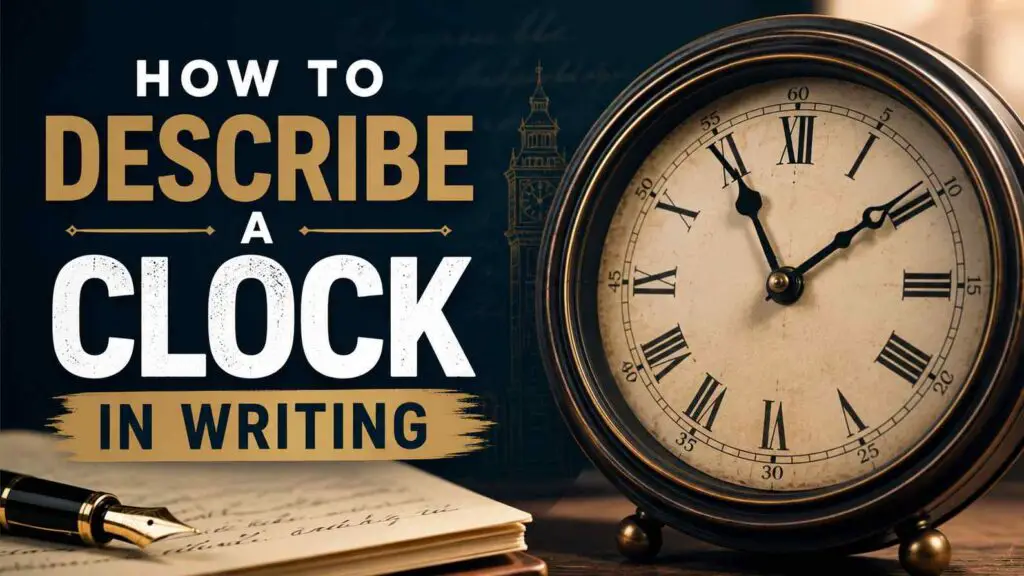
A clock is never just a clock in fiction — it’s an heirloom, an authority, a witness, a machine that outlives its owners while measuring exactly how. As an object it offers faces, hands, weights, and chimes; as a symbol it offers mortality on a mantelpiece. The trick is describing the physical thing well enough that the symbolism arrives on its own. Below are the techniques for describing a clock as an object with presence, each with examples you can study and adapt.
How to Describe a Clock in Writing
#1. Choose the Kind of Clock Deliberately
Grandfather clock, kitchen wall clock, mantel clock, station clock, cuckoo, alarm, wristwatch — each carries its own social register and era, and the choice sets tone before a word of description. A grandfather clock promises inheritance and gravity; a plastic kitchen clock promises fluorescent light and waiting.
The grandfather clock had come over on a ship, like the family, and like the family it was tall, dark, and reluctant to change its ways.
The break-room clock was white plastic and lied by four minutes, and everyone had privately decided which direction to believe.
Over the station platform hung a clock the size of a dinner table, and generations had arranged their reunions under it.
#2. Describe the Face Like a Face
Clock faces have features — Roman numerals or plain strokes, yellowed enamel, brass fittings gone soft with polish, a hairline crack across the six — and describing the dial as a countenance with age and expression gives the object a personality. The word “face” is an invitation the language already made.
Its enamel face had yellowed like old piano keys, and the Roman numerals stood around the rim with the dignity of a jury.
A crack ran from the twelve to the center pin — some old accident nobody living could explain — and the clock wore it like a dueling scar.
The gilt had worn off the hands where a century of dusting had touched them, time polished thin by housekeeping.
#3. Put the Hands in Motion — or Freeze Them
The hands are the clock’s gesture — the minute hand’s small lurch, the second hand sweeping or stuttering, the hour hand’s glacial certainty — and a stopped clock’s frozen hands turn the face into a photograph of a moment. What time a broken clock shows, and why, is a story hook in itself.
The minute hand moved in small decisive jumps, a tiny official stamping paperwork.
The parlor clock had said 4:12 for thirty years, and no one in the family would either fix it or explain it.
The second hand didn’t sweep; it flinched, sixty small flinches to the minute, as if each second cost it something.
#4. Open the Case — Weights, Gears, and Winding
A mechanical clock is a machine with a body — brass weights on chains, a pendulum with its patient arc, the toothed architecture of gears, the ritual of the winding key — and its maintenance is relationship. Who winds the clock, and what happens when they stop, is domestic plot ready-made.
Inside the case the brass weights hung like organ pipes, and the pendulum crossed its small sky at the pace of a man who has never once hurried.
Winding it was his Sunday office — eight turns, never nine — and the week did not officially begin until the key clicked home.
The repairman opened the back and whistled at the little brass city inside, a hundred and forty years old and still holding its rush hour.
#5. Give the Clock Its Voice — Chime, Strike, and Cuckoo
Beyond ticking, clocks announce — the Westminster chime rolling through a house, the single sober strike of one a.m., the cuckoo’s absurd interruption — and the announcement structures household life. A chime heard from three rooms away, marking a scene’s hour, is setting and timestamp in one sound.
The hall clock struck ten through the whole house, each note arriving in the bedroom slightly softened, like news from downstairs.
Mid-argument, the cuckoo burst out of its little door and performed, and neither of them could keep a straight face for the divorce they’d been discussing.
The clock struck one — a single bronze syllable — and the house took it as an accusation.
#6. Write the Clock as Heirloom and Witness
An old clock has attended everything — weddings, wakes, arguments, quiet decades — and treating it as the household’s longest-serving witness gives it narrative gravity. Who inherits the clock, who sells it, who can’t stand its sound anymore: the object organizes family history around itself.
The clock had stood in that corner through four presidents, two funerals, and one night nobody discussed, and it kept all of it to itself.
Three siblings, one estate, and the only thing all of them wanted was the clock — not for its value, for its evenings.
She sold the furniture without blinking and wept at the clock, because the furniture had never spoken and the clock had talked all night, every night, her whole childhood.
#7. Use Wrongness — the Clock That Lies
A clock that’s wrong is instantly interesting — the kitchen clock kept eight minutes fast on purpose, the bedroom clock nobody corrected after the time change, clocks in one house disagreeing like relatives — because wrong time is character information. How a household manages its inaccurate clocks is how it manages everything.
Every clock in her mother’s house was set fast by a different secret amount, a defense system against lateness that meant no one had known the real time in that family for forty years.
The oven clock and the microwave clock disagreed by six minutes, and the marriage had quietly organized itself into his time and hers.
He kept his watch ten minutes fast and knew it was ten minutes fast, and somehow the arithmetic still worked on him every day.
#8. Place It in the Room’s Power Structure
Where a clock hangs is what it governs — over the classroom door where every student’s eyes go, above the factory floor, on the office wall behind the boss so visitors watch time while he watches them — and placement makes the clock an instrument of authority. The room’s most-watched object runs the room.
The classroom clock hung over the door like a guard, and thirty pairs of eyes made the pilgrimage to it every ninety seconds after two o’clock.
He’d hung the clock behind his own desk, so that everyone who sat across from him spent the meeting watching their time run out over his shoulder.
In the waiting room, the clock had been mounted just high enough that checking it required a visible, confessional lift of the chin.
#9. Let the Symbol Emerge From the Object
Clocks drag mortality behind them — time running out is built into the mechanism — but announcing the symbolism (“the clock reminded her of her own mortality”) flattens it. Describe the physical clock precisely at the right story moment and the reader supplies the meaning, which they trust more because it was theirs.
She wound her late husband’s watch every night, a machine that only measured what was gone, and the winding was somehow the point.
The nursery clock and the hospice clock were the same round white model, and the author never mentioned it, and every careful reader felt it.
The draft explained the clock symbolized time’s passage; the revision deleted the sentence and let the pendulum swing.
Closing Thoughts
Of all the objects in a room, the clock is the only one doing something — always working, always spending the one currency everybody in the scene shares. Describe the case, the face, the hands, the voice, and then let it stand there doing its quiet arithmetic. Readers bring their own mortality to the page; a well-described clock just gives it somewhere to sit.