
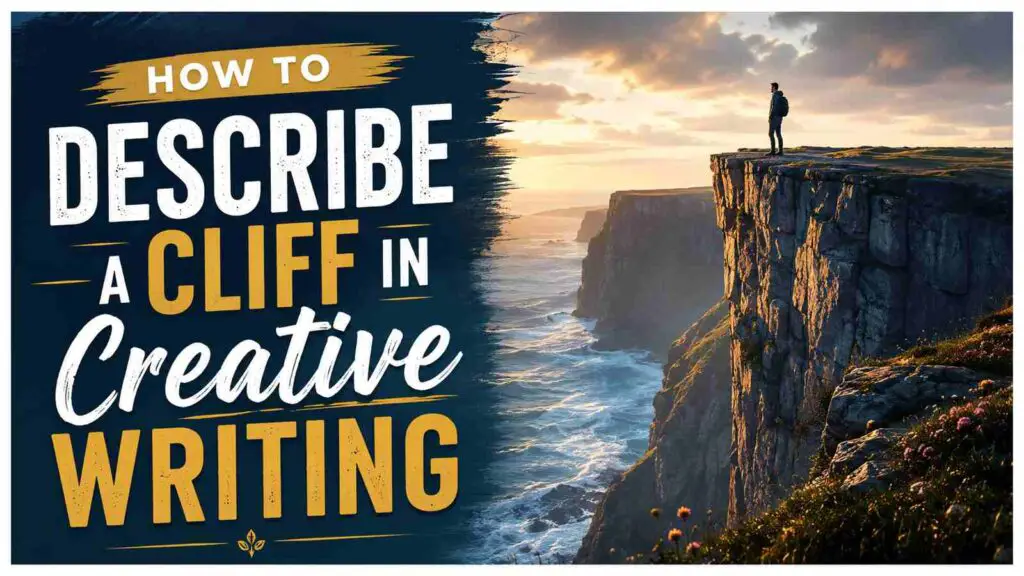
A cliff is landscape with a threat built in — the one piece of scenery that can kill a character who takes a wrong step, which is why stories keep returning to its edge for confrontations, confessions, and choices. Describing one well means capturing both the geology and the vertigo: the rock as it is, and the body’s response to standing above all that air. Below are the techniques for describing a cliff in creative writing, each with examples you can study and adapt.
How to Describe a Cliff in Creative Writing
#1. Establish the Drop Through the Body, Not the Number
“Three hundred feet” is abstract; the swimming stomach, the backward-pulling instinct, the hand that finds a rock to hold without being asked — those are the drop as the body reads it. Vertigo is the cliff’s signature sensation, and writing it from inside the character puts the reader’s own feet at the edge.
Two steps from the edge, her body staged its mutiny — knees softening, palms wet, some ancient committee voting unanimously for retreat.
He looked over once, and the drop did that thing drops do — reached up and pulled his stomach out over the air while his boots stayed on the grass.
She found she’d taken hold of the fence post at some point. She had no memory of deciding to.
#2. Give the Rock Itself a Character
Cliffs differ like faces — white chalk sheer as a wall, red sandstone in layered slabs, black volcanic rock, crumbling shale that betrays every handhold — and the stone’s color, texture, and reliability set both palette and danger level. A chalk cliff and a shale one promise different scenes.
The chalk face stood white as a sail against the gray sea, so bright on clear days it looked lit from inside.
The sandstone ran in bands of rust and rose, a geology of sunsets stacked one era on another.
This rock was rotten — shale that came away in handfuls, a cliff that shed itself, and every climber in the valley knew its name.
#3. Describe Both Vantages — From Above and Below
A cliff is two different landscapes depending on where you stand — from the top, a horizon and a lethal absence; from the base, a wall that cancels half the sky — and choosing the vantage chooses the emotion. Looking down is vertigo; looking up is smallness; a scene can traverse from one to the other.
From the top, the bay was a map of itself, boats reduced to punctuation, and the edge between her and all of it was one stride wide.
From the beach the cliff ate the afternoon sky, and the walkers at its base moved like figures along the bottom of a wall built by something that had never heard of people.
Halfway up the trail, the cliff was neither view nor wall — just rock in front of his face and air behind his heels, the world narrowed to holds.
#4. Add the Cliff’s Weather — Wind, Spray, and Sound
Edges have their own climate — wind that arrives unbroken off the sea and shoves, the boom of waves in caves below, gulls surfing the updraft, spray reaching the top on rough days — and the sensory weather makes the cliff a full environment rather than a backdrop. The wind at an edge is never neutral.
The wind came off the Atlantic with nothing to slow it for three thousand miles, and it treated everyone at the edge as negotiable.
Below, the sea worked the caves with a boom she felt through her boot soles, the cliff being slowly hollowed like a tooth.
Gulls hung level with her face on the updraft, riding the cliff’s own breath, insolently at ease in all that fatal air.
#5. Use the Edge as a Stage for Decisions
Fiction brings characters to cliffs for a reason — the edge externalizes every brink: confession, proposal, despair, the point of no return — and the geography does half the scene’s work if you let it. Distance from the edge becomes a live metric the reader tracks with their own pulse.
They had the conversation four feet from the drop, and every step either of them took, in any direction, meant something.
He’d walked up here to decide, because the cliff was honest about what deciding was.
She stood a long time where the grass gave out, and then she stepped back — and the stepping back was the whole chapter.
#6. Respect the Deep Time in the Rock
A cliff is a cross-section of ages — strata stacked like unread volumes, fossils surfacing in the face, the sea’s patient demolition running millimeters a year — and letting a character register that deep time resizes their crisis against it. Geology is the quietest way to put a human problem in scale.
The face held sixty million years in horizontal lines, and her entire species fit somewhere in the top inch.
A fossil shell sat in the rock at eye level, a sea creature summering three hundred feet above the sea, and he stopped rehearsing his grievance to look at it.
The cliff lost a little of itself every winter, and on the timescale the rock kept, the village at its base was a rumor.
#7. Make the Edge Physically Real — and Unstable
The actual lip of a cliff is specific — undercut turf that overhangs nothing, cracks running parallel to the edge, the warning sign bent by wind, the crumble of soil underfoot — and those close-up details carry more danger than any panorama. Whether the ground itself can be trusted is the edge’s real question.
The grass ran right to the lip and past it — a green overhang roofing empty air — and the path’s worn line kept a superstitious yard back.
A crack ran along the clifftop like a dotted line on a coupon, and last year’s fence now hung out in space, still dutifully strung.
The soil at the edge gave a soft crunch underfoot, granular and loose, ground that had already made its decision and was merely waiting on a date.
#8. Avoid the Postcard — Put a Person on the Edge
“Majestic cliffs towered over the sparkling sea” is brochure prose — scenery with nobody in it and nothing at stake. The cure is bodies and consequence: a character’s grip, the wind’s shove, the pebble kicked over and counted down to its distant landing. A cliff becomes real the moment someone could fall off it.
The view was magnificent, probably. He was mostly aware of the wind at his back, like a hand that hadn’t decided.
She kicked a pebble over the lip and they both listened — one Mississippi, two, three, four — and the click, when it finally came, was very small and very far away, and it ended the picnic.
Cut “majestic,” the note said. Tell me what her hands were doing.
Closing Thoughts
Every cliff scene is really two descriptions running at once — the rock and the reaction, the geology and the grip. Get both on the page and the reader stands where your character stands, doing what everyone does at an edge: leaning out just far enough to feel it, and holding on.