
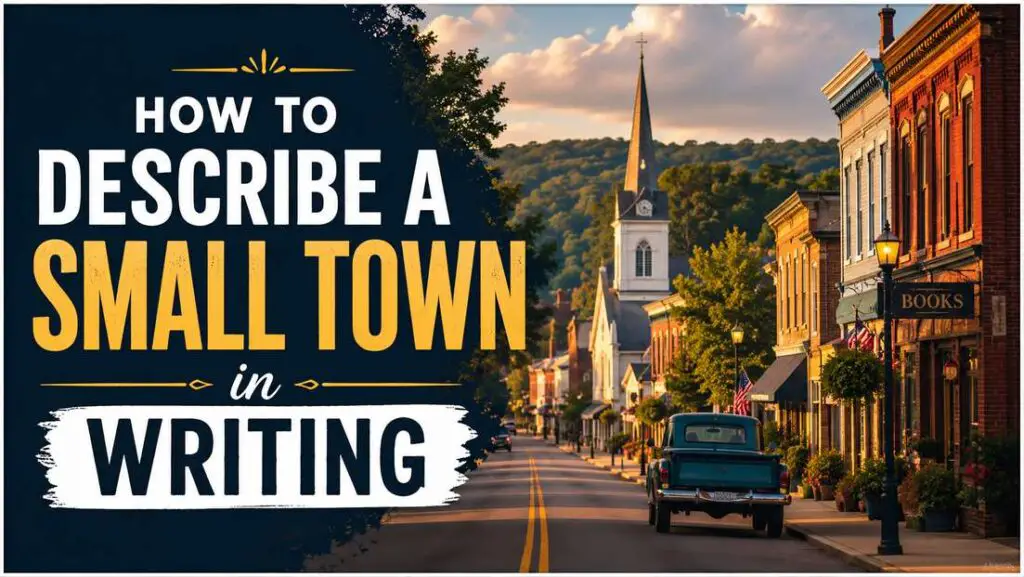
A small town is a setting where the setting talks back — everyone knows everyone, memory is municipal, and a stranger’s arrival is news by lunchtime. That density of attention is what makes small towns irresistible to fiction: they’re pressure cookers disguised as postcards. The describing, then, is double work: the physical main street, and the invisible web of knowing that runs over it. Below are the techniques for describing a small town with both layers intact, each with examples you can study and adapt.
How to Describe a Small Town in Writing
#1. Build the Main Street Inventory — With One Wrong Detail
The diner, the hardware store, the bank, the church, the empty storefront — the reader expects the inventory, so deliver it efficiently and then break it with one specific, slightly off detail that makes this town nobody else’s. The wrong detail is the fingerprint.
Main Street had the usual suspects — diner, bank, two churches glaring at each other across the intersection — and, for reasons nobody could adequately explain, a taxidermied bear in the window of the insurance office.
The hardware store had outlived the mine, the mill, and three mayors, and its window display hadn’t changed since the moon landing it commemorated.
It was a town of four hundred people and eleven churches, a ratio that told you everything about the entertainment options and most things about the feuds.
#2. Describe the Web of Knowing
The small town’s defining physics is total information — the waitress knows your order, the pharmacist knows your diagnosis, your car parked anywhere is a public statement — and describing that surveillance-by-affection (or by malice) captures the town’s true architecture. Privacy is the one commodity the general store doesn’t stock.
Her car was outside the lawyer’s office for forty minutes on a Tuesday, and by Friday three casseroles had arrived, calibrated precisely to a divorce.
The diner had his coffee poured before the door finished chiming — black, two sugars, and don’t mention the election.
In that town you could be anonymous for about the length of one tank of gas.
#3. Give the Town a Memory Longer Than Its Residents
Small towns run on deep archive — grudges inherited like furniture, a family still “the new people” after twenty years, the fire of ’74 as a live reference — and that long memory is both texture and plot fuel. What the town refuses to forget defines it as surely as its geography.
The Hendersons had been the new family for twenty-two years and were expected to remain so for at least one more generation.
Nobody mentioned why the Pratts and the Colemans sat on opposite sides at football games; nobody needed to; the reason had a headstone.
Directions in town used buildings that no longer existed — turn left where the depot was — a map of ghosts everyone under forty had memorized secondhand.
#4. Anchor It to Its Economic Engine — Running or Dead
Every small town orbits something — the mill, the mine, the interstate exit, the college, the lake tourists — and whether that engine is running, sputtering, or thirty years cold sets the town’s entire emotional register. The boarded storefront and the new vape shop are both economics made visible.
The mill had closed in ’89, but the town still set its clock by a shift whistle nobody living had heard.
Summer trebled the population and the prices, and the year-rounders served the lake people with a politeness you could skate on.
When the bypass opened, the town didn’t die exactly — it just stopped being on the way to anywhere, which took longer.
#5. Use the Gathering Places as Stages
The town’s real business happens in its few shared rooms — the diner’s regular booths, the post office line, the Friday bleachers, the church basement — and each has its own protocols and seating charts worth describing. Who sits where, and who stopped coming, is the town’s news feed.
The corner booth belonged to the retired farmers from six to eight-thirty, a parliament with coffee, and no legislation in town passed without at least being mocked there first.
The whole town attended Friday’s game, which meant the whole town noticed who didn’t, which meant Friday’s game was also the census.
The post office line moved slowly on purpose; it was less a line than a talk show with stamps.
#6. Write Arrival and Departure as the Town’s Two Dramas
Small-town stories pivot on the door swinging both ways — the stranger arriving into total scrutiny, the local leaving (or failing to), the one who came back and is re-measured against who they were. The town’s reaction to comings and goings reveals its whole character in a single scene.
The stranger’s rental car idled outside the café for five minutes, and in that five minutes it was observed, discussed, and provisionally attributed to either real estate or a funeral.
She came home with a law degree and a hyphenated name, and the town graciously agreed to pretend both were phases.
Every June the town exported its eighteen-year-olds like a crop, and every June it pretended to be surprised.
#7. Catch the Sound and Pace of the Streets
Small towns have their own acoustics and clock — streets where a single passing truck is an event, the noon siren, dogs answering each other across blocks, sidewalks rolled up by nine — and the sensory pace sets scene rhythm. Quiet that a city character finds eerie, a local finds legible.
By nine p.m. the town was so quiet that the traffic light’s changing made an audible click, performing for no one.
The noon whistle went, and every dog in four square blocks filed its objection, same as every day since the Coolidge administration.
She could identify every vehicle on her street blind — the Meyers’ diesel, the mail Jeep, and anything she couldn’t name was worth going to the window for.
#8. Let One Local Character Personify the Town
Towns compress well into people — the postmistress who is the information system, the mechanic who is the economy, the old man on the bench who is the memory — and describing the town through its human institutions is faster and warmer than civic overview. When that person dies or retires, the town visibly loses an organ.
Doris at the post office was functionally the town’s nervous system, and her two weeks in Florida each January were universally experienced as an outage.
When Earl finally closed the garage, four hundred people simultaneously discovered they didn’t know where the oil went.
The bench outside the feed store came with Herb on it, and Herb came with the town’s entire twentieth century filed by weather.
#9. Hold Both Truths — Haven and Trap
The same town is sanctuary to one character and cage to another — casseroles in crisis and claustrophobia at the class reunion, everyone knowing you and everyone knowing you — and honest small-town writing keeps both readings live at once. Which truth a character feels on a given day is the story.
When the barn burned, the town rebuilt it in a weekend; when she dyed her hair blue, the town discussed it for a month. It was the same town. That was the deal.
He loved that everybody knew him. His sister left because everybody knew her. Both of them were right.
The town held her the way a hand holds a bird — warmth, safety, and the constant light pressure of the fingers.
#10. Resist the Postcard and the Sneer Alike
Small towns on the page tend to collapse into two clichés — the twinkly Hallmark postcard or the condescending backwater — and both flatten real places into props. The corrective is specificity without verdict: real detail, mixed people, and the town allowed to be complicated on its own terms.
It wasn’t quaint and it wasn’t dying; it was four hundred people running a school, two churches, and a volunteer fire department on nerve and bake sales, same as always.
The visiting reporter kept looking for either charm or tragedy, and the town, which contained a robotics club, an opioid problem, and the best pie in three counties, declined to simplify.
Write it like a place, the note said, not like a point you’re making.
Closing Thoughts
The main street takes an afternoon to describe; the web of knowing takes a book, and it’s the web that readers come for. Get the diner and the dead mill on the page, then spend your real effort on who watches whom, what nobody mentions, and how fast a casserole can find a crisis. That’s the town. The buildings are just where it keeps itself.