
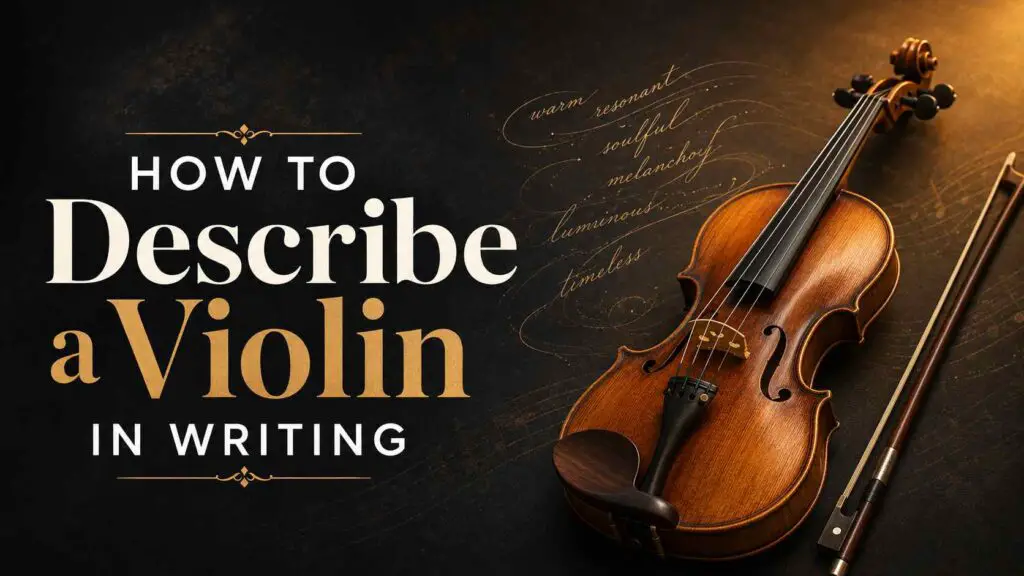
A violin on the page tends to arrive pre-romanticized — gleaming, soaring, weeping — and disappears into its own reputation before the reader sees a single real detail. Yet the actual object is wonderfully concrete: seventy-odd pieces of spruce and maple, a smell of rosin and old varnish, a voice that changes with the weather and the hands holding it.
To put a real instrument in your reader’s hands, work through the approaches below.
How to Describe a Violin in Writing
#1. Treat It as a Made Object
Ground the instrument in its craftsmanship — the flamed maple back, the hand-cut f-holes, the neck’s worn shading, the purfling’s thin inked line. Materials and workmanship give the reader something solid to see, and they quietly establish the instrument’s value without a price tag.
Tilted to the lamp, the back rippled like water over sand — tiger stripes in the maple that the varnish had been feeding for a century.
The varnish had gone thin on the shoulder where a hundred years of collarbones had rested, a patch of honest wood in all that amber.
She ran a thumbnail along the purfling, that thin black inlaid line following the body’s curve, and thought of a man in Turin bending over it with a knife, being careful for her sake, centuries early.
#2. Write the Sound in Textures, Not Superlatives
“Beautiful” and “haunting” describe your opinion of a sound, not the sound. Reach for texture and register instead — grainy on the low G, glassy near the bridge, a whisper on harmonics — and comparisons drawn from the physical world. Specific sound-writing lets readers hear; superlatives only instruct them to be impressed.
The low string had grain to it, like a voice after midnight, and when she leaned into it the note frayed pleasantly at the edges — velvet dragged the wrong way.
Up high the sound narrowed to a bright wire, and on the last harmonic it thinned past hearing, the way a kite doesn’t land so much as stop being visible.
Two rooms away, the violin came through the walls as pure vowel — no melody yet, just a long brown A that made the house feel occupied in a new way.
#3. Put It in the Player’s Body
A violin is worn as much as played: jaw clamped to the chinrest, the callused fingertips, the ache across the left shoulder, the practiced landing on strings. Describing this physical partnership lets the instrument characterize its player and keeps music scenes muscular instead of misty.
She tucked it under her jaw with the small settling motion of a cat taking its chair, and her whole posture reorganized around it, shoulder down, spine lifted, ready.
His left fingertips were shined flat at the tips, four small polished coins, the receipt for ten thousand hours.
After the concerto her jaw carried the chinrest’s oval like a brand, and she wore her scarf high on the train home, privately proud of it.
#4. Give It Moods and Weather
Real violins are temperamental — strings go sour in humidity, pegs slip in dry heat, a soundpost shifts and the voice dulls overnight. Letting the instrument have bad days makes it a character with a body of its own, and gives the player a relationship to maintain rather than a tool to use.
All August the violin sulked, its strings gone soft and sour by noon, and Miri played anyway, apologizing to it with her tuning every few minutes like a couple bickering on holiday.
The first cold snap, a peg let go in the night with a soft twang from inside the case — the instrument talking in its sleep.
Something had moved inside it over the winter, the luthier said, tapping the belly, listening — and the word he used, “unsettled,” struck Nora as a diagnosis for them both.
#5. Open the Case First
The case is the violin’s antechamber — the smell of rosin and felt that lifts out, the spare strings and dented rosin cake, the photographs tucked in the lid. Describing this small domestic world builds anticipation before the instrument appears and tells the reader who its owner is.
The case exhaled when she opened it — rosin, felt, something faintly like church — and there it lay in its blue plush, dressed for its own unveiling.
In the lid: a hotel luggage tag from Vienna, a child’s drawing of a stick figure sawing at a stick violin, and a funeral card, softened at the corners from handling.
His case was a small hardware store — cut strings coiled like snares, three rosin cakes worn to saucers, a mute, a pitch pipe, and under the neck rest, folded very small, a setlist from a band that no longer existed.
#6. Let Its History Be Legible
An old violin is a ledger of its owners — a repaired crack like a healed bone, a previous player’s initials inked inside an f-hole, the fingerboard’s wear mapping someone else’s favorite positions. Reading these marks gives you backstory as physical description, no flashback required.
Down the belly ran an old crack, cleated and glued generations ago, a scar with better workmanship than most new instruments.
Through the f-hole, past the dust, a label: a name, a town that had changed countries twice, and a date her grandfather would not have believed either.
The fingerboard was worn pale in places her fingers never went — some earlier hand had loved the high positions — and playing it felt like moving into a furnished house.
#7. Ban the Weeping and the Soaring
The violin “wept,” the music “soared,” the melody was “hauntingly beautiful” — this is the instrument’s cliché kit, and it turns every scene into the same scene. The alternative is effect on a listener: what the sound interrupts, what it makes someone remember, who stops walking. Consequence beats adjective every time.
The talk at the bar kept on through the first phrase, thinned in the second, and by the third the barman had set down the glass he was drying, cloth still in it.
She played the old dance tune, and her grandfather’s hands, folded in his lap for a decade of Sundays, began without his permission to keep time.
On the platform the busker started something slow, and a man in a hurry missed his train — not stopped, exactly; just walked more and more slowly until the doors closed without him, and found he didn’t mind.
#8. Use Silence as Its Frame
A violin is loudest in a story when it stops — the unplayed instrument on the wall, the case unopened since the accident, the last note’s decay into a listening room. Describing the silence around the instrument turns it into a vessel for grief, hope, or suspense at almost no word cost.
The violin hung on the kitchen wall between the clock and the calendar, and though no one had played it in nine years, his mother still dusted it first.
When the last note went, it went slowly, a bright thread pulled up out of the room, and for three full seconds nobody clapped — the silence itself seeming bowed.
The case stood in the hall closet behind the coats, latched, and every winter when she reached past it for her boots, it said nothing, in the particular way it had of saying nothing.
Closing Thoughts
If you can, spend ten minutes near a real one before you write — a music shop, a rehearsal, a street corner will do. Watch the player tune it: the little frown, the plucked fifths, the peg coaxed a hair backward. Smell the rosin. Notice that the instrument is smaller than you remembered and the sound bigger. Then leave, and write the violin your scene needs — inherited, pawned, mourned, triumphant — with those ten minutes of fact underneath it. One observed detail, honestly placed, will carry more music than a page of soaring; the reader’s ear does the rest.