
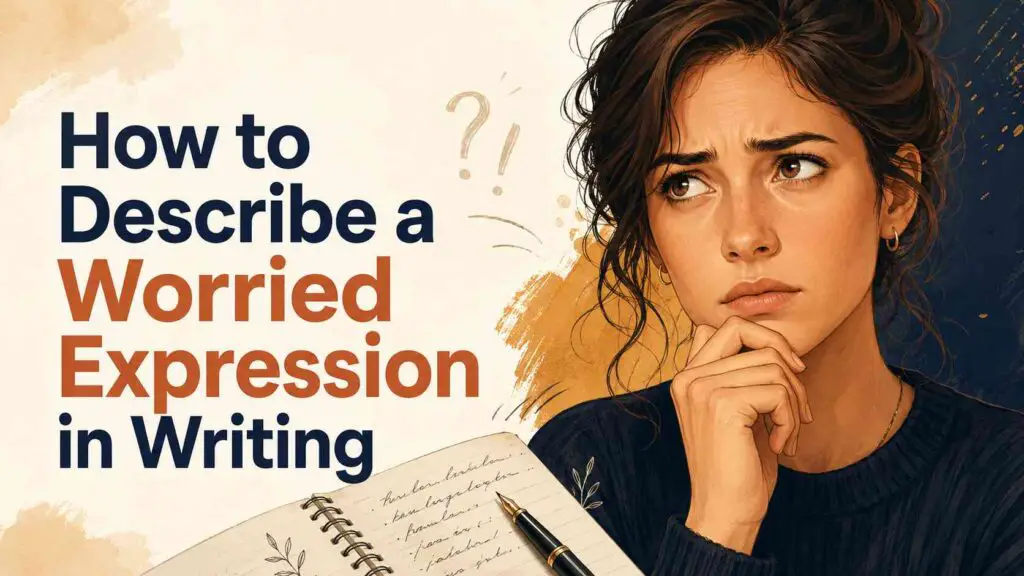
Worry is the hardest expression to write because it is the one people work hardest to hide. Fear flashes and anger declares itself, but worry seeps — it leaks out through a held mouth, a wandering gaze, a coffee gone cold untouched. Write it too plainly and it reads as melodrama; name it outright and the reader feels cheated of the detective work.
The techniques below let a worried face do its worrying without the word ever appearing.
How to Describe a Worried Expression in Writing
#1. The Mouth Gives It Away First
Worry lives in the mouth before anywhere else — lips pressed thin, a bottom lip caught in teeth, a smile held two seconds past its expiry. Readers are wired to read mouths, so one precise mouth detail outperforms a paragraph of general facial description.
She said everything was fine, and her mouth stayed in the shape of the last word, pressed flat, like a letter sealed before she could take it back.
His smile did its job for the length of the toast, then sagged at one corner, a tent with a loosening rope.
All through the phone call she chewed the inside of her cheek, slowly, methodically, as if working through a problem tooth by tooth.
#2. Eyes That Keep Checking
A worried gaze is restless in a specific way: it returns — to the door, the phone, the clock, the child. Describing the checking rather than the eyes themselves shows the reader what the worry is about, which turns an expression into a piece of plot.
He kept the conversation going admirably, but his eyes made the round trip to the driveway every minute or so, regular as a lighthouse.
She watched the movie the way you watch a pot — glancing off it constantly to check her phone, face-down and silent beside her, which was somehow the loudest thing in the room.
His gaze snagged on every white coat that passed the waiting-room window, lifted, hoped, and settled back like something repeatedly failing to land.
#3. Hands at the Face’s Edges
Worry recruits the hands — a thumbnail worried at, a jaw rubbed, a mouth covered mid-sentence. These self-touching gestures are humanity’s oldest self-soothing, and readers recognize them below the level of thought, so they land as felt truth rather than stated emotion.
While the lawyer talked, Ada’s thumb found the edge of her other thumbnail and pushed at it, tiny repeated movements, sanding down a corner of herself.
He kept dragging his palm down over his mouth and chin, as if trying to wipe the expression off before anyone could read it.
Her hands couldn’t settle: they smoothed her skirt, tested an earring, laced and unlaced — small birds refusing every branch.
#4. The Face Behind the Face
Most adult worry is worn under a performance of calm, so describe both layers: the composed surface and the seams where it fails. The gap between what a character shows and what escapes is inherently dramatic and tells the reader the worry is serious enough to hide.
Dad did his easy voice, his weekend voice, but it sat on his face like a rented suit, and none of us mentioned that he’d buttered the same slice of toast twice.
She was luminous with calm all through dinner — too luminous, the way a lamp burns brightest on a failing bulb.
His face held its pleasant meeting-shape, but when the door clicked shut behind the client, it let go all at once, like a fist opening.
#5. Let Another Character Read It
Route the description through an observer who knows the worried person well — a spouse who recognizes this particular silence, a child who clocks the wrong kind of cheerfulness. Filtered description characterizes two people at once and spares you the clinical catalog of features.
Marcus was fine to anyone who hadn’t been married to him for nineteen years. Lena had, so she saw the fineness for what it was: the good china of his face, brought out for emergencies.
The twins couldn’t have said what was different about their mother that morning, only that they both, without discussing it, decided not to fight about the cereal.
You learn a boss’s weathers. When Ferrante started saying “no worries” to everything, the whole floor quietly began updating their résumés.
#6. Worry Interrupts the Body’s Routines
An anxious mind abandons the body mid-task — food pushed around a plate, a book held unread at the same page, sentences that trail off. Showing broken routines widens the expression beyond the face and gives worry a timeline: the reader sees how long it has been going on.
Her fork moved the rice from the east of the plate to the west and back, a small agriculture that never became eating.
He’d been on page forty-one since Tuesday. He turned the lamp off, then on again, then sat in the half-dark holding the book like a passport in a long queue.
Three times she started watering the ferns and three times ended up at the front window with the can still full, the ferns developing their own quiet worry.
#7. Age and History in the Lines
Long-term worry leaves geography — a groove worn between the brows, a face that folds instantly into a familiar shape because it has been there so often. Describing worry as something a face has practiced adds years of backstory in a single line.
The expression arrived with terrible ease, every crease already knowing its place, a bed that had been slept in for thirty years.
Between her eyes ran a vertical line that no cream had ever softened — her daughter privately called it the ledger, the place where all of them had been written down.
He had a young man’s face until something worried it; then, briefly, you saw exactly what he would look like at sixty.
#8. Retire the Etched and Creased Kit
“Worry was etched on her face,” “his face creased with concern,” “a look of worry crossed his features” — these phrases are so worn they process as white space. The fix is specificity of behavior: one particular thing this face does, in this scene, that a stranger could photograph.
Instead of answering, she began stacking the coasters into a small tower, aligning the edges with surgical care, as if a neat enough tower might hold the evening together.
He laughed at the joke a beat late, and then his face went somewhere else entirely — checked out of the room, in and gone like a man who has remembered a stove.
She kept touching the back of her neck as she read the letter, as though the bad news were a draft coming from somewhere behind her.
Closing Thoughts
Picture the scene that ends a thousand ordinary evenings: a kitchen gone quiet, one light on, a woman standing at the counter with a cooling cup, looking at nothing in particular. Nobody in that image is frowning. Nobody’s face is “etched with worry.” And yet you knew instantly what she was feeling, because worry is a posture toward the future, not an arrangement of features. That is the whole craft in one image. Give the reader the stillness, the checking, the task abandoned halfway — and they will supply the word you never had to write.