
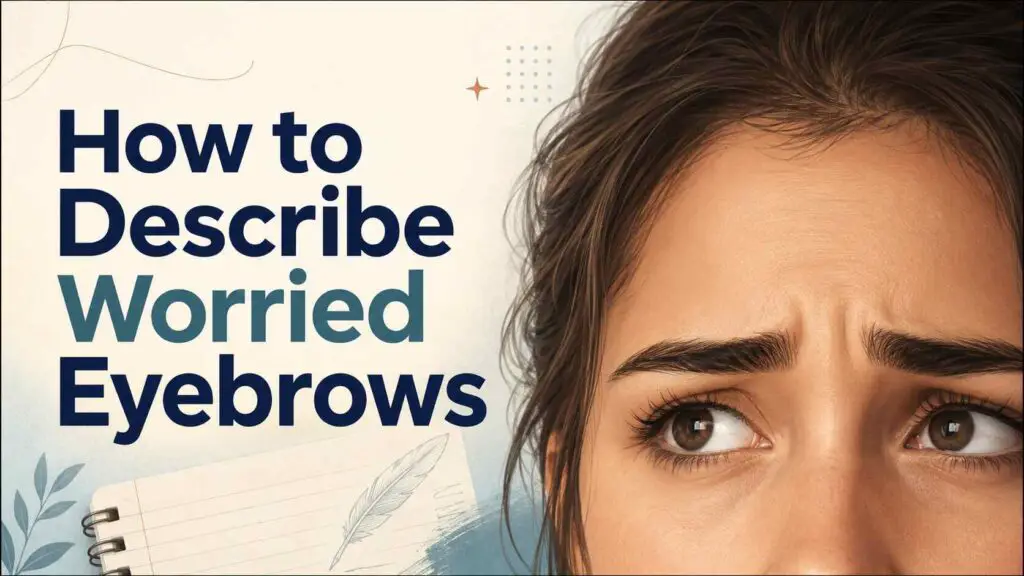
Of all the ways a face admits worry, the eyebrows confess first and lie worst. A mouth can be trained into a smile and a voice can be steadied, but the small muscles between the brows answer to feeling before they answer to willpower. For a writer, that makes the brow a precision instrument — and most prose wastes it with a single all-purpose “furrowed.”
These techniques will get you past furrowed and into brows that actually say something.
How to Describe Worried Eyebrows
#1. Learn the Real Mechanics
Worried brows don’t just lower — their inner ends pull up and together while the outer ends stay put, creating that tented, pleading angle. Knowing the actual movement lets you describe it accurately, and accuracy is what separates a brow the reader can see from a vague frown.
Her brows tipped inward and upward at once, like two roofs leaning together over the trouble between them.
The inner corners of his brows climbed while the rest held still, giving him the look of a man asking a question he already feared the answer to.
Something pulled her brows toward each other by their nearest ends — not a scowl, nothing so decisive — more like two people edging closer at bad news.
#2. The Pinch and Its Small Real Estate
Between the brows is a patch of skin barely an inch wide, and worry works it like dough — puckering, knotting, stitching a vertical crease. Concentrating your description on this tiny territory gives the reader a close-up sharper than any whole-face summary.
A small knot tied itself above the bridge of her nose and stayed there through the whole phone call, tightening a little at each pause on the other end.
Two short lines appeared between his brows, like the beginning of a tally.
The skin between her eyebrows gathered into a soft pleat — the exact pleat her mother had, the one she’d sworn she wouldn’t inherit.
#3. Time the Movement to the Trigger
Brows are fast — they react to a word, a name, a glance at an envelope, often before the person knows they’ve moved. Pinning the brow-shift to its exact trigger turns a static description into a beat of action, and quietly tells the reader what the character actually fears.
He read the text without expression — until the second line, where his brows flinched together as if the phone had given off a spark.
Her eyebrows survived the diagnosis, the treatment plan, the percentages. It was the word “arrangements” that finally pulled them in.
Every time the boy’s name came up, the old man’s brows performed the same small ceremony: a lift, a hover, a slow settling, lower than before.
#4. The Brows Fighting the Face
When someone hides worry, the brows are usually the last holdout — a smile below, turmoil above. Describing this split-screen face gives you concealment and truth in one image, and readers love catching a character in the act of almost managing.
Her voice was bright, her smile was bright, and above it all her eyebrows were conducting a completely different meeting.
He agreed that it was great news. His brows, drawn in and pitched like a worried roof, abstained.
From the nose down she was a hostess; from the nose up, a woman listening for sirens.
#5. Duration Is the Message
A flicker of drawn brows is a passing doubt; brows that stay knotted through a whole dinner are a condition. Telling the reader how long the brows hold their shape — and when they finally release — lets you measure the size of the worry without naming it.
The crease appeared at breakfast when the mail came, and it was still there at midnight, faithful as a guard who hadn’t been relieved.
Only when the car pulled into the driveway did her brows finally let go, and the letting go was so sudden it looked like grief.
His eyebrows drew together for exactly as long as it took him to do the math, then released — a two-second storm, gone before the waiter returned.
#6. Seen From Across the Room
Let another character read the brows from a distance — through a window, across a party, in a rearview mirror. Worry in the brow is legible at range in a way small mouth-details aren’t, so it’s the perfect signal when your point-of-view character can’t hear what’s being said.
She couldn’t hear the phone call through the glass, but she could see his eyebrows, and his eyebrows were enough: pulled in tight, holding on to each other.
Across the gym, over the heads of forty parents, Dana found her husband’s face and read the school year in his brows.
In the mirror the driver’s eyes stayed on the road, but his brows had bunched over them like weather coming in, and Theo quietly rechecked his seatbelt.
#7. Beyond Furrowed and Knitted
“Furrowed brow” and “knitted brows” are the two settings on the genre’s default machine, and both have been worn smooth of meaning. When you need fresh language, borrow from other domains — architecture, weather, punctuation — or replace the adjective with what the brows are doing to the space around them.
His brows came together like a drawbridge going up — the castle closed, the visitor uncertain of his welcome.
Her eyebrows made a circumflex over each eye, small accents of concern, her whole forehead becoming a word in a language of apology.
The foreman’s brows lowered and gathered until his eyes were two lit windows under heavy eaves.
#8. The Comfort That Answers Them
Worried brows invite response — a thumb smoothing the crease, a joke aimed at the knot, a hand on the face. Writing the gesture that answers the brows turns a description into a relationship beat, and the moment the brows soften becomes the scene’s emotional payoff.
She reached up and pressed her thumb gently between his brows, as if paying a small toll, and the crease surrendered under it.
“Your eyebrows are doing the thing,” he said, and she laughed despite everything, and the thing, briefly, undid itself.
The baby, with a baby’s terrible aim, reached up and grabbed exactly the knot between her father’s brows, and he let her keep it.
Closing Thoughts
Try this at a mirror tonight: think of something genuinely unresolved in your life and watch your own forehead. Notice that your brows don’t “furrow” — they tilt, gather at their inner ends, and stitch that small vertical seam. Notice how little it takes, and how unmistakable it is. That’s your calibration. When you write worried eyebrows tomorrow, reproduce what the mirror showed you, at that scale — a centimeter of movement, precisely reported — rather than the heavy machinery of furrowing and knitting. Small and exact beats big and borrowed every time a face is on the page.