
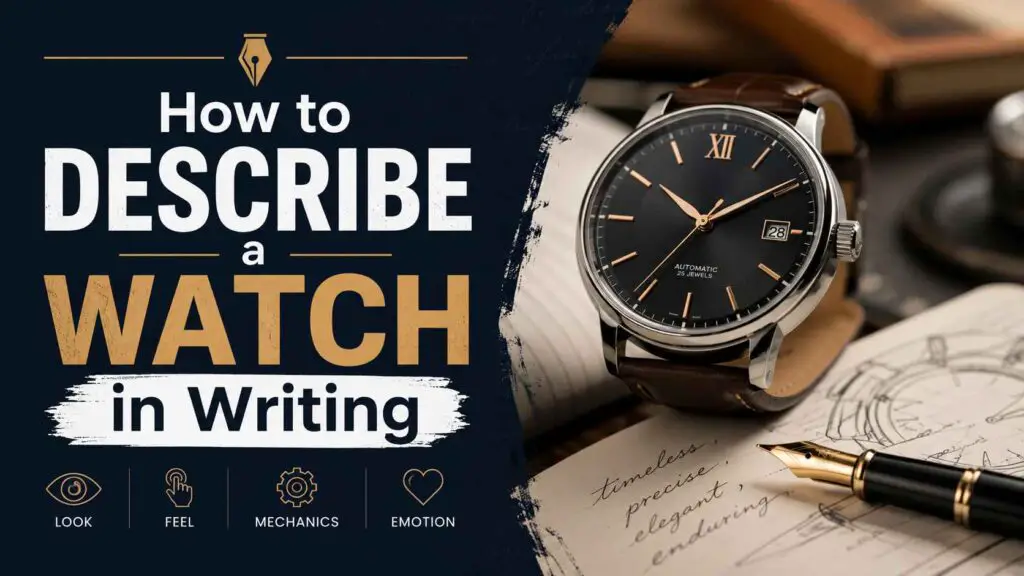
A watch is the most autobiographical object a character can wear — it announces money or its absence, taste or its performance, and it’s frequently inherited, gifted, stolen, or pawned, which means it comes pre-loaded with plot. It’s also a small machine with real texture: weight, tick, glow, scratches. Few props reward close description so richly per square inch. Below are the techniques for describing a watch so it works as character, object, and story, each with examples you can study and adapt.
How to Describe a Watch in Writing
#1. Read It as the Wearer’s Autobiography
The watch a person chooses — battered field watch, tiny gold heirloom, ostentatious chronograph, drugstore digital — is a compressed statement of who they are or want to be. Describing the watch first and letting the reader infer the wearer is faster and subtler than describing the wearer directly.
The surgeon wore a plastic digital watch that cost eleven dollars, and somehow that told you more about his confidence than the diploma wall did.
Her watch was small, gold, and older than her mother — a watch you don’t buy, only receive.
The watch was enormous and new and worn loose so it moved, a watch purchased to be noticed noticing the time.
#2. Give It Weight, Warmth, and Wrist-Feel
A watch is felt all day — the heft of steel, the warm familiarity of a leather strap, the pale stripe of skin beneath it, the phantom presence when it’s off — and the tactile relationship makes the object bodily rather than visual. A bare wrist where a watch has lived for decades feels genuinely wrong.
The steel had his body’s temperature by breakfast and kept it all day, less an object than a habit with weight.
When the clasp finally gave out, he kept checking a bare wrist for a week — the time still lived there, even if the watch didn’t.
Under the strap, a band of skin two shades paler — the watch’s shadow, thirty summers deep.
#3. Describe the Face Up Close
A dial is a tiny landscape — cream or black, batons or numerals, a date window, hands that sweep or tick, lume that glows green in a dark room — and precise dial details give the object the specificity of a face. The crystal’s scratches and the bezel’s wear are its lived-in expression.
The dial had yellowed to the color of old menus, and the radium hands still woke faintly green at night, an antique ghost keeping antique hours.
A scratch crossed the crystal from ten to two — the doorframe in Lisbon, she said, though the story changed with the drink.
The second hand didn’t tick; it swept, one smooth unbroken glide, and he could watch it the way you watch water.
#4. Use the Checking Gesture as Language
Glancing at a watch is a social act with a dozen dialects — the bored theatrical check aimed at a rambling speaker, the anxious every-thirty-seconds flick, the discreet under-table look, the interviewer’s deliberate one. The gesture communicates to everyone watching, and characters read it instantly.
He checked his watch with his whole arm, a performance visible from the back row, and the meeting’s speaker finally found his last sentence.
She glanced at her wrist under the tablecloth, a half-second flick, and her husband caught it anyway, the way he caught everything.
The nurse took his pulse against her watch, eyes on the second hand, lips moving — the oldest duet in medicine.
#5. Let the Heirloom Carry Its Dead
An inherited watch is a relative you can wind — the father’s watch worn to the funeral, resized for a smaller wrist, the engraving inside the caseback — and passing one down is fiction’s most compact way to move love, duty, or debt between generations. Who gets the watch is a will’s loudest sentence.
They’d taken three links out of the bracelet so it would fit her, and she wore her father anyway, loose, the way she’d always had him.
Inside the caseback, an engraving nobody had seen for forty years did its quiet work: “For Tom. Come home. — E.”
The estate divided cleanly except for the watch, which all three brothers claimed and none of them could bring himself to wear.
#6. Run It as a Machine — Winding, Ticking, Stopping
A mechanical watch is alive in a small way — it needs winding, it ticks against the ear, it runs fast or slow with a personality, and it stops when neglected — and the maintenance ritual is a relationship written in daily gestures. A watch found stopped tells you exactly when its owner’s routine ended.
He wound it every morning with his coffee, eleven half-turns, a small handshake between the day and him.
The watch on the nightstand had stopped at 6:40 on some morning weeks ago — the exact hour the routine had died, preserved under glass.
She held it to her ear the way her grandfather had taught her, and the tiny heartbeat was still going, which was somehow the news she’d needed.
#7. Trade It — Pawn, Gift, and Theft
Watches move through plots as portable value — pawned in desperation and redeemed in triumph, given at retirements and graduations, eyed by thieves, slipped off before a fight — and each transaction carries emotional freight beyond the price. A watch changing wrists is never a neutral event.
The pawnbroker saw the watch and then the man, in that order, and offered a number that insulted only one of them.
She’d redeemed the ticket every month for a year, paying interest on her own history, until the watch finally came home for good.
Forty years of service compressed into a box, a speech, and a watch — and he wore it home wondering exactly what it had cost per year.
#8. Set It Against Phone Time
In a contemporary setting, wearing a watch is now a choice — the phone tells better time — so the wristwatch signals ritual, style, rebellion, or loyalty to a dead giver, and characters who check a wrist versus a screen are drawn differently. The obsolete object worn anyway is characterization by anachronism.
He still wore the watch though the phone in his pocket kept truer time — but the phone had never been strapped to his father.
She was the only one in the seminar who checked a wrist instead of a screen, one small analog gesture in a room of glowing rectangles.
“Why wear one at all?” the kid asked, and the old man considered the question. “The phone tells everyone’s time,” he said. “This one tells mine.”
#9. Retire the Rolex Shorthand
“A gold Rolex flashed at his wrist” has become the lazy signifier for wealth or villainy, a brand name doing work the writing should do. The fresher move is specific observation — how the watch is worn, what condition it’s in, what the wearer does with it — which characterizes with detail instead of price tag.
It wasn’t the brand she noticed; it was that the watch was worth more than her car and set four minutes fast — a rich man still afraid of being late.
The draft flashed a gold Rolex; the revision gave him his actual tell — he turned the watch face to the inside of his wrist, the way men do when they don’t want to be seen needing the time.
Anyone can write an expensive watch. Write the thumb that keeps polishing its crystal during the deposition.
Closing Thoughts
Look at the nearest wrist — yours or anyone’s — and ask what the watch there would testify to under oath: where it came from, what it’s survived, who else wore it. That testimony is the description. The time was never the interesting part.