
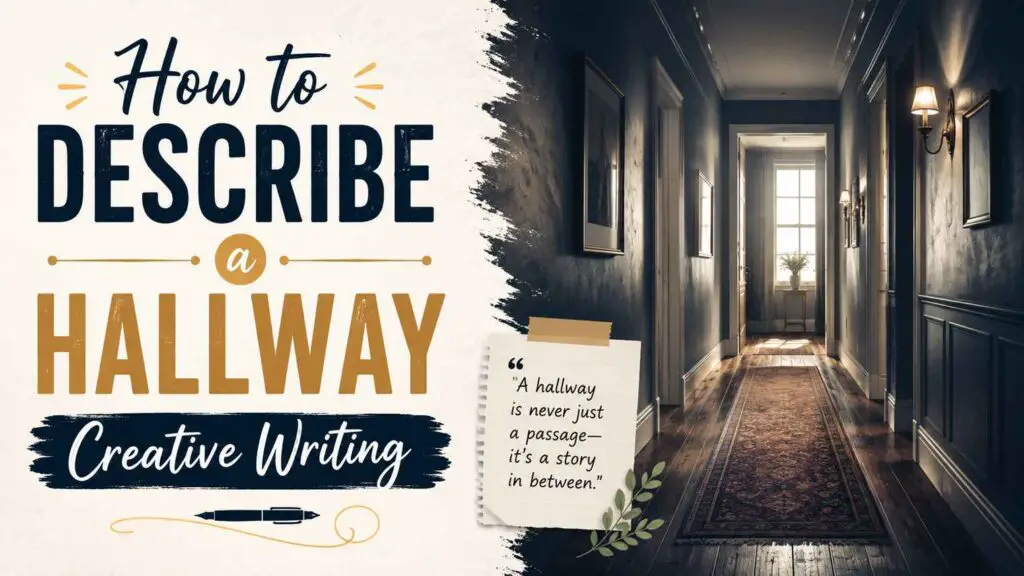
Nobody lives in a hallway. That’s what makes it such potent territory for fiction: it is pure between — between rooms, between conversations, between the person a character was at one door and the person they’ll be at the next. Films understand this instinctively, staging confrontations and long walks toward bad news in corridors. Prose tends to waste them, treating the hallway as blank connective tissue to hurry through.
Here’s how to make the walk between rooms carry its own weight.
How to Describe a Hallway Creative Writing
#1. Use the Squeeze
A hallway is architecture that forbids stopping — too narrow to linger, nowhere to sit, built only for passage. Describing that pressure makes any pause inside it feel charged, because a character who halts in a corridor is breaking the room’s one rule.
The corridor allowed exactly one activity, and she stopped doing it — just stood there between the coat hooks and the radiator, holding the letter, while the house waited for her to keep moving.
It was a hallway with opinions: shoulders in, eyes forward, no loitering. Even the wallpaper seemed to be walking somewhere.
They tried to argue in the passage and it cramped them — no room to gesture, no distance to storm off to — so the fight stood still, packed tight, twice as strong for the confinement.
#2. The Doors Are the Plot
A hallway is a menu of doors, and their states — shut, ajar, locked, lit underneath — are narrative information. Describe which doors a character notices and in what order, and you’ve mapped their fears and priorities without leaving the corridor.
Four doors, all shut, all identical — except that the third one had been shut recently enough that the air still remembered it.
Her brother’s door stood ajar an inch, the way it had for two years, an inch nobody in the family could bring themselves to close or open.
He walked the hotel corridor counting the doors that had trays outside and the one, near the fire exit, that had a chair wedged under its handle from the inside.
#3. Read the Walls Like a Museum
Hallway walls are where households curate themselves — school photos in years-long rows, diplomas, a rectangle of brighter paint where a picture used to hang. Because visitors pass them slowly and residents not at all, wall details can deliver decades of family history in a single walk.
The hallway told the family in order: wedding, baby, baby, dog, gap. The gap was newer than the rest of the wallpaper and precisely the size of a son.
Pencil marks climbed the door frame — Ella 4, Ella 5, Ella 7 — stopping at a height that made Nadia’s chest hurt, halfway up the wood.
Every award in the passage was Gerald’s. You had to get to the kitchen before anyone else in the family had ever done anything.
#4. Score the Footsteps
Corridors are instruments: bare boards report every step, carpet swallows them, parquet creaks in known places. Sound tells characters who is coming before any face appears — and a household’s members are identifiable by their footsteps, which is intimacy no living room can offer.
She knew the third board from the bathroom would give its little cough, so she stepped long over it, a practiced stride her mother had never once slept through anyway.
Heels on the ward corridor: brisk, doubled by echo, arriving well before the news did.
He could tell his father’s return by the hallway alone — two heavy steps, the pause at the mirror, the keys landing in the bowl like a verdict.
#5. Light It From the Ends
Hallways rarely have their own generous light — they borrow it: a window at the far end, a strip under a door, a bulb halfway along leaving both ends dim. Describing where the light enters gives the corridor depth and direction, and makes the walk down it a passage between brightnesses.
The window at the corridor’s end held the afternoon like a framed painting, and the whole passage existed only as a means of walking toward it.
Halfway along, the one working bulb made a pool of jaundiced light, and the residents crossed it quickly, like a ford.
Under the study door lay a blade of lamplight. It was nearly midnight. It had been nearly midnight, under that door, every night since the audit began.
#6. Institutional Corridors Have Their Own Grammar
A school, hospital, or office corridor speaks a different dialect from a home’s — waxed vinyl, numbered doors, noticeboards, the smell of disinfectant or floor polish. Getting the institutional signature right sets tone instantly, because every reader has waited in one of these and remembers the feeling.
The corridor outside the head’s office had a bench worn shiny by fifty years of waiting boys, and Danny added himself to the shine.
Ward C’s corridor was a weather system of smells — disinfectant fronts, a warm drift of toast, and underneath, always, the faint tide of illness.
The office corridor was designed to be forgettable and had succeeded so completely that people got lost in it daily, wandering the beige like polite ghosts.
#7. Stage the Passing Encounter
Two people in a hallway must negotiate — who flattens against the wall, who looks away, who slows hoping to talk. The corridor’s narrowness turns a simple crossing into choreography, and the choreography into a report on the relationship: avoidance, longing, and hierarchy all show in the passing.
They met outside the bathroom at the worst possible width — too narrow to pass without touching, too wide to pretend touching was necessary — and managed both badly.
After the divorce filing they still shared the upstairs passage, and developed a wordless timetable of avoidance so precise it was almost, again, a marriage.
The intern pressed herself to the corridor wall as the surgeons passed, and not one of them altered course by a centimeter — the hallway, like the hospital, was theirs.
#8. The 3 A.M. Version
Every hallway has a night self — the same passage, resized by darkness and silence, walked barefoot toward the bathroom or the crying child. Describing the familiar corridor made strange by the hour lets you unsettle a reader inside the safest possible setting: their own home’s geography.
By day it was eight steps of carpet. At 3 a.m. it was a country — borderless, unlit, longer in both directions — and she crossed it with a diplomat’s caution.
The night hallway ran on different physics: the mirror held more than it should, the coats had postures, and the front door’s frosted glass glowed faintly, like something thinking.
Carrying the feverish baby, he paced the corridor’s whole night-length twenty times, and by the last lap he knew its every seam the way sailors know a deck.
#9. Cancel the Endless Stretching Corridor
“The long, dark hallway seemed to stretch on forever” is the genre’s laziest corridor — infinite, featureless, and therefore weightless. Dread lives in specifics, not length: a smell that shouldn’t be there, one door open that is always shut, a light on at the wrong end. Make the hallway wrong, not long.
The corridor was six doors long, as always. What was different tonight was simple and complete: the runner rug was straight. Nobody in this house had ever straightened it.
Nothing about the passage had changed except the temperature of it, which belonged to a different season, and the fact that the cat would not come past the coat stand.
It was a short hallway. That was the horror of it — whatever had made the sound was, at most, four steps away.
Closing Thoughts
Keep one image as your standard: a woman pausing halfway down her own hallway, between the kitchen where the phone is ringing and the bedroom where her husband is sleeping, deciding — in that narrow, transitional, doorless middle — which person she is about to be. Everything a hallway can do in fiction is in that picture: pressure, passage, choice, and the small architecture of between. Write your corridors so that something is always mid-transit in them — a body, a secret, a decision — and the reader will never again skim the walk from room to room.