
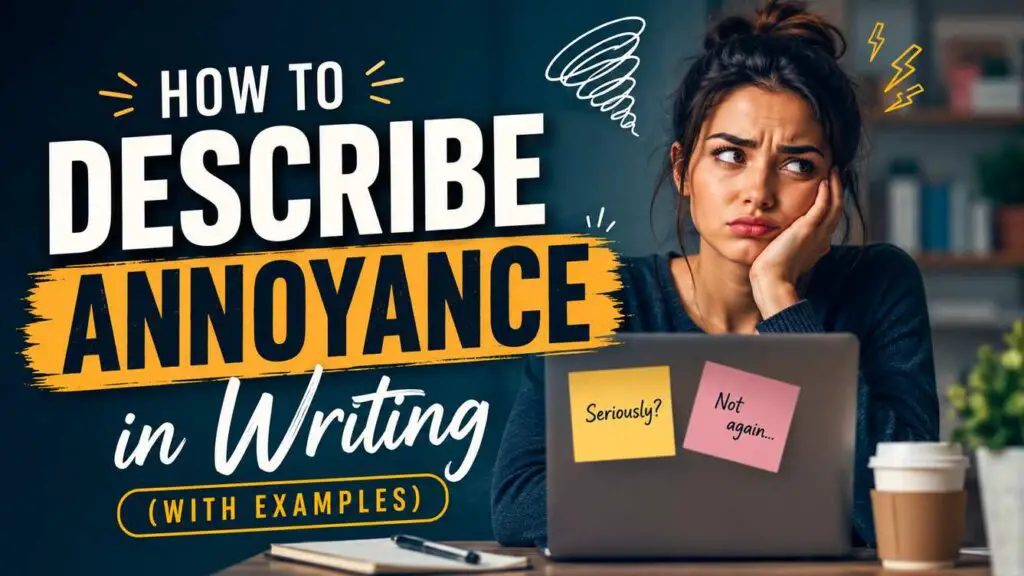
Annoyance is one of the most useful emotions to portray in fiction and creative nonfiction because it adds realism to everyday interactions. Unlike rage or intense anger, annoyance is often subtle. It can simmer beneath the surface, gradually building until it influences a character’s decisions, relationships, or actions. Even a brief moment of irritation can reveal important aspects of a character’s personality, emotional state, or priorities.
The key is to avoid simply writing, “She was annoyed.” Instead, show annoyance through body language, dialogue, thoughts, pacing, and small reactions. These details allow readers to experience the emotion for themselves rather than being told how a character feels. The following techniques will help make annoyance feel natural, believable, and engaging in your writing.
How to Describe Annoyance in Writing
Annoyance can appear in many forms. Some characters snap. Others go quiet. Some become sarcastic, restless, distracted, or overly polite. The best description depends on the character, the situation, and how intense the irritation feels. Different personalities express annoyance in different ways, so choosing reactions that fit the character is essential. Use the following techniques to make annoyance clear on the page.
#1. Show It Through Facial Expressions
Facial expressions are one of the easiest and most effective ways to communicate annoyance. Readers naturally notice changes in a character’s face, making these details powerful emotional cues. A character might narrow their eyes, press their lips together, raise an eyebrow, wrinkle their forehead, or force a tight smile that never reaches their eyes. Even a brief expression can reveal irritation before a single word is spoken.
Using facial expressions also helps keep emotional descriptions subtle. Instead of directly naming the emotion, you allow readers to recognize it through familiar visual signals. This creates a more immersive reading experience while making the character’s feelings feel authentic.
She pressed her lips into a thin line and stared at the blinking cursor, as if the computer had personally insulted her.
His eyebrow twitched, but he said nothing.
Mara smiled, but the smile looked sharp around the edges.
#2. Use Body Language
Annoyance often appears in a person’s body before it comes out in their words. Small physical movements can communicate irritation without drawing much attention to themselves. A character might cross their arms, tap their fingers, clench their jaw, shift their weight repeatedly, or sigh with visible frustration. These unconscious habits often reveal emotions that the character is trying to hide.
Body language is especially useful when writing scenes with restrained conflict. A character may remain polite on the surface, but their posture and movements quietly expose what they are truly feeling. Combining body language with dialogue often creates a stronger emotional impact than either technique alone.
He drummed his fingers against the table, each tap louder than the last.
She crossed her arms and leaned back, her foot bouncing under the desk.
Daniel rubbed the bridge of his nose and took a long, careful breath.
#3. Let Dialogue Reveal Irritation
Dialogue is one of the most natural ways to show annoyance because people often reveal irritation in how they speak rather than in what they say. Annoyed dialogue may become shorter, sharper, more repetitive, or filled with dry sarcasm. A character may interrupt someone, answer with one-word responses, or emphasize certain words to express impatience.
Not every annoyed person raises their voice. Sometimes the most convincing irritation comes through calm but cutting remarks or overly polite responses that carry obvious frustration beneath the surface. Paying attention to word choice and rhythm helps dialogue feel realistic.
“Yes, I heard you the first three times,” she said.
“Wonderful. Another meeting about the meeting.”
“Fine,” he said, in a tone that made it clear nothing was fine.
#4. Show Annoyance Through Thoughts
Internal thoughts give readers direct access to emotions that remain hidden from everyone else in the story. This technique works particularly well when a character wants to avoid confrontation or feels unable to express their frustration openly. Their thoughts may become impatient, sarcastic, exaggerated, or quietly resentful.
Showing annoyance through internal monologue also helps readers connect more deeply with the character. They understand not only what the character is doing but why those reactions are occurring. This creates stronger emotional engagement throughout the scene.
Of course he was late. Being on time would have been far too generous.
She wondered how many times a person could explain the same thing before turning into dust.
If he clicked that pen one more time, she was going to lose whatever patience she had left.
#5. Use Small Repetitive Actions
Annoyance often builds gradually rather than appearing all at once. Repetitive actions are an excellent way to show that growing tension. A character might repeatedly check the clock, tap a pencil, straighten objects, reread the same sentence, or glance toward the door every few seconds.
These habits communicate that something continues to bother the character even when they are trying to focus on something else. Because these actions are subtle and believable, they make the emotion feel more realistic while steadily increasing the scene’s tension.
She checked the time again. Only two minutes had passed.
He clicked the pen open. Closed. Open. Closed.
Every time the phone buzzed, her shoulders tightened a little more.
#6. Describe the Voice
The way a character speaks often changes when they become annoyed. Their voice may become flat, clipped, strained, cold, overly cheerful, or unusually quiet. Sometimes they speak faster because of impatience, while others slow down as they carefully control their emotions.
Describing vocal changes gives readers another clue about the character’s emotional state without directly naming it. Since tone often communicates more than words themselves, this technique can make conversations feel much more believable.
Her voice was calm, but every word landed hard.
“That’s helpful,” he said, his tone making it clear it was not helpful at all.
She spoke slowly, as if each word had to fight its way past her patience.
#7. Show Impatience With Movement
Physical movement can make annoyance feel active and dynamic. Instead of standing still, annoyed characters often pace, walk faster, slam drawers, shove chairs back, or handle objects with unnecessary force. Their movements become quicker, sharper, or less controlled than usual.
These actions not only reveal emotion but also increase the energy of a scene. Readers can almost visualize the character’s frustration as it spills into their physical behavior, making the annoyance feel immediate and convincing.
He pushed back his chair so quickly it scraped against the floor.
She snatched the papers from the printer and straightened them with unnecessary force.
Caleb paced from the window to the door, then back again, muttering under his breath.
#8. Use Sarcasm Carefully
Sarcasm is a common expression of annoyance, but it should always match the character’s personality and the situation. Some people naturally respond to frustration with humor or clever remarks, while others become blunt, dismissive, or passive-aggressive. Choosing the right type of sarcasm helps the dialogue remain believable.
Because sarcasm can quickly become repetitive, it works best when used selectively. A well-placed sarcastic comment can reveal both annoyance and personality while adding tension or even a touch of humor to the scene.
“Perfect. Because what this day needed was a surprise disaster.”
“No, please, take your time. It’s not like anyone else exists.”
“Brilliant idea,” she said. “Let’s make the simple thing impossible.”
#9. Show Annoyance Through Silence
Silence can communicate annoyance just as effectively as angry words. Some characters stop responding altogether, choosing to withhold conversation instead of arguing. They may pause before answering, avoid eye contact, or simply walk away without saying anything.
This type of restrained reaction often creates more tension than an outburst because it leaves both the other characters and the readers wondering what remains unsaid. Strategic silence can make a scene feel emotionally charged while fitting quieter personalities.
She stared at him for three full seconds before turning back to her book.
He opened his mouth, closed it, and decided the argument was not worth the oxygen.
No one spoke. The silence had edges.
#10. Let the Setting Reflect the Mood
The setting can reinforce a character’s annoyance by highlighting everything that contributes to their frustration. Loud noises, bright lights, crowded spaces, constant interruptions, or uncomfortable weather can all intensify an already irritated mood. Rather than existing as simple background details, these environmental elements become part of the emotional experience.
Using the setting this way helps readers feel the same mounting irritation as the character. It also makes scenes richer by allowing the surroundings to support the emotional tone instead of merely describing the location.
The fluorescent light buzzed overhead, the copier jammed again, and someone in the next room was laughing too loudly.
The clock ticked with smug little clicks, each one reminding her that he was still not there.
Rain tapped against the window in uneven bursts, just loud enough to make concentrating impossible.
Closing Thoughts
To describe annoyance in writing, focus on what the emotion does to the character. Show it in the face, body, voice, thoughts, dialogue, and movement. Let annoyance appear through small details before it becomes obvious.
The best descriptions do not simply name the feeling. They make the reader feel the irritation building. When you show annoyance through action and reaction, the emotion becomes sharper, more believable, and more engaging.