
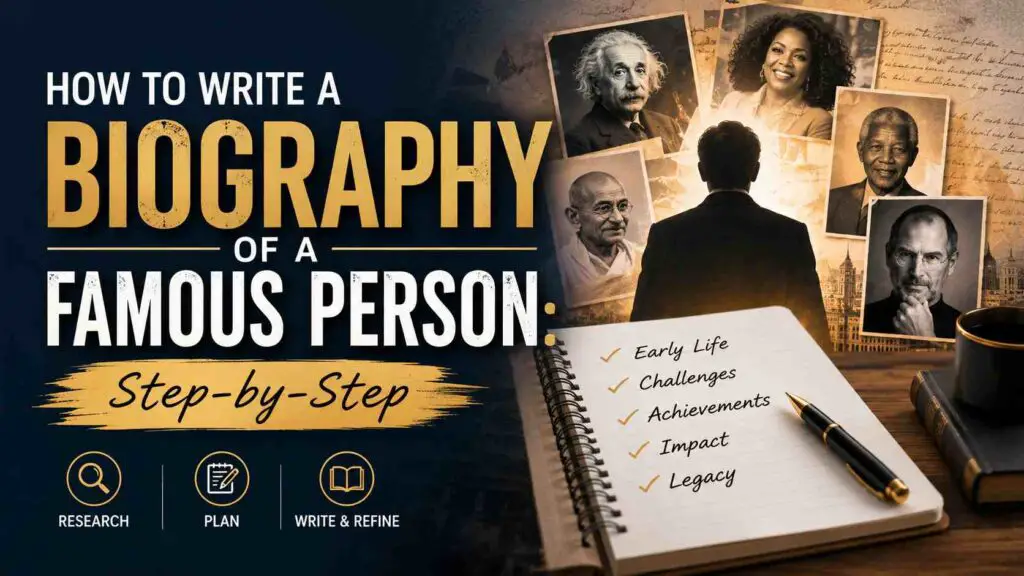
Biographies help readers understand the life, work, struggles, and legacy of another person. When the subject is famous, the task becomes even more important because readers may already know the basic facts. A strong biography does more than list dates and achievements. It explains what shaped the person, why their life matters, and how their influence continues.
Writing a biography of a famous person requires research, structure, fairness, and storytelling. The goal is to present the person as a real human being, not just as a public figure. That means showing their background, major accomplishments, personal challenges, turning points, and lasting impact.
What to Keep In Mind When Writing a Biography
Before writing a biography, it is important to understand what makes the life story meaningful. A good biography is not just a timeline. It is a carefully organized account that helps readers see the person clearly and understand their place in history, culture, business, science, politics, entertainment, or another field.
Here are the key things to keep in mind before beginning.
#1. Focus on Accuracy
Accuracy is the foundation of any biography. Since famous people often have many stories written about them, it is easy to repeat mistakes, rumors, or exaggerated claims. Always check facts from reliable sources.
Look carefully at birth dates, family details, education, career milestones, awards, controversies, and major life events. If two sources disagree, compare them and use the most trustworthy information. A biography loses credibility when basic facts are wrong.
#2. Show the Person Behind the Fame
A famous person is often known for achievements, public appearances, or major events. But a biography should go deeper. Readers want to understand the person behind the public image.
This means exploring their childhood, values, motivations, struggles, failures, relationships, and personal growth. These details help readers see the subject as a full human being. The best biographies explain not only what someone did, but also what shaped them.
#3. Avoid Turning the Biography Into Praise
A biography should be balanced. It should not read like an advertisement or a fan letter. Even if the person achieved great things, the writing should stay honest and fair.
Include successes, but also discuss difficulties, mistakes, criticism, and controversy when relevant. This does not mean attacking the person. It means presenting a complete picture. Balanced writing makes the biography more believable and useful.
#4. Understand the Historical Context
No person lives in isolation. A famous person’s life is often shaped by the time and place in which they lived. Their choices, opportunities, and challenges may be connected to politics, culture, technology, religion, war, social change, or economic conditions.
For example, a biography of a civil rights leader should explain the social climate of the time. A biography of a scientist should explain the state of knowledge in their field. Context helps readers understand why the person’s actions mattered.
#5. Choose a Clear Main Angle
A biography can cover many details, but it still needs a clear focus. Without focus, the article may feel scattered. Decide what the main angle will be.
The angle might be the person’s rise to success, their influence on society, their creative genius, their leadership, their personal transformation, or their lasting legacy. This central idea will guide what details to include and what to leave out.
How to Write a Biography of a Famous Person Step-by-Step
Writing a biography becomes much easier when the process is broken into clear steps. Instead of trying to write everything at once, move from research to planning, then from drafting to editing.
Follow this step-by-step process to write a strong biography of a famous person.
Step #1: Choose the Famous Person Carefully
Start by choosing the person you want to write about. This may seem simple, but the choice matters. Pick someone whose life has enough information, significance, and interest for your readers.
Ask yourself why this person deserves a biography. Did they change history? Did they influence culture? Did they create something important? Did they overcome major obstacles? Did they become a symbol of a larger movement?
A strong subject gives the biography direction. The more meaningful the person’s life story is, the easier it becomes to write an engaging article.
Step #2: Decide the Purpose of the Biography
Before researching deeply, decide what the biography should accomplish. Are you writing to inform students? Inspire readers? Explain the person’s achievements? Analyze their influence? Present a short overview?
The purpose affects the tone and depth of the article. A school biography may need clear facts and simple explanations. A professional biography may focus on career achievements. A historical biography may require more context and analysis.
Once the purpose is clear, every section becomes easier to plan.
Step #3: Gather Reliable Sources
Research is the most important part of biography writing. Use reliable sources such as books, interviews, documentaries, official websites, academic articles, reputable newspapers, speeches, letters, and archived materials.
Avoid depending only on random websites or social media posts. Famous people often attract myths, rumors, and simplified stories. Reliable research helps separate fact from fiction.
As you research, take notes on important dates, places, events, achievements, failures, relationships, quotes, and turning points. Keep track of where each fact came from so you can verify it later.
Step #4: Create a Timeline of Their Life
After gathering information, organize the person’s life into a timeline. Start with birth and early life, then move through education, career beginnings, major achievements, challenges, later years, and legacy.
A timeline helps you see the structure of the person’s life. It also prevents confusion when events overlap or happen close together.
However, the final biography does not always need to follow the timeline strictly. Sometimes it is better to begin with a dramatic event or major achievement, then go back to earlier life. Still, the timeline gives you control over the material.
Step #5: Identify the Major Turning Points
Every strong biography has turning points. These are the moments that changed the person’s direction or shaped their legacy.
A turning point could be a childhood experience, a major opportunity, a failure, a public controversy, a career breakthrough, a personal loss, a political event, or a bold decision.
Once you identify these turning points, you can build the biography around them. They make the story more interesting and help readers understand how the person changed over time.
Step #6: Write About Their Early Life
The early life section should explain where the person came from and what shaped them. Include details about their birth, family background, childhood environment, education, early interests, and important influences.
Do not include every small detail. Focus on the facts that help explain who they became later. For example, if a famous writer loved books as a child, that detail matters. If a future athlete showed early discipline, that matters too.
The goal is to show the roots of the person’s later achievements.
Step #7: Explain Their Rise to Fame
After early life, describe how the person became known. This section should show the path from ordinary beginnings to public recognition.
Explain the key choices, opportunities, talents, risks, and events that helped them rise. Mention early struggles as well. Most famous people faced rejection, failure, competition, or doubt before becoming successful.
This part of the biography should feel like a journey. Readers should understand how the person moved from obscurity to influence.
Step #8: Discuss Major Achievements
Next, focus on the person’s most important achievements. These may include inventions, books, films, speeches, discoveries, reforms, performances, records, awards, businesses, leadership roles, or social contributions.
Explain why these achievements mattered. Do not simply list them. Show their impact.
For example, instead of only saying someone won an award, explain what the award recognized. Instead of only saying someone founded a company, explain how that company changed an industry.
This makes the biography more meaningful and less like a resume.
Step #9: Include Challenges and Controversies
A complete biography should include major challenges, failures, criticism, or controversies when they are relevant. These moments often reveal character and complexity.
Be careful with tone. Do not sensationalize. Present the facts fairly and explain different sides when necessary. If the person made mistakes, describe them honestly. If they faced unfair criticism, explain that too.
This section helps readers understand that famous people are not perfect. Their struggles can make the biography more realistic and powerful.
Step #10: Explain Their Legacy
The legacy section explains why the person still matters. Discuss how their work, ideas, actions, or example influenced others.
Their legacy may be seen in laws, art, science, culture, business, education, religion, politics, entertainment, or public memory. Some legacies are widely admired. Others are debated. Either way, explain the lasting effect.
A strong legacy section gives the biography a sense of conclusion. It answers the reader’s biggest question: why is this person important?
Step #11: Write in a Clear and Engaging Style
Once the structure is ready, begin drafting the biography. Use clear language, short paragraphs, and logical transitions. Avoid making the article sound like a dry list of facts.
Tell the life story with movement. Show how one stage led to another. Use specific details to make the person’s life vivid. Include important dates, but do not overload the reader with too many of them.
The writing should be informative, but also readable. A biography should teach and hold attention at the same time.
Step #12: Edit for Balance, Flow, and Clarity
After writing the first draft, revise it carefully. Check whether the biography flows naturally from one section to the next. Remove repeated information. Make unclear sentences simpler.
Then review the balance. Have you included both achievements and challenges? Have you explained the person’s impact? Have you avoided exaggeration? Have you checked the facts?
Editing turns a rough biography into a polished article. This step is essential because biography writing depends on trust, clarity, and structure.
Closing Thoughts
Writing a biography of a famous person is about more than collecting facts. It is about understanding a life and explaining why that life matters. A strong biography shows the person’s background, rise, achievements, struggles, and legacy in a clear and balanced way.
The best biographies help readers see both the public figure and the human being. They explain what the person did, what shaped them, what challenges they faced, and how they influenced the world around them.
By researching carefully, organizing the story clearly, and writing with fairness, anyone can create a biography that is informative, engaging, and meaningful.