
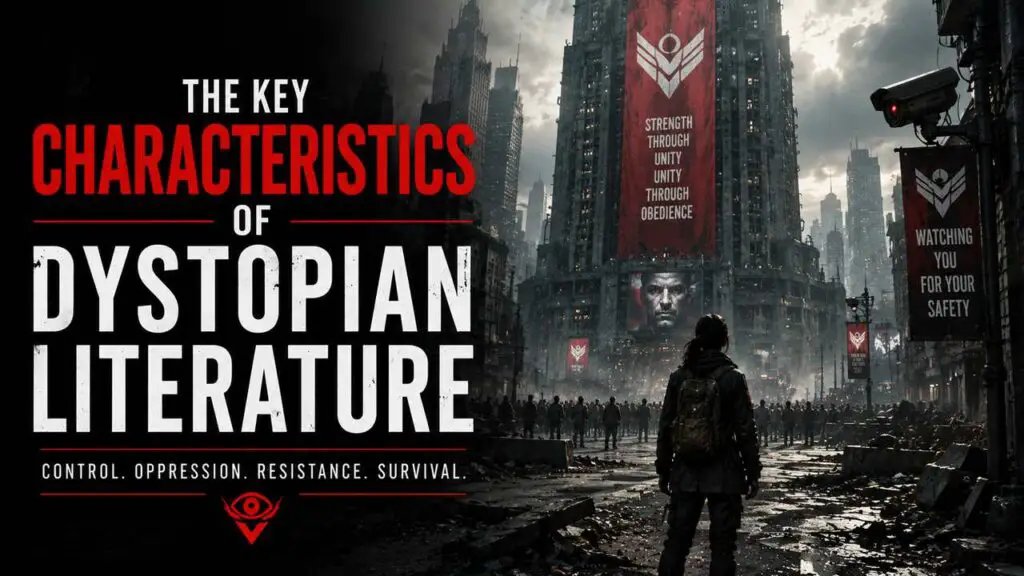
Dystopian literature has a powerful way of showing us what can happen when society goes wrong. These stories often take place in dark, controlled, or broken worlds where ordinary people struggle against systems that are unfair, oppressive, or dangerous.
At its core, dystopian fiction is not just about the future. It is about fear, power, freedom, and human survival. It takes problems that already exist in the real world and pushes them to an extreme. Through this, dystopian literature forces readers to ask difficult questions about government, technology, inequality, violence, and personal responsibility.
A Brief Introduction to Dystopian Literature
Dystopian literature presents a society that appears deeply flawed, frightening, or dehumanizing. These worlds are often controlled by powerful governments, corporations, machines, or social systems. Life may seem organized on the surface, but underneath, people suffer from fear, surveillance, poverty, manipulation, or loss of freedom.
A dystopia is often the opposite of a utopia. While a utopia imagines a perfect society, a dystopia reveals a society that has become a nightmare. Sometimes, the society may even claim to be perfect. Leaders may say they are creating peace, safety, equality, or progress. But the story slowly reveals the cost of that so-called perfection.
Dystopian literature is important because it warns readers. It shows how good intentions can become dangerous when power is unchecked. It also shows how ordinary people can resist injustice, even when the odds are against them.
The Key Characteristics of Dystopian Literature
Dystopian literature usually contains certain common features that help create its dark and unsettling world. These characteristics make the genre powerful because they connect fictional societies to real human fears. The following are the most important characteristics of dystopian literature.
#1. Oppressive Government or Authority
One of the most common features of dystopian literature is an oppressive authority. This authority may be a government, corporation, religious order, military force, or ruling elite. It controls people’s lives and limits their freedom.
In many dystopian stories, the ruling power decides what people can say, read, believe, or do. Citizens may be punished for asking questions or thinking differently. The government may claim that these controls are necessary for peace, security, or social order.
This kind of authority creates fear. People obey not because they trust the system, but because they are afraid of punishment. Dystopian literature uses this feature to show the danger of unchecked power.
#2. Loss of Individual Freedom
Dystopian societies often take away personal freedom. People may not be allowed to choose their jobs, partners, beliefs, education, or way of life. Their identity becomes less important than their role in the system.
This loss of freedom is one of the reasons dystopian fiction feels so disturbing. Readers see characters who cannot live freely or make basic decisions for themselves. Their lives are shaped by rules they did not create.
The struggle for freedom often becomes the heart of the story. A character may begin by accepting the system, but later realizes that life without freedom is not truly human.
#3. Constant Surveillance
Surveillance is another major characteristic of dystopian literature. People are watched by the government, technology, neighbors, police, or hidden systems of control.
This constant watching creates a society where people are afraid to speak honestly. Even private thoughts can feel dangerous. Characters may censor themselves because they do not know who is listening.
Surveillance also destroys trust. Friends, family members, and coworkers may report one another. This makes resistance harder because people feel isolated and exposed.
#4. Propaganda and Manipulation
Dystopian societies often depend on propaganda. The ruling power controls information and uses it to shape public opinion. Citizens are told what to believe, what to fear, and who to hate.
Propaganda may appear through posters, speeches, news reports, slogans, education, entertainment, or digital media. It often presents the system as good and its enemies as dangerous.
This manipulation keeps people obedient. If citizens believe the system is protecting them, they may not question its cruelty. Dystopian literature shows how dangerous it is when truth is controlled by those in power.
#5. Restricted Knowledge and Censorship
In many dystopian stories, books, history, art, and education are controlled or destroyed. The ruling authority may censor ideas that challenge its power.
This restriction of knowledge keeps people ignorant. If citizens do not know the truth about the past, they cannot understand the present. If they cannot access different ideas, they cannot imagine a better future.
Censorship is powerful because it limits thought. Dystopian literature often shows that controlling knowledge is one of the easiest ways to control society.
#6. Dehumanization
Dystopian literature often shows people being treated as objects, numbers, workers, or tools. Their emotions, relationships, and individuality are ignored.
Dehumanization may happen through harsh labor systems, scientific experiments, social ranking, violence, or strict conformity. People are valued only for what they produce or how well they obey.
This characteristic makes dystopian fiction deeply emotional. It reminds readers that a society becomes dangerous when it forgets the value of human life.
#7. Social Inequality
Many dystopian societies are built on extreme inequality. A small group may enjoy comfort, power, and privilege, while the majority suffer.
This inequality is often hidden or justified. The ruling class may claim that the system is fair, even when it clearly benefits only a few. Poor or powerless people may be blamed for their own suffering.
Dystopian literature uses inequality to reveal how unfair systems protect themselves. It shows how power often depends on keeping certain groups weak, silent, or divided.
#8. Fear as a Tool of Control
Fear is central to dystopian literature. People may fear punishment, poverty, exile, violence, public shame, or death. This fear keeps them obedient.
In these societies, fear is not accidental. It is often created deliberately. The system uses threats and examples of punishment to remind people what happens when they resist.
Fear can be more powerful than physical force. When people are afraid enough, they may control themselves without needing to be constantly forced.
#9. A Rebellious Protagonist
Most dystopian stories include a main character who begins to question the system. This protagonist may notice contradictions, experience injustice, or discover hidden truths.
The rebellion may start quietly. The character may read a forbidden book, form a forbidden relationship, ask dangerous questions, or refuse to obey a rule. Over time, this small act can become a larger resistance.
The rebellious protagonist gives the story hope. Even in a dark world, one person’s courage can expose the truth and challenge oppression.
#10. A Warning About the Future
Dystopian literature often serves as a warning. It shows what might happen if current problems are ignored or allowed to grow worse.
These stories may warn against authoritarianism, environmental destruction, technology abuse, social division, extreme consumerism, or loss of privacy. The future setting helps readers see present dangers more clearly.
This warning is one of the reasons dystopian literature remains so relevant. It does not only entertain. It asks readers to think carefully about the direction of society.
Closing Thoughts
Dystopian literature is powerful because it turns fear into reflection. It creates disturbing worlds, but those worlds are rarely meaningless. They are built to make readers think about freedom, justice, truth, power, and human dignity.
The key characteristics of dystopian literature include oppressive authority, loss of freedom, surveillance, propaganda, censorship, dehumanization, inequality, fear, rebellion, and warning. Together, these features create stories that are dark but meaningful.
At its best, dystopian literature reminds us that society must be protected from cruelty, corruption, and control. It shows that freedom should never be taken for granted and that even small acts of resistance can matter.