
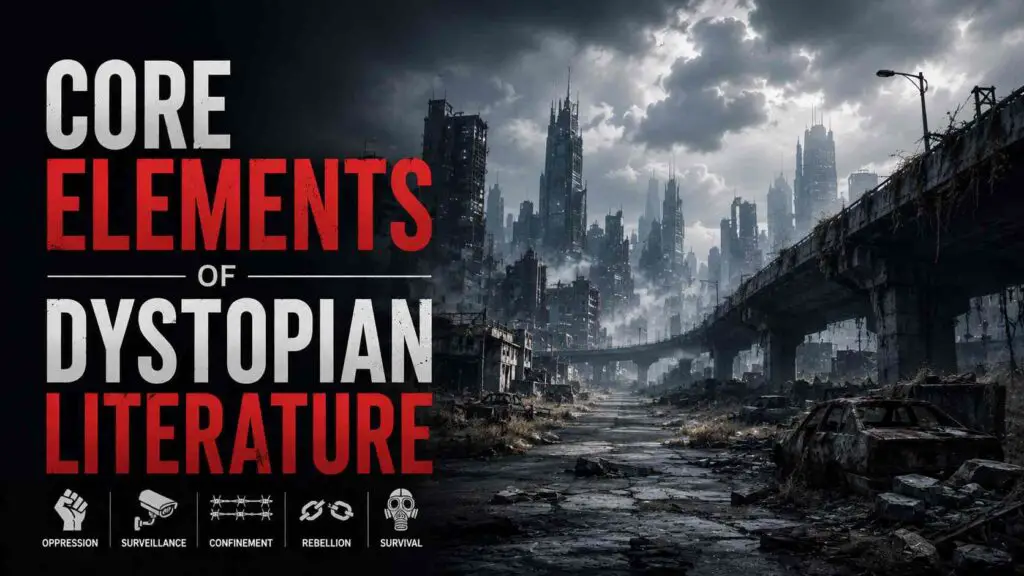
Dystopian literature has always held a powerful place in storytelling because it shows what can happen when society goes wrong. These stories often imagine dark futures, broken governments, controlled populations, and worlds where freedom has been replaced by fear. Yet dystopian fiction is not only about bleak settings. It is also about warning, reflection, and resistance.
At its best, dystopian literature forces readers to ask difficult questions. What happens when power is left unchecked? How much freedom should people give up for safety? Can individuals still think, choose, and hope in a society built to control them? These questions make dystopian stories both disturbing and deeply meaningful.
What is Dystopian Literature?
Dystopian literature is a type of fiction that presents an imagined society where life has become deeply flawed, oppressive, or dehumanizing. These societies often appear organized or even perfect on the surface, but beneath that surface, they are marked by control, fear, injustice, inequality, censorship, violence, or loss of freedom.
A dystopian world is usually the opposite of a utopia. While a utopia imagines an ideal society, a dystopia reveals a society where ideal promises have failed or become corrupted. For example, a government may claim to protect citizens, but it may actually control every part of their lives. A society may promise equality, but it may achieve it by removing individuality. A system may promise peace, but only by silencing disagreement.
Dystopian literature often reflects real-world concerns. These may include authoritarian rule, surveillance, propaganda, environmental destruction, technological control, social inequality, war, or the loss of human values. Writers use imagined worlds to exaggerate these dangers so readers can see them more clearly.
Because of this, dystopian literature is not just about the future. It is also about the present. It warns readers about the direction society could take if people ignore injustice, surrender freedom, or allow powerful institutions to become too strong.
Core Elements of Dystopian Literature
Dystopian literature usually contains a set of recognizable elements that help create its dark and unsettling world. These elements work together to show how society has failed and how individuals struggle inside that failure. The following are the most important core elements of dystopian literature.
#1. Oppressive Government or Authority
One of the most common elements of dystopian literature is an oppressive government or ruling authority. This authority may be a dictator, a political party, a corporation, a religious order, a military system, or even an advanced technological network. Whatever form it takes, it controls society by limiting freedom and demanding obedience.
In many dystopian stories, the ruling power claims to act for the good of the people. It may say that strict control is necessary for peace, security, equality, or survival. However, this control usually comes at a terrible cost. Citizens lose the right to speak freely, think independently, choose their own futures, or question those in power.
The oppressive authority often uses fear to maintain control. People may be punished for disobedience, watched constantly, separated from their families, or forced to follow strict social rules. This creates a world where citizens obey not because they believe in the system, but because they are afraid of what will happen if they resist.
This element is important because it shows the danger of unchecked power. Dystopian literature warns that when governments or institutions become too powerful, they can turn human beings into tools of the system.
#2. Loss of Individual Freedom
Another major element of dystopian literature is the loss of individual freedom. In dystopian societies, people often cannot make basic choices about their lives. They may not be allowed to choose their jobs, relationships, beliefs, education, clothing, language, or even emotions.
This loss of freedom is often presented as necessary for social order. The society may argue that personal choice causes conflict, inequality, or danger. As a result, the system removes freedom in the name of stability. But instead of creating a better world, it creates a society where people are trapped.
Characters in dystopian literature often begin the story accepting these restrictions. They may believe the system is normal because they have never known anything else. Over time, however, the main character usually begins to feel that something is wrong. This awakening becomes an important part of the story.
The loss of freedom matters because it raises a central question: what makes a human life meaningful? Dystopian literature often suggests that freedom, choice, and individuality are essential parts of being human.
#3. Surveillance and Control
Surveillance is another core element of dystopian literature. In many dystopian worlds, citizens are constantly watched by the government or ruling system. Cameras, informants, digital tracking, secret police, artificial intelligence, or social monitoring may be used to observe people’s actions and even their thoughts.
Surveillance creates fear. When people know they are being watched, they begin to control themselves. They avoid speaking honestly. They hide their opinions. They stop trusting their neighbors, friends, and family members. This makes resistance difficult because no one knows who might report them.
Control does not always appear as open violence. Sometimes it works quietly. The system may control what people see, what they read, what they learn, and what they believe. It may use technology, education, entertainment, or social pressure to shape behavior.
This element is powerful because it shows how control can become invisible. A society does not always need chains or prisons to control people. Sometimes fear, constant observation, and social conditioning are enough.
#4. Propaganda and Censorship
Dystopian societies often depend on propaganda and censorship. Propaganda is information designed to manipulate people into supporting the system. Censorship is the suppression of ideas, books, speech, history, or truth that might threaten those in power.
In dystopian literature, the ruling authority often controls the official version of reality. It tells citizens what to believe, who to fear, and what to love. It may rewrite history, ban books, destroy records, or create slogans that replace independent thought.
Propaganda helps the system appear good, even when it is cruel. Citizens may be taught that enemies are everywhere, that the government is always right, or that suffering is necessary for the greater good. Over time, many people may accept these ideas without question.
Censorship is especially dangerous because it limits the imagination. When people cannot access truth, they cannot easily imagine a different kind of society. This is why many dystopian stories show characters discovering forbidden books, hidden memories, or secret knowledge. Truth becomes a form of rebellion.
#5. Dehumanization
Dehumanization is a key feature of dystopian literature. In these stories, people are often treated as numbers, workers, machines, bodies, or categories instead of full human beings. Their feelings, relationships, creativity, and individuality are ignored or suppressed.
A dystopian society may divide people into classes, castes, genetic groups, occupations, or levels of usefulness. Some people may be considered valuable, while others are treated as disposable. This creates a cold and unjust world where human dignity is no longer respected.
Dehumanization can also happen when technology or bureaucracy replaces compassion. People may be processed by systems rather than understood as individuals. They may be punished by rules that leave no room for mercy. They may be forced to serve the needs of the state, economy, or ideology.
This element is important because dystopian literature often asks what happens when society forgets the value of human life. It reminds readers that a society can become efficient, orderly, and powerful while also becoming deeply inhuman.
#6. Social Inequality and Division
Many dystopian stories include extreme social inequality. Some groups may live in comfort and privilege, while others suffer from poverty, hunger, danger, or forced labor. The society may be divided by class, wealth, race, intelligence, genetics, geography, or loyalty to the system.
These divisions are often maintained deliberately. The ruling power may keep people separated so they do not unite against injustice. It may encourage competition, suspicion, or hatred between groups. By dividing the population, the system protects itself.
Social inequality in dystopian literature often exposes the hypocrisy of the society. A government may claim that everyone is equal, but some citizens clearly have more rights than others. A society may claim to be peaceful, but that peace may depend on the suffering of hidden or powerless groups.
This element makes dystopian fiction socially and politically meaningful. It shows how injustice can become normal when people are trained to accept division as natural or necessary.
#7. A Controlled or Artificial Environment
Dystopian literature often takes place in a controlled environment. This may be a walled city, a sealed community, a ruined planet, an underground settlement, a highly regulated school, or a society where nature has been destroyed. The setting itself becomes part of the system of control.
In some stories, the environment is physically damaged because of war, climate collapse, pollution, or technological disaster. In others, the environment is artificial and carefully managed. Citizens may not be allowed to leave, explore, or experience the world beyond the boundaries set by the ruling power.
This controlled environment creates a sense of confinement. Characters often feel trapped, even if they do not fully understand why. The world around them reflects the limits placed on their minds and lives.
The setting is important because dystopian literature uses place to create mood and meaning. Dark cities, sterile buildings, restricted zones, and ruined landscapes all help show that something has gone terribly wrong.
#8. The Illusion of a Perfect Society
Many dystopian societies present themselves as perfect. They may claim to have eliminated war, crime, poverty, conflict, disease, or unhappiness. At first glance, the world may seem peaceful and orderly. But as the story unfolds, readers discover that this perfection is false.
The society’s apparent success usually depends on hidden suffering. People may be controlled, drugged, lied to, separated, sacrificed, or denied freedom. The system may remove pain by also removing love, choice, memory, or truth.
This illusion of perfection is one of the most interesting parts of dystopian literature. It shows that a society can look successful on the outside while being morally corrupt underneath. It also challenges readers to think about what a good society really means.
A perfect society that destroys freedom is not truly perfect. A peaceful society built on fear is not truly peaceful. Dystopian literature exposes this contradiction.
#9. Rebellion and Resistance
Rebellion is a central element in many dystopian stories. The main character often begins as an ordinary person living under the system. Over time, they become aware of injustice and start to question the world around them. This questioning may lead to resistance.
Resistance can take many forms. It may be open rebellion, secret communication, forbidden love, preserving memory, telling the truth, reading banned books, refusing orders, or simply thinking independently. In dystopian literature, even small acts of freedom can become powerful.
The rebel character is important because they give the story hope. Dystopian worlds are often dark, but resistance shows that control is never complete. As long as people can question, remember, love, and imagine something better, the system can be challenged.
However, dystopian literature does not always promise victory. Sometimes rebellion fails. Sometimes the system remains powerful. But even then, resistance matters because it affirms human dignity in a world designed to crush it.
#10. A Warning About the Future
Perhaps the most important element of dystopian literature is its function as a warning. Dystopian stories are not usually predictions in a literal sense. Instead, they warn readers about dangerous tendencies in society.
A dystopian story may warn against authoritarianism, blind obedience, environmental destruction, technological dependence, consumerism, censorship, inequality, or the loss of empathy. It takes real fears and pushes them to extremes so readers can see their consequences more clearly.
This warning gives dystopian literature its lasting power. These stories are disturbing because they feel possible. They show futures that are fictional but rooted in real human choices.
By imagining what could go wrong, dystopian literature encourages readers to protect what is valuable in the present. It asks people to think critically, defend freedom, question power, and care about justice before it is too late.
Closing Thoughts
Dystopian literature remains powerful because it speaks to some of the deepest fears and questions in human society. It shows worlds where power has become abusive, freedom has disappeared, truth has been controlled, and human beings have been reduced to parts of a system.
Yet dystopian fiction is not only dark. It also reminds readers why freedom, truth, dignity, and courage matter. Through stories of control and resistance, it reveals the fragile nature of human rights and the danger of taking them for granted.
The core elements of dystopian literature help readers understand how these stories work. Oppressive governments, surveillance, censorship, dehumanization, inequality, controlled environments, false perfection, and rebellion all combine to create worlds that are frightening but meaningful.
In the end, dystopian literature warns us not to become passive. It asks us to pay attention to the systems around us, question what is presented as normal, and protect the human values that make life worth living.