
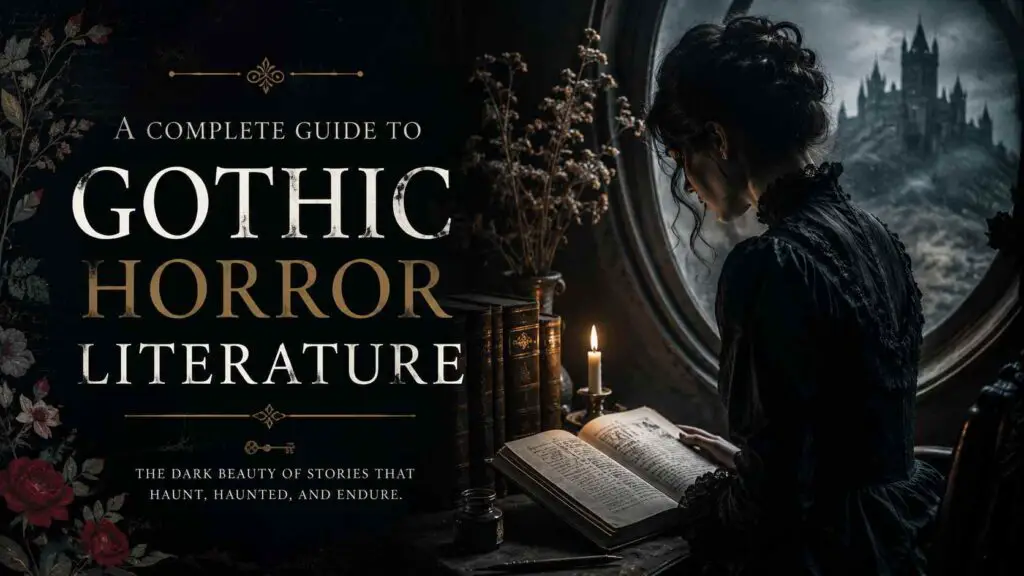
Gothic horror literature is one of the most atmospheric and enduring forms of fiction. It blends fear, mystery, romance, psychological tension, and the supernatural to create stories that feel dark, haunting, and emotionally intense. From ruined castles and cursed families to ghosts, madness, and hidden secrets, gothic horror explores what frightens people on both the outside and the inside. It is not only about monsters or haunted houses. It is also about guilt, desire, isolation, death, and the past refusing to stay buried.
What Is Gothic Horror Literature?
Definition of Gothic Horror Literature
Gothic horror literature is a genre of fiction that combines horror, suspense, mystery, and dark romantic elements. It often features gloomy settings, supernatural events, emotional extremes, and characters who face forces they do not fully understand.
The word “Gothic” originally referred to a style of medieval architecture, especially buildings with pointed arches, towers, vaults, and dramatic stonework. In literature, the term came to describe stories set in old castles, abbeys, mansions, ruins, and other places filled with darkness and mystery.
Gothic horror literature is different from ordinary horror because it usually depends more on atmosphere than shock. It creates a slow feeling of dread. The fear often comes from uncertainty, secrets, madness, guilt, and the feeling that something terrible is hidden beneath the surface.
A gothic horror story may include ghosts, vampires, monsters, curses, or strange events. But even when nothing supernatural is clearly shown, the mood remains disturbing. The reader is made to feel that the world of the story is unstable, dangerous, and haunted.
The Purpose of Gothic Horror
The purpose of gothic horror is not only to frighten the reader. It also explores deep emotional and moral fears. Gothic horror asks what happens when people are trapped by the past, consumed by forbidden desires, or forced to confront things they cannot explain.
The genre often creates psychological fear. Characters may doubt their senses. They may wonder whether they are seeing something real or losing their minds. This uncertainty is one of the most powerful features of gothic horror literature.
Gothic horror also explores the unknown. It pushes characters into dark rooms, locked chambers, ancient ruins, and hidden memories. These places often represent the parts of life people fear to face.
At its best, gothic horror reflects social and cultural anxieties. It can reveal fears about science, religion, class, gender, family, death, sexuality, and power. Beneath the haunted house or supernatural curse, there is often a serious question about human nature.
The Origins of Gothic Horror Literature
The Birth of the Gothic Novel
Gothic horror literature began in the eighteenth century, during a time when readers were becoming fascinated with emotion, imagination, terror, and the mysterious past. The Enlightenment had emphasized reason, science, and order. Gothic fiction pushed back against that confidence by showing a world filled with irrational forces, hidden crimes, and terrifying uncertainty.
The early gothic novel became popular in Europe, especially in England. These stories often took place in foreign or medieval settings. They included castles, secret passages, tyrannical villains, innocent heroines, family mysteries, and supernatural signs.
The genre also grew alongside Romanticism. Romantic writers valued strong emotion, wild landscapes, individual experience, and the sublime. The sublime refers to the feeling of awe and terror people experience when facing something vast, powerful, or overwhelming. Gothic horror used this feeling to great effect.
The First Gothic Novel
The first major gothic novel is usually considered to be The Castle of Otranto by Horace Walpole, published in 1764. This novel introduced many elements that later became central to gothic horror literature.
It includes a castle, a family curse, strange supernatural events, hidden identities, and a villain driven by fear and ambition. The story may seem dramatic or exaggerated to modern readers, but it helped establish the basic pattern of gothic fiction.
The Castle of Otranto showed that readers enjoyed stories filled with mystery, terror, ancient buildings, and impossible events. It opened the way for later gothic writers such as Ann Radcliffe, Matthew Lewis, Mary Shelley, Edgar Allan Poe, and Bram Stoker.
Historical Influences on Gothic Literature
Gothic horror literature was shaped by several historical and cultural influences. One major influence was medieval architecture. Castles, cathedrals, monasteries, and ruins became ideal settings because they suggested age, secrecy, religion, power, and decay.
Folklore also played an important role. Ghost stories, legends, curses, monsters, and local superstitions gave gothic fiction a rich source of terrifying material.
Religion influenced the genre as well. Many gothic works explore sin, guilt, punishment, temptation, corruption, and spiritual fear. Monasteries, priests, nuns, forbidden rituals, and religious symbols often appear in classic gothic stories.
Social change also shaped the genre. As Europe moved through political revolutions, scientific discoveries, and changes in family and class structures, gothic horror gave writers a way to express fear about a world that no longer felt stable.
Key Characteristics of Gothic Horror Literature
Dark and Atmospheric Settings
Setting is one of the most important features of gothic horror literature. The place where the story happens often feels like a character in itself.
Common gothic settings include castles, mansions, monasteries, abbeys, graveyards, forests, mountains, and isolated villages. These places are usually dark, old, mysterious, and filled with secrets.
A gothic setting often creates a sense of decay. The building may be crumbling. The family that owns it may be declining. The landscape may feel wild and threatening. This physical decay often reflects moral, emotional, or psychological decay.
The atmosphere is usually heavy and oppressive. Storms, fog, shadows, candlelight, locked doors, hidden rooms, and strange noises are common. These details help create suspense before anything frightening actually happens.
Supernatural Elements
Many gothic horror stories include supernatural elements. These may include ghosts, curses, vampires, demons, omens, prophecies, animated corpses, or mysterious forces.
Sometimes the supernatural is real within the story. In other cases, it may be explained away later as a misunderstanding, trick, or psychological disturbance. This uncertainty is part of the genre’s power.
The supernatural in gothic horror often represents something deeper. A ghost may represent guilt. A curse may represent family sin. A monster may represent forbidden desire or scientific arrogance.
The supernatural allows gothic horror literature to explore fears that realistic fiction cannot always express directly.
Psychological Terror
Gothic horror literature often focuses on psychological terror rather than physical violence. The reader is drawn into the mind of a character who is afraid, confused, guilty, obsessed, or unstable.
Characters may fear madness. They may hear voices, see visions, or become trapped in their own thoughts. They may not know whether the danger is outside them or inside them.
This psychological tension makes gothic horror especially powerful. The scariest part of the story is often not the ghost, monster, or locked room. It is the collapse of certainty.
The reader begins to ask the same questions as the character. Is this real? Is this imagined? Who can be trusted? What secret is being hidden?
Mystery and Suspense
Mystery is central to gothic horror literature. These stories often begin with unanswered questions. What happened in the past? Why is the house forbidden? What is hidden in the locked room? Why does a family seem cursed?
Gothic plots often reveal information slowly. Secrets are uncovered through letters, diaries, confessions, rumors, portraits, dreams, or old documents.
Suspense builds because the reader knows that something terrible is being concealed. The danger may not be clear at first, but the atmosphere suggests that the truth will be disturbing.
This slow revelation of secrets gives gothic horror its gripping quality.
Isolation and Vulnerability
Isolation is another major feature of gothic horror literature. Characters are often physically or emotionally cut off from help.
They may be trapped in a remote castle, a lonely mansion, a strange country, or a hostile family. They may be surrounded by people who cannot be trusted. They may have no one who believes them.
This isolation makes the character vulnerable. It also increases the feeling of helplessness. The more isolated the character becomes, the more powerful the fear becomes.
In many gothic works, isolation is not only physical. It is also emotional. Characters may feel alienated by guilt, grief, forbidden love, madness, or social rejection.
Common Themes in Gothic Horror Literature
The Conflict Between Good and Evil
Gothic horror literature often explores the struggle between good and evil. This conflict may appear as a battle between innocent victims and cruel villains. It may also happen inside a single character.
Many gothic villains are powerful, secretive, and morally corrupt. They may abuse authority, manipulate others, or hide terrible crimes. Their evil is often connected to pride, greed, lust, revenge, or obsession.
However, gothic horror rarely presents morality in a simple way. Good characters may have dark impulses. Evil characters may be tragic. The genre often shows that darkness exists within human nature.
Death and Decay
Death is everywhere in gothic horror literature. Graveyards, corpses, funerals, ghosts, family tombs, and decaying buildings appear again and again.
Decay is not only physical. Families decay. Traditions decay. Minds decay. Moral values decay. Gothic horror often presents the world as something beautiful but ruined.
This focus on death and decay gives the genre its melancholy tone. Gothic horror is frightening, but it is also often sad. It reminds readers that time destroys everything, and that the past is never completely gone.
Madness and Mental Instability
Madness is one of the most powerful themes in gothic horror literature. Characters may become obsessed, paranoid, delusional, or emotionally overwhelmed.
Sometimes madness is caused by guilt. Sometimes it comes from grief, isolation, fear, or forbidden knowledge. In other cases, the reader is left unsure whether a character is truly mad or whether supernatural forces are at work.
This theme allows gothic horror to explore the fragility of the human mind. It shows how fear can distort perception and how secrets can destroy inner peace.
The Supernatural Versus Reason
Many gothic horror stories create tension between the supernatural and reason. Characters may try to explain frightening events logically, but the evidence often points toward something beyond ordinary understanding.
This conflict reflects a larger human fear. People want the world to make sense. Gothic horror suggests that some things may not be explainable.
In some stories, reason wins and the supernatural is exposed as illusion. In others, reason fails completely. Either way, the conflict between logic and mystery gives the genre much of its suspense.
Forbidden Knowledge
Gothic horror literature often warns against the pursuit of forbidden knowledge. Characters may seek secrets that humans were not meant to know.
This theme appears strongly in works such as Frankenstein, where scientific ambition leads to horror and tragedy. It also appears in stories involving occult rituals, hidden family histories, forbidden books, or secret experiments.
The message is not always anti-knowledge. Rather, gothic horror asks whether knowledge without wisdom, humility, or morality can become destructive.
Fear of the Past
The past is rarely dead in gothic horror literature. Old crimes, family curses, hidden scandals, ancestral guilt, and forgotten promises return to disturb the present.
This fear of the past is one of the genre’s defining themes. Gothic horror shows that what has been buried can still shape the lives of the living.
A haunted house is often haunted because something terrible happened there. A family may be cursed because of an old sin. A character may suffer because of a secret they inherited rather than created.
The past becomes a force that demands recognition.
The Doppelgänger and Divided Self
The doppelgänger, or double, is a common gothic theme. It represents a divided self, hidden identity, or dark reflection of a character.
This theme appears in stories where a character has a double, an alter ego, or a secret personality. It suggests that people are not always whole, stable, or fully known to themselves.
The divided self is especially important in The Strange Case of Dr Jekyll and Mr Hyde. The story shows how civilization and respectability can hide violence, desire, and evil.
Gothic horror often asks a disturbing question: what if the monster is not outside us, but within us?
Major Gothic Horror Authors
Horace Walpole
Horace Walpole is one of the founders of gothic horror literature. His novel The Castle of Otranto introduced many conventions of the genre, including the haunted castle, family curse, supernatural signs, and dramatic mystery.
Walpole’s work may seem unusual today, but its influence is enormous. He helped create a new kind of fiction that combined medieval romance, terror, and mystery.
Ann Radcliffe
Ann Radcliffe was one of the most important early gothic writers. Her novels, especially The Mysteries of Udolpho, helped define the atmosphere of gothic fiction.
Radcliffe was known for suspense, mysterious settings, emotional heroines, and the “explained supernatural.” In many of her works, events that seem supernatural are later given rational explanations.
Her writing helped make gothic fiction popular and respectable.
Matthew Lewis
Matthew Lewis is best known for The Monk, one of the most shocking gothic novels of the eighteenth century. Unlike Radcliffe, Lewis embraced horror, violence, temptation, and supernatural terror more directly.
The Monk includes corruption, demons, forbidden desire, religious hypocrisy, and moral collapse. It pushed gothic fiction into darker and more sensational territory.
Mary Shelley
Mary Shelley transformed gothic horror literature with Frankenstein. Her novel combined gothic atmosphere with philosophical questions about science, creation, responsibility, and alienation.
Frankenstein is not only a monster story. It is also a tragedy about ambition, loneliness, rejection, and the consequences of playing God.
Shelley’s work helped shape both gothic horror and science fiction.
Edgar Allan Poe
Edgar Allan Poe brought gothic horror into the realm of intense psychological terror. His stories often explore madness, guilt, death, obsession, and the unstable mind.
Works such as “The Fall of the House of Usher,” “The Tell-Tale Heart,” and “The Black Cat” show Poe’s mastery of atmosphere and inner horror.
Poe’s gothic fiction is often claustrophobic. The real terror comes from inside the human mind.
Bram Stoker
Bram Stoker is best known for Dracula, one of the most famous gothic horror novels ever written. The novel combines vampires, sexuality, religion, science, invasion fears, and ancient evil.
Dracula helped define the modern vampire story. It also shows how gothic horror can combine old-world superstition with modern technology and social change.
Robert Louis Stevenson
Robert Louis Stevenson made a major contribution to gothic horror with The Strange Case of Dr Jekyll and Mr Hyde. The novel explores duality, repression, morality, and the hidden darkness within respectable society.
Stevenson’s story remains powerful because it presents evil not as an outside force, but as part of the self.
Charlotte Brontë
Charlotte Brontë’s Jane Eyre is often considered a gothic novel because of its dark mansion, mysterious secrets, emotional intensity, and imprisoned woman motif.
Although it is also a romance and coming-of-age novel, Jane Eyre uses many gothic elements to explore power, morality, gender, and independence.
Emily Brontë
Emily Brontë’s Wuthering Heights is one of the most intense gothic novels in English literature. It features wild landscapes, destructive passion, revenge, death, haunting, and emotional violence.
The novel’s atmosphere is bleak and powerful. Its characters are not simply good or evil. They are consumed by love, pride, bitterness, and obsession.
Shirley Jackson
Shirley Jackson brought gothic horror into the modern age. Her novel The Haunting of Hill House is a masterpiece of psychological and supernatural ambiguity.
Jackson’s work often explores domestic spaces, social pressure, isolation, and mental instability. She showed that gothic horror does not need a medieval castle. A modern house can be just as terrifying.
Classic Gothic Horror Literary Works
The Castle of Otranto
The Castle of Otranto is important because it established the gothic novel. It includes many familiar elements: a castle, a curse, hidden identity, supernatural events, and a threatening patriarch.
The novel may feel melodramatic, but it created the foundation for later gothic horror literature.
The Mysteries of Udolpho
The Mysteries of Udolpho by Ann Radcliffe is one of the most influential gothic novels. It features a vulnerable heroine, mysterious landscapes, a threatening castle, and suspenseful events.
The novel is especially important for its use of atmosphere and emotional tension. It helped make gothic fiction widely popular.
Frankenstein
Frankenstein by Mary Shelley is one of the greatest works of gothic horror literature. It tells the story of Victor Frankenstein, a scientist who creates life and then rejects his creation.
The novel explores ambition, responsibility, loneliness, revenge, and what it means to be human. Its gothic power comes from both its dark atmosphere and its moral depth.
Dracula
Dracula by Bram Stoker is one of the most famous vampire novels ever written. It combines gothic horror with folklore, sexuality, religion, and modern anxieties.
Count Dracula is both ancient and threatening. He represents foreign danger, supernatural evil, and forbidden desire. The novel remains one of the central works of gothic horror literature.
The Strange Case of Dr Jekyll and Mr Hyde
Robert Louis Stevenson’s The Strange Case of Dr Jekyll and Mr Hyde explores the divided self. Dr Jekyll creates a potion that allows him to separate his respectable identity from his darker impulses.
The story is gothic because it reveals the horror hidden beneath civilized society. It suggests that evil is not always external. Sometimes it is part of the human personality.
Wuthering Heights
Wuthering Heights by Emily Brontë is a gothic tale of love, revenge, obsession, and haunting. Its wild moorland setting creates a dark and stormy atmosphere.
The novel’s emotional intensity makes it unforgettable. It is not horror in the simple sense, but it is deeply gothic in mood, theme, and structure.
Jane Eyre
Jane Eyre by Charlotte Brontë uses gothic elements within a broader story of moral growth and independence. Thornfield Hall, with its secrets, strange laughter, and hidden suffering, is one of the great gothic settings.
The novel explores fear, desire, power, conscience, and freedom. Its gothic mystery deepens the emotional force of the story.
The Haunting of Hill House
The Haunting of Hill House by Shirley Jackson is a classic modern gothic novel. It tells the story of people who come to investigate a haunted house, but the real terror lies in uncertainty.
Is Hill House truly haunted? Is the main character losing her mind? Jackson never gives easy answers. This ambiguity makes the novel deeply unsettling.
Rebecca
Rebecca by Daphne du Maurier is a gothic novel of memory, jealousy, marriage, and psychological suspense. Manderley, the grand estate at the center of the story, feels haunted by the presence of the dead Rebecca.
The novel shows how gothic horror can work without obvious monsters. The haunting here is emotional, social, and psychological.
Types of Gothic Horror Literature
Classic Gothic Literature
Classic gothic literature refers to the early works of the genre from the eighteenth and early nineteenth centuries. These stories often include castles, aristocratic villains, family curses, innocent heroines, and mysterious events.
Classic gothic literature established the main conventions that later writers adapted and transformed.
Victorian Gothic Literature
Victorian gothic literature developed during the nineteenth century. It often reflects anxieties about science, empire, sexuality, religion, urban life, and social respectability.
Works such as Dracula, The Strange Case of Dr Jekyll and Mr Hyde, and many ghost stories belong to this tradition.
Victorian gothic horror often shows that darkness exists beneath the surface of polite society.
Southern Gothic Literature
Southern Gothic is a form of gothic literature associated with the American South. It often features decaying homes, family secrets, social violence, grotesque characters, and moral corruption.
Southern Gothic is less focused on castles and more focused on communities, history, race, class, religion, and family decline.
Its horror often comes from human cruelty and social decay rather than supernatural events.
Modern Gothic Literature
Modern gothic literature adapts traditional gothic elements to contemporary settings. Instead of castles, it may use suburban homes, apartment buildings, schools, hotels, or isolated communities.
Modern gothic stories often focus on trauma, identity, memory, family secrets, and psychological fear.
The genre remains flexible because its core concerns are timeless. People still fear isolation, hidden guilt, madness, death, and the return of the past.
Gothic Romance
Gothic romance combines love, mystery, danger, and dark atmosphere. These stories often feature a central romantic relationship complicated by secrets, fear, power, or moral uncertainty.
A gothic romance may include a mysterious mansion, a brooding love interest, a vulnerable protagonist, and a hidden truth that must be uncovered.
The romance is rarely light or simple. It is usually intense, dangerous, and emotionally charged.
Gothic Psychological Horror
Gothic psychological horror focuses on the mind. It creates fear through paranoia, guilt, obsession, trauma, and uncertainty.
In this type of gothic horror, the reader may not know whether the threat is supernatural or psychological. The character’s perception becomes unstable.
This form of gothic horror is especially effective because it makes the reader question reality along with the character.
Conclusion
Gothic horror literature remains powerful because it speaks to fears that never fully disappear. It explores darkness, death, madness, isolation, forbidden knowledge, family secrets, and the unsettling power of the past. Its haunted castles and shadowy mansions are memorable, but its true strength lies in what those places represent.
The genre has changed over time, moving from medieval castles to modern homes and from supernatural terror to psychological suspense. Yet its central mood remains the same. Gothic horror creates a world where beauty and fear exist side by side, where secrets shape lives, and where the past always threatens to return.
For readers who enjoy atmospheric stories with emotional depth, gothic horror literature offers a rich and unforgettable tradition. From The Castle of Otranto and Frankenstein to Dracula, Rebecca, and The Haunting of Hill House, the genre continues to haunt literature because it understands one essential truth: the deepest horrors are often the ones hidden closest to home.