
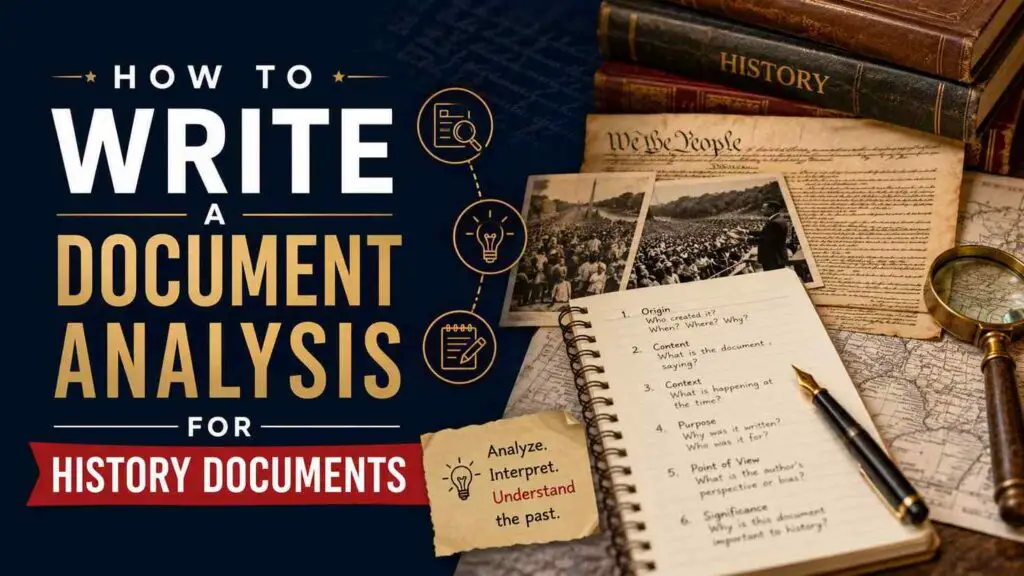
A document analysis for history documents is a critical examination of a historical source. It helps students, researchers, and history enthusiasts understand not only what a document says but also why it was created, who created it, and what it reveals about a particular period in history.
Historical documents serve as evidence of the past. They provide firsthand or secondhand accounts of events, ideas, beliefs, and experiences. Whether the document is a speech, letter, diary entry, newspaper article, law, treaty, or government report, analyzing it carefully can uncover valuable insights about the people and circumstances that shaped history.
A strong document analysis goes beyond summarizing content. It evaluates the source, considers its context, and explains its significance. Understanding how to conduct a thorough document analysis is an essential skill for anyone studying history.
What is a Document Analysis for History Documents?
A document analysis for history documents is a written evaluation of a historical source. The purpose is to examine the document’s content, context, author, audience, purpose, reliability, and historical importance.
Historians use document analysis to understand the past more accurately. Rather than accepting a source at face value, they ask critical questions about how and why it was created. Every document reflects a particular perspective, and understanding that perspective is key to interpreting the source correctly.
For example, a political speech may reveal the goals of a government leader, while a personal diary may provide insight into how ordinary people experienced historical events. Both sources can be valuable, but they must be analyzed differently.
Document analysis allows historians to transform historical documents into meaningful evidence that supports historical interpretations and arguments.
Key Components of a Document Analysis for History Documents
Several elements work together to create an effective document analysis. Understanding these components will help you evaluate historical sources more thoroughly and produce stronger analyses.
#1. Historical Context
Historical context refers to the circumstances surrounding the creation of the document. This includes the political, economic, social, cultural, and religious conditions that existed at the time.
Understanding context helps explain why the document was written and what issues may have influenced the author. For example, a speech delivered during a war may reflect concerns about national security, patriotism, or public morale. A letter written during an economic depression may reveal worries about employment, poverty, or government policies.
Without historical context, it can be difficult to fully understand the meaning and significance of a document.
#2. Author or Creator
The author is the individual or group responsible for creating the document.
Knowing who wrote the document helps readers understand the perspective presented in the source. Factors such as the author’s occupation, social status, education, political beliefs, nationality, and personal experiences can influence how events are described.
A government official, journalist, activist, religious leader, or ordinary citizen may each present a different interpretation of the same event. Identifying the author’s background provides valuable insight into the source.
#3. Audience
The audience refers to the people for whom the document was intended.
Some documents are written for the general public, while others are intended for a specific group or individual. Understanding the audience helps explain why the author used certain language, arguments, or examples.
For instance, a campaign speech directed at voters will likely differ significantly from a private letter sent to a family member. The intended audience often influences the tone, style, and content of the document.
#4. Purpose
Purpose refers to the reason the document was created.
An author may write to inform, persuade, criticize, justify, inspire, entertain, record events, or influence public opinion. Identifying the purpose helps readers understand the goals behind the document and evaluate its reliability.
Documents written to persuade may emphasize certain facts while ignoring others. Understanding purpose helps reveal the motivations behind the source.
#5. Main Argument or Message
Every historical document communicates a central idea or message.
The main argument may be stated directly or implied through the author’s words and examples. Identifying this message helps readers understand what the author wanted the audience to believe, understand, or do.
A strong document analysis clearly identifies and explains this central message.
#6. Evidence and Details
Evidence consists of the specific information contained within the document that supports the author’s message.
This may include facts, statistics, descriptions, examples, quotations, or observations. Effective document analyses reference important details from the source and explain how they contribute to its overall meaning.
Using evidence strengthens the analysis and demonstrates a close reading of the document.
#7. Bias and Point of View
Every historical source reflects a particular point of view.
Bias does not necessarily mean a source is unreliable. Instead, it means the author approaches the subject from a particular perspective shaped by personal beliefs, experiences, or interests.
Recognizing bias helps readers evaluate the source critically and understand how the author’s perspective influences the content.
#8. Historical Significance
Historical significance explains why the document matters.
A document may be important because it influenced events, reflects public opinion, reveals social conditions, documents a major historical development, or provides insight into a particular group of people.
Explaining significance helps connect the document to broader historical themes and events.
How to Write a Document Analysis for History Documents
Writing a document analysis can seem overwhelming at first, but following a structured process makes the task much easier. The steps below will help you move from simply reading a document to producing a thoughtful and detailed analysis.
Step #1: Read the Document Multiple Times
Begin by reading the document carefully from start to finish. Your first reading should focus on understanding the basic content. Ask yourself what the document is about and what information it contains.
During your second reading, start highlighting important details. Look for names, dates, locations, key events, repeated themes, and emotionally charged language. Take notes in the margins or on a separate sheet of paper.
During your third reading, begin asking analytical questions. Consider why certain ideas are emphasized and what the author may be trying to accomplish.
By reading the document multiple times, you will notice details that are often missed during a quick first reading.
Step #2: Identify the Document’s Basic Information
Before writing your analysis, gather the essential facts about the source.
Create a list that includes:
- Title of the document
- Author or creator
- Date of creation
- Type of document
- Place of origin
- Historical period
For example, you might note that the source is a speech delivered by a president in 1941 during World War II.
Including this information in your notes provides a foundation for the rest of your analysis and ensures that you understand the source’s origins.
Step #3: Research the Historical Context
Once you understand the document itself, investigate the historical circumstances surrounding it.
Ask questions such as:
- What major events were occurring at this time?
- What political issues were being debated?
- What social or economic conditions existed?
- Were there wars, revolutions, reforms, or cultural movements taking place?
Spend time reviewing textbooks, class notes, scholarly sources, or reliable historical websites to gather this information.
When writing your analysis, explain how these historical circumstances may have influenced the document’s content and creation.
Step #4: Analyze the Author
Examine the person or group responsible for creating the document.
Ask yourself:
- Who was the author?
- What role did they play in society?
- What were their beliefs or interests?
- Did they have firsthand knowledge of the events being discussed?
- What motivations might they have had?
For example, a government leader may present events differently than a political opponent. A soldier may describe a battle differently than a civilian.
Including information about the author’s background helps explain the perspective presented in the document.
Step #5: Determine the Intended Audience
Consider who the author expected to read, hear, or receive the document.
Ask questions such as:
- Was it written for the public?
- Was it intended for government officials?
- Was it a private communication?
- Was it directed at supporters, critics, or future generations?
The intended audience often shapes the language and tone of the document.
When writing your analysis, explain how the audience may have influenced the author’s choices and message.
Step #6: Identify the Author’s Purpose
Every historical document was created for a reason.
As you read, ask:
- Why was this document created?
- What outcome did the author hope to achieve?
- Was the goal to persuade, inform, justify, criticize, or record events?
Look for clues in the language used. Strong emotional appeals often indicate persuasion, while detailed descriptions may suggest an attempt to inform or document.
In your analysis, clearly state what you believe the author’s purpose was and provide evidence from the document to support your conclusion.
Step #7: Find the Main Message
After understanding the context, author, audience, and purpose, identify the document’s central message.
Try summarizing the document’s main idea in one or two sentences.
Ask yourself:
- What is the author’s primary argument?
- What does the author want the audience to believe?
- What issue or problem is being addressed?
Avoid merely repeating the topic. Instead, explain the specific point the author is making about that topic.
This message will often become one of the central points in your analysis.
Step #8: Collect Supporting Evidence
A strong document analysis relies on evidence from the source.
As you read, highlight important passages that support your interpretation. These may include:
- Key statements
- Memorable phrases
- Important examples
- Statistics or data
- Descriptions of events
- Emotional language
When writing, introduce the evidence and explain its significance. Never assume the reader will automatically understand why a quotation is important.
For every piece of evidence you include, explain what it reveals about the author’s message, purpose, or perspective.
Step #9: Evaluate Bias and Perspective
Next, consider the author’s point of view and potential bias.
Ask questions such as:
- What beliefs may have influenced the author?
- What interests does the author represent?
- What information may have been omitted?
- Does the author appear objective or persuasive?
Remember that all historical sources have limitations. Even firsthand accounts reflect personal experiences and perspectives.
Your analysis should acknowledge these limitations while also explaining the value of the source.
Step #10: Explain the Document’s Historical Significance
One of the most important parts of a document analysis is explaining why the source matters.
Ask yourself:
- What does this document reveal about the period?
- How does it contribute to our understanding of history?
- Does it illustrate a broader historical theme?
- Did it influence events or public opinion?
Connect the document to larger historical developments whenever possible.
This step helps move your analysis beyond description and demonstrates deeper historical thinking.
Step #11: Create an Organized Outline
Before writing your final draft, organize your ideas into a clear structure.
A simple outline might include:
- Introduction
- Summary of the document
- Historical context
- Analysis of author, audience, and purpose
- Discussion of evidence and bias
- Historical significance
- Conclusion
An outline helps ensure that your analysis remains focused and logically organized.
Step #12: Write the Analysis and Revise Carefully
Using your outline, write your first draft.
Focus on explaining rather than simply describing. Support every major point with evidence from the document.
Once the draft is complete, revise it carefully. Check for:
- Accuracy
- Clarity
- Organization
- Grammar and spelling
- Strong evidence
- Clear explanations
Ask yourself whether the analysis demonstrates why the document matters and what it reveals about history.
A well-revised analysis is often far more effective than a first draft written quickly.
Closing Thoughts
A document analysis for history documents is far more than a summary of a historical source. It is a careful investigation into the document’s origins, purpose, meaning, and significance.
By examining the historical context, author, audience, purpose, evidence, bias, and broader impact of a document, readers can gain a deeper understanding of both the source itself and the period in which it was created.
Following a structured approach makes the process manageable and helps produce stronger analyses. With practice, document analysis becomes an invaluable skill that strengthens critical thinking and historical understanding.