
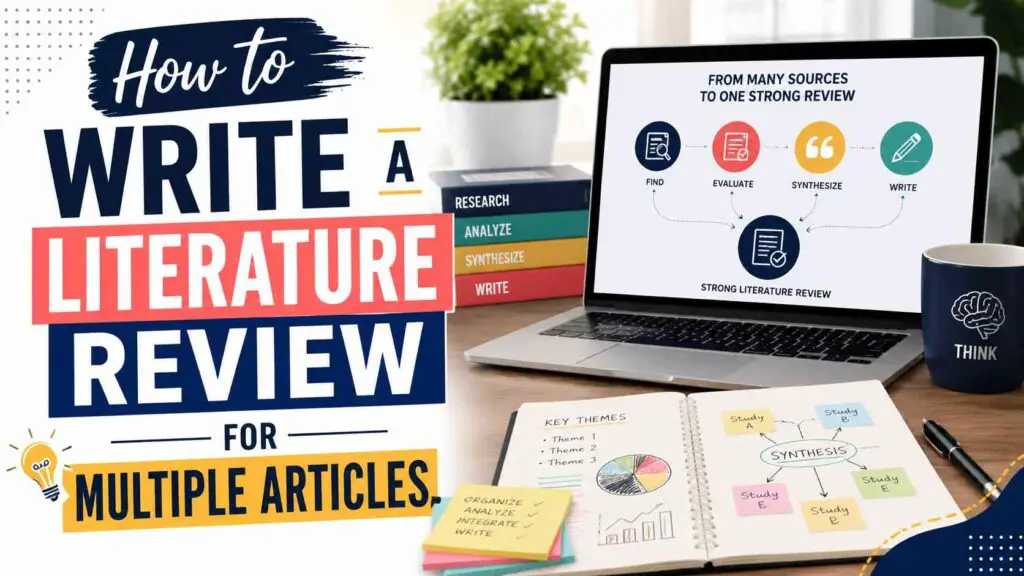
Writing a literature review for multiple articles requires more than summarizing one source after another. It involves analyzing a collection of scholarly works, identifying patterns among them, evaluating their contributions, and presenting the findings in a coherent academic discussion.
A literature review helps readers understand what researchers have already discovered about a topic, where disagreements exist, what gaps remain in the research, and how existing studies relate to your own work. When working with multiple articles, the challenge is not simply reading more material. The challenge is synthesizing that material into a clear and organized narrative.
Literature Review for Multiple Articles: Special Considerations
Writing a literature review based on numerous sources requires careful planning and critical thinking. Rather than treating each article as a separate piece of information, you must connect the sources and show how they contribute to the broader scholarly conversation. The following considerations can help improve the quality of your review.
#1. Focus on Themes Instead of Individual Articles
One of the most common mistakes students make is organizing the literature review article by article. This often creates a disconnected paper that reads like a series of summaries.
Instead, identify common themes, topics, debates, findings, or research questions that appear across the articles. Organizing by theme allows you to discuss multiple sources together and demonstrate how the research connects.
For example, if your topic is remote work, potential themes might include employee productivity, work-life balance, organizational communication, and employee satisfaction. Within each theme, you can compare what different authors found and discuss similarities and differences.
This thematic approach creates a stronger and more analytical literature review.
#2. Compare and Contrast the Articles
A literature review should do more than explain what researchers found. It should also examine how the findings relate to one another.
Look for areas where researchers agree and areas where they disagree. Consider whether different studies used different populations, methodologies, or theoretical frameworks that may explain the differences in findings.
Comparing and contrasting studies demonstrates critical thinking and helps readers understand the complexity of the topic.
#3. Pay Attention to Research Methods
The methodology used in a study often influences the conclusions that researchers reach.
As you review multiple articles, pay attention to whether studies use surveys, interviews, experiments, case studies, observational research, or literature-based analysis. Consider how the chosen method affects the reliability and scope of the findings.
Including methodological observations in your literature review adds depth and helps readers evaluate the strength of the evidence being presented.
#4. Identify Gaps in the Research
One of the most valuable contributions of a literature review is identifying what researchers have not yet explored.
You may discover that certain populations are underrepresented, specific questions remain unanswered, or newer developments have not been adequately studied.
Highlighting these gaps demonstrates your understanding of the field and provides justification for future research.
#5. Maintain a Clear Academic Voice
A literature review should be objective, balanced, and professional.
Avoid emotional language or unsupported opinions. Instead, evaluate studies based on evidence and scholarly standards. Recognize both strengths and limitations without dismissing research unfairly.
An academic voice helps establish credibility and allows readers to trust your analysis.
How to Write a Literature Review for Multiple Articles
Writing a literature review becomes much more manageable when you follow a structured process. The following steps provide a practical framework that you can apply to almost any academic topic.
Step #1: Understand the Purpose of the Literature Review
Before opening your first article, clarify exactly why you are writing the literature review.
Ask yourself:
- What research question am I trying to answer?
- What topic am I investigating?
- What is the purpose of this assignment?
- Am I identifying gaps, supporting an argument, or providing background information?
Write your research topic or question at the top of a blank document. Keep it visible throughout the process. This helps prevent you from collecting information that is interesting but irrelevant.
For example, if your topic is “The Impact of Social Media on Academic Performance,” your literature review should focus specifically on research that addresses social media usage and educational outcomes. Articles about social media marketing or political communication may not be relevant.
Having a clear purpose before reading saves time and improves focus.
Step #2: Read Each Article Carefully
Many students rush through articles and immediately begin writing. This often results in weak analysis and incomplete understanding.
Instead, read each article actively.
While reading, take notes on:
- The author’s purpose
- The research question
- The methodology
- The sample population
- The key findings
- The conclusions
- The limitations
A useful strategy is to create a one-page summary for each article. Use your own words rather than copying sentences from the source.
For example:
Article Summary Template
- Author(s):
- Year:
- Topic:
- Research Question:
- Method:
- Main Findings:
- Strengths:
- Limitations:
- Relevant Themes:
By the time you finish reading all articles, you should have concise summaries that are easy to review later.
Step #3: Create a Comparison Chart
After reading the articles, organize your information into a comparison chart.
A comparison chart allows you to see relationships between studies that may not be obvious when reading individual notes.
You can create a table with columns such as:
| Author | Year | Method | Sample | Main Findings | Limitations | Theme |
|---|
For example:
| Smith | 2022 | Survey | 500 students | Social media reduced study time | Single university | Academic Performance |
| Jones | 2023 | Interviews | 40 students | Social media increased collaboration | Small sample | Student Engagement |
As your chart grows, patterns will begin to emerge. You may notice that several studies report similar findings or that different methods produce different results.
This chart becomes one of the most useful tools during the writing stage.
Step #4: Identify Major Themes Across the Articles
Once your comparison chart is complete, begin looking for recurring ideas.
Ask yourself:
- Which topics appear repeatedly?
- Which findings occur across multiple studies?
- Which debates appear throughout the literature?
- What issues seem most important?
Write down potential themes and group articles under each one.
For example:
Theme 1: Academic Performance
- Article A
- Article B
- Article C
Theme 2: Student Engagement
- Article B
- Article D
- Article E
Theme 3: Mental Health Effects
- Article A
- Article F
- Article G
Notice that one article may fit into multiple themes. This is normal.
The goal is to move away from thinking about individual articles and begin thinking about broader conversations within the literature.
Step #5: Develop a Clear Structure
Before writing, create an outline for the entire literature review.
A typical structure may look like:
- Introduction
- Theme 1
- Theme 2
- Theme 3
- Major Agreements and Disagreements
- Research Gaps
- Conclusion
Under each section, list the articles you plan to discuss.
For example:
Theme: Academic Performance
- Smith (2022)
- Johnson (2021)
- Brown (2023)
Theme: Student Engagement
- Lee (2020)
- Smith (2022)
- Davis (2024)
This outline serves as a roadmap and prevents your writing from becoming disorganized.
Step #6: Write by Theme, Not by Article
This is where many literature reviews either succeed or fail.
Instead of writing:
“Smith found X. Johnson found Y. Brown found Z.”
Write:
“Several studies suggest that increased social media usage negatively affects academic performance. Smith (2022) found reduced study time among heavy users, while Johnson (2021) reported lower GPA scores among students with high daily usage. Brown (2023), however, found that educational uses of social media could improve learning outcomes.”
Notice how the discussion focuses on the theme rather than individual articles.
A useful formula is:
- Introduce the theme.
- Present evidence from multiple studies.
- Compare findings.
- Explain differences.
- Transition to the next point.
This approach demonstrates synthesis, which is one of the primary goals of a literature review.
Step #7: Use Transitions to Connect Ideas
Transitions help readers follow your analysis.
Without transitions, the literature review can feel like a collection of unrelated observations.
Useful transition phrases include:
Showing Agreement
- Similarly
- Likewise
- Consistent with
- Supporting these findings
Showing Contrast
- However
- In contrast
- On the other hand
- Conversely
Showing Addition
- Furthermore
- Additionally
- Another study found
- Moreover
Showing Conclusions
- Taken together
- Collectively
- Overall
- These findings suggest
As you revise your paper, look at the first sentence of each paragraph and ensure it connects logically to the previous discussion.
Step #8: Evaluate the Strengths and Limitations of the Research
A literature review should analyze research quality, not simply report findings.
Ask questions such as:
- Was the sample size large enough?
- Were the methods appropriate?
- Were there potential biases?
- Can the findings be generalized?
- Were important variables overlooked?
For example:
“Although Smith’s study included over 1,000 participants, it relied on self-reported data, which may affect the accuracy of the findings.”
Or:
“Jones provided rich qualitative insights through interviews, although the small sample size limits the generalizability of the results.”
Evaluating strengths and weaknesses demonstrates higher-level academic thinking.
Step #9: Show the Gaps in the Literature
Near the end of your literature review, explain what remains unknown.
To identify gaps, ask:
- Which populations have not been studied?
- Are there conflicting findings that need clarification?
- Are the studies outdated?
- Are certain regions or demographics underrepresented?
- Have researchers ignored emerging developments?
For example:
“While existing studies have extensively examined social media usage among university students, limited research has explored its impact on elementary school students.”
Or:
“Most studies focus on North American populations, leaving questions about whether similar findings apply in other cultural contexts.”
Research gaps help establish the importance of future studies and strengthen the overall purpose of the review.
Step #10: Revise for Clarity and Flow
The first draft of a literature review is rarely the final version.
After completing your draft, review it carefully.
Check for:
- Clear organization
- Strong transitions
- Logical flow
- Consistent citation style
- Balanced coverage of sources
- Repetition
- Grammar and spelling errors
One helpful technique is to read the review aloud. This often reveals awkward wording and weak transitions that are easy to miss when reading silently.
You should also ask yourself:
- Does each paragraph support the overall topic?
- Are the themes clearly defined?
- Have I synthesized the research rather than summarized it?
- Have I identified meaningful patterns and gaps?
Revision is often where a good literature review becomes an excellent one.
Closing Thoughts
Writing a literature review for multiple articles is a process of reading, organizing, comparing, and synthesizing research. The goal is not to summarize every source individually but to show how the body of literature collectively contributes to understanding a topic.
The strongest literature reviews identify themes, compare findings, evaluate research quality, and highlight gaps in current knowledge. By following a systematic process and focusing on synthesis rather than summary, you can create a literature review that is insightful, organized, and academically rigorous.
With careful planning, detailed note-taking, and thoughtful analysis, even a large collection of articles can be transformed into a clear and compelling literature review.