
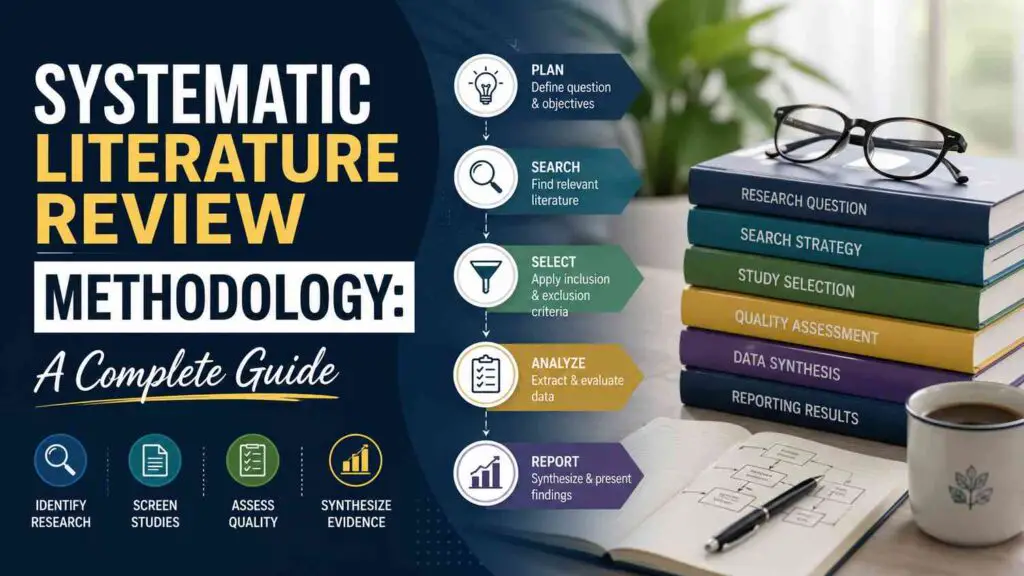
Systematic literature reviews are used when researchers need a clear, reliable, and transparent way to study existing research on a topic. Instead of reading a few articles and summarizing them casually, a systematic literature review follows a planned method. This helps researchers reduce bias, organize evidence, and show exactly how they reached their conclusions.
A strong systematic literature review does more than collect sources. It explains how the sources were found, why some studies were included, why others were excluded, and how the final findings were analyzed. This makes the review easier to trust, repeat, and evaluate.
What is a Systematic Literature Review Methodology?
A systematic literature review methodology is the structured process used to plan, search, select, evaluate, and analyze academic literature on a specific research question. It gives the review a clear path from the initial topic to the final conclusions.
The methodology is important because it makes the review transparent. Readers should be able to see what databases were searched, which keywords were used, what criteria guided the selection of studies, and how the evidence was interpreted. Without a clear methodology, a literature review can become too subjective or incomplete.
In simple terms, the methodology is the rulebook for the review. It prevents the researcher from choosing only convenient studies or ignoring research that challenges their assumptions. It also helps other researchers understand, evaluate, or even replicate the review.
What Does a Systematic Literature Review Methodology Include?
A systematic literature review methodology includes all the key decisions and procedures used to conduct the review. These elements help make the review organized, transparent, and academically reliable. The main parts usually include the following.
#1. Research Question
The research question is the foundation of the entire review. It defines what the review is trying to discover, compare, explain, or evaluate.
A good research question should be specific enough to guide the search process. For example, instead of asking, “What does research say about online learning?” a stronger question might ask, “What factors influence student engagement in online learning in higher education?”
The research question affects every later decision, including the databases used, the keywords selected, and the type of studies included.
#2. Search Strategy
The search strategy explains how the researcher found relevant studies. This usually includes the databases searched, the search terms used, and any filters applied.
Common academic databases include Google Scholar, Scopus, Web of Science, PubMed, ERIC, IEEE Xplore, and discipline-specific databases. The search strategy may also include Boolean operators such as AND, OR, and NOT to combine keywords more precisely.
A clear search strategy helps readers understand whether the review was broad enough and whether important studies may have been missed.
#3. Inclusion and Exclusion Criteria
Inclusion and exclusion criteria define which studies qualify for the review and which do not.
Inclusion criteria may focus on publication date, language, research design, population, subject area, or type of publication. Exclusion criteria may remove opinion pieces, duplicate studies, non-peer-reviewed articles, outdated research, or studies outside the topic.
These criteria are important because they prevent random or biased study selection. They also make the review process more consistent.
#4. Study Selection Process
The study selection process explains how the researcher moved from a large number of search results to the final set of studies included in the review.
This process often involves screening titles, abstracts, and full texts. Many systematic reviews also use a flow diagram to show how many records were identified, screened, excluded, and included.
A transparent study selection process shows that the researcher did not choose studies carelessly. It also helps readers see how the final evidence base was created.
#5. Quality Assessment
Quality assessment is the process of evaluating the reliability and strength of the studies included in the review.
Not all studies are equally strong. Some may have weak methods, small sample sizes, unclear data, or biased conclusions. Quality assessment helps the researcher decide how much weight each study should receive.
This step is especially important in fields such as medicine, education, social sciences, and technology, where study designs can vary widely.
#6. Data Extraction
Data extraction involves collecting important information from each included study in a consistent way.
This may include the author, year, country, research design, sample size, methods, findings, limitations, and key themes. Researchers often use a data extraction table to organize this information.
Data extraction helps make the review systematic rather than impression-based. It ensures that the same kind of information is collected from each study.
#7. Data Analysis and Synthesis
Data analysis and synthesis explain how the findings from the selected studies were combined and interpreted.
In some reviews, this may involve a narrative synthesis, where themes and patterns are discussed in words. In others, it may involve statistical analysis, such as a meta-analysis. Some reviews may group findings by theory, method, population, region, or outcome.
The goal is not just to summarize individual studies. The goal is to show what the body of research says as a whole.
Common Systematic Literature Review Methodologies
Different systematic literature review methodologies are used depending on the purpose of the review, the field of study, and the type of evidence being analyzed. Some methods are more suitable for broad mapping, while others are better for answering narrow research questions. The most common methodologies include the following.
#1. PRISMA Methodology
PRISMA stands for Preferred Reporting Items for Systematic Reviews and Meta-Analyses. It is one of the most widely used frameworks for reporting systematic reviews.
PRISMA helps researchers document the review process clearly. It is especially known for its flow diagram, which shows how studies were identified, screened, excluded, and included.
In addition to the flow diagram, PRISMA provides a checklist that guides researchers on what information to report at each stage of the review. This includes details about the search strategy, eligibility criteria, data extraction, and synthesis methods. Following this checklist helps ensure that no important steps are overlooked.
This methodology is useful when researchers want to make their search and selection process highly transparent. It is commonly used in healthcare, social sciences, education, and other research fields. It is especially valuable when the goal is to produce a review that others can replicate or critically evaluate.
#2. Cochrane Methodology
The Cochrane methodology is commonly used in healthcare and medical research. It is designed to produce rigorous reviews of evidence, especially evidence related to treatments, interventions, and clinical decisions.
This methodology places strong emphasis on reducing bias, assessing study quality, and evaluating the strength of evidence. It often includes detailed protocols, risk-of-bias tools, and structured evidence grading.
Cochrane reviews typically begin with a registered protocol that outlines the research question, methods, and planned analyses before the review starts. This reduces the risk of selective reporting and increases transparency. Researchers also use standardized tools to assess the quality of randomized controlled trials and other study designs.
Cochrane reviews are considered highly reliable because they follow strict standards. However, they can also be time-consuming and complex. They often require collaboration among multiple researchers and careful adherence to detailed guidelines.
#3. Scoping Review Methodology
A scoping review is used when researchers want to map the existing literature on a broad topic. It is useful when a field is new, complex, or not yet clearly organized.
Unlike some systematic reviews, a scoping review may not focus on answering a narrow question. Instead, it identifies key concepts, research gaps, types of evidence, and major themes in the literature.
Scoping reviews often follow structured frameworks such as the Arksey and O’Malley framework or later refinements. These frameworks guide researchers through stages such as identifying the research question, searching for relevant studies, selecting studies, charting the data, and summarizing the results.
This methodology is helpful when researchers want to understand the size and shape of a research area before conducting a more focused review. It can also highlight areas where evidence is lacking and where future research is needed.
#4. Meta-Analysis Methodology
A meta-analysis is a statistical method used to combine results from multiple quantitative studies. It is often used when studies measure similar outcomes and provide numerical data.
The strength of meta-analysis is that it can produce a more precise estimate of an effect than a single study alone. For example, it may be used to measure the effectiveness of a treatment, teaching method, or intervention.
In a meta-analysis, researchers calculate effect sizes from individual studies and then combine them using statistical models. They may also assess heterogeneity, which refers to how different the study results are from each other. Tools such as forest plots are often used to visualize the combined results.
However, meta-analysis requires studies that are similar enough to compare. If the included studies are too different, the results may be misleading. Researchers must also carefully assess publication bias and study quality to ensure accurate conclusions.
#5. Narrative Synthesis Methodology
Narrative synthesis is used when findings are explained and combined through words rather than statistics. It is common when studies use different methods, theories, populations, or outcomes.
This methodology is useful for identifying patterns, themes, contradictions, and gaps in the literature. It allows the researcher to interpret evidence in a flexible but structured way.
Narrative synthesis often involves grouping studies based on shared characteristics and then describing similarities and differences across them. Researchers may also develop conceptual frameworks or thematic categories to organize the findings.
Narrative synthesis is especially helpful in social sciences, humanities, education, management, and interdisciplinary research. It allows for deeper interpretation when numerical comparison is not possible.
#6. Integrative Review Methodology
An integrative review allows researchers to include different types of evidence, such as theoretical papers, qualitative studies, quantitative studies, and mixed-methods research.
This methodology is useful when the topic cannot be fully understood through one type of study alone. It helps create a broader understanding of a concept, problem, or field.
Integrative reviews often involve comparing and combining findings from diverse sources to build new perspectives or frameworks. Researchers may analyze how different types of evidence support or challenge each other.
Because integrative reviews include diverse evidence, they require careful organization and clear criteria. Without structure, they can become too broad or unfocused. Strong integrative reviews clearly explain how different types of data were evaluated and synthesized.
#7. Rapid Review Methodology
A rapid review is a streamlined version of a systematic review. It is used when evidence is needed quickly, often for policy, practice, or decision-making.
Rapid reviews still follow systematic principles, but some steps may be simplified. For example, researchers may limit databases, restrict publication dates, or use fewer reviewers.
In many cases, rapid reviews focus on the most relevant and recent evidence rather than attempting to capture all available studies. They may also use simplified quality assessment methods to save time.
This methodology is useful when time is limited. However, because the process is shortened, rapid reviews may be less comprehensive than full systematic reviews. Researchers must clearly report any limitations caused by the faster process.
#8. Umbrella Review Methodology
An umbrella review reviews existing systematic reviews and meta-analyses rather than individual studies. It is sometimes called a review of reviews.
This methodology is useful when a topic already has many systematic reviews. Instead of repeating the same work, the researcher compares and summarizes the findings from those reviews.
Umbrella reviews often assess the quality of the included reviews and examine how consistent their findings are. They may also identify areas where reviews disagree or where evidence is still uncertain.
Umbrella reviews are helpful for high-level evidence summaries. They can show where review findings agree, where they conflict, and where more research is still needed. They are especially useful for policymakers and practitioners who need a broad overview of existing evidence.
Closing Thoughts
A systematic literature review methodology gives structure, transparency, and credibility to a review. It shows readers how the research was found, selected, evaluated, and analyzed.
The best methodology depends on the purpose of the review. PRISMA is useful for transparent reporting. Cochrane is strong for healthcare evidence. Scoping reviews help map broad fields. Meta-analysis combines numerical findings. Narrative synthesis explains patterns across diverse studies.
Choosing the right methodology is essential. A good method does not just organize the review. It strengthens the value of the conclusions and helps readers trust the evidence behind them.