
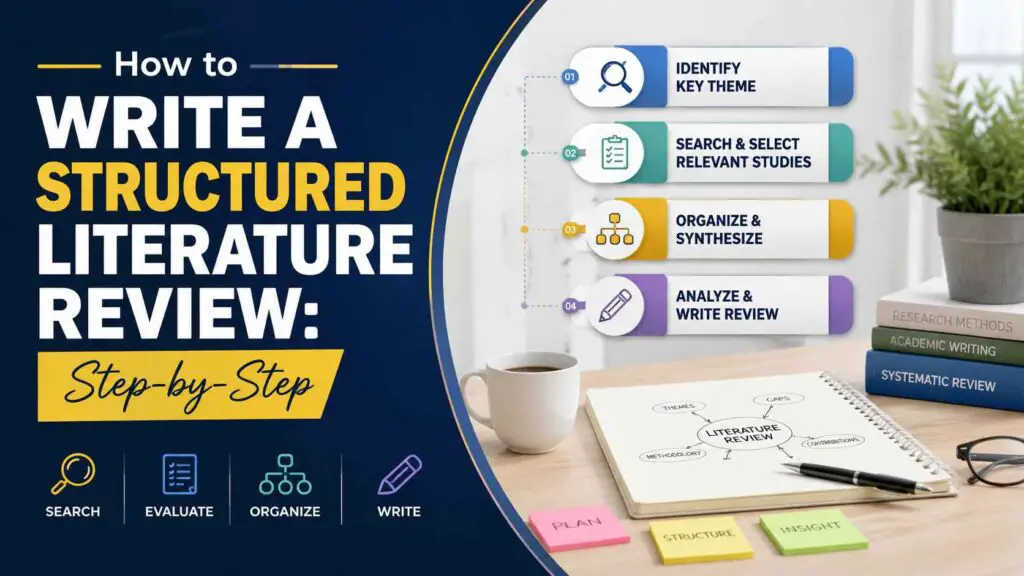
A structured literature review is one of the most important components of academic research. Whether you are writing a research paper, dissertation, thesis, or scholarly article, a literature review helps establish the foundation of your work by showing what is already known about a topic.
Unlike a simple summary of sources, a structured literature review follows a systematic approach. It involves identifying relevant studies, evaluating their quality, organizing findings into themes, and drawing meaningful conclusions from the existing body of knowledge.
When done correctly, a structured literature review demonstrates your understanding of the field, highlights research gaps, and provides a strong rationale for future investigation.
What is a Structured Literature Review?
A structured literature review is a systematic examination of existing research related to a specific topic or research question. It follows a clear and organized process for locating, selecting, evaluating, and synthesizing scholarly sources.
The purpose of a structured literature review is not simply to summarize previous studies. Instead, it seeks to identify patterns, trends, debates, strengths, weaknesses, and gaps within the existing literature.
Compared to a traditional narrative review, a structured literature review is more transparent because it clearly explains how sources were identified and analyzed. This makes the review more reliable and easier for readers to evaluate.
Researchers use structured literature reviews to build a foundation for new studies, understand the current state of knowledge, and identify opportunities for future research.
Key Components of a Structured Literature Review
Several essential components work together to create an effective structured literature review. Understanding these components will help you develop a review that is organized, comprehensive, and academically sound.
#1. Clear Research Question
Every structured literature review begins with a well-defined research question.
The research question serves as the guiding force behind the entire review process. It determines what sources you search for, what information you collect, and how you organize your findings.
A vague question often leads to a disorganized review with too much irrelevant information. In contrast, a focused question narrows the scope and allows you to examine a specific aspect of a topic in depth.
For example, instead of asking, “How does technology affect education?” a stronger question would be, “How does artificial intelligence influence student learning outcomes in higher education?”
A clear research question helps maintain focus throughout the review process.
#2. Defined Search Strategy
A search strategy outlines how you locate relevant literature.
This includes the databases searched, keywords used, search operators applied, and any filters or limitations imposed during the search process.
Documenting your search strategy improves transparency and allows others to understand how the evidence was gathered.
A comprehensive search strategy often includes multiple databases, such as Google Scholar, JSTOR, Scopus, Web of Science, ERIC, or PubMed, depending on the discipline.
Carefully selecting search terms helps ensure that you identify the most relevant studies related to your topic.
#3. Inclusion and Exclusion Criteria
Inclusion and exclusion criteria determine which studies are accepted into the review and which are excluded.
These criteria help maintain consistency and reduce bias when selecting sources.
Examples of inclusion criteria may include:
- Peer-reviewed journal articles
- Studies published within a specific date range
- Research conducted in a particular country or population
- Sources written in a specific language
Examples of exclusion criteria may include:
- Opinion pieces
- Non-academic websites
- Duplicate studies
- Research unrelated to the research question
Clearly defining these criteria helps create a focused and manageable literature review.
#4. Critical Evaluation of Sources
A structured literature review requires more than summarizing studies.
Each source should be critically evaluated to assess its quality, credibility, methodology, strengths, and limitations.
Questions to consider include:
- Was the research design appropriate?
- Was the sample size adequate?
- Were the conclusions supported by evidence?
- What limitations did the authors identify?
- Are the findings consistent with other studies?
Critical evaluation helps distinguish strong evidence from weaker evidence and contributes to a more insightful review.
#5. Thematic Organization
Rather than discussing studies one by one, structured literature reviews often organize findings into themes.
Themes represent common patterns, ideas, findings, or debates found across multiple studies.
For example, a literature review on remote work may identify themes such as:
- Employee productivity
- Work-life balance
- Communication challenges
- Organizational culture
Thematic organization helps readers understand the broader picture rather than focusing on individual studies in isolation.
#6. Identification of Research Gaps
One of the most valuable outcomes of a literature review is identifying gaps in the existing research.
Research gaps may include:
- Topics that have received little attention
- Underrepresented populations
- Conflicting findings
- Outdated research areas
- Methodological limitations
Highlighting these gaps demonstrates the need for further investigation and helps justify future research efforts.
How to Write a Structured Literature Review Step-by-Step
Writing a structured literature review can seem overwhelming at first. However, breaking the process into manageable steps makes the task much easier. By following a systematic approach, you can produce a review that is comprehensive, organized, and academically rigorous.
Step #1: Choose a Focused Research Topic
The first step is selecting a topic that is specific enough to be manageable but broad enough to provide sufficient research material.
Many students make the mistake of choosing topics that are too broad. For example, a topic such as “Social Media” could generate thousands of studies. Narrowing the topic makes the review more focused and meaningful.
Consider factors such as:
- Your academic interests
- Availability of research
- Relevance to your field
- Assignment requirements
A focused topic like “The Impact of Social Media on Adolescent Mental Health” is much easier to review than a broad topic such as “Social Media.”
Before finalizing your topic, perform a preliminary search to ensure enough scholarly literature exists.
Step #2: Develop a Clear Research Question
Once you have selected a topic, transform it into a specific research question.
A strong research question should:
- Be clear and concise
- Be researchable
- Define the scope of the review
- Guide your literature search
For example:
Weak Question: What is online learning?
Strong Question: How does online learning affect student engagement in higher education institutions?
Write your research question down and keep it visible throughout the review process. Every source you include should contribute to answering this question.
Step #3: Create a Search Plan
Before searching for articles, create a strategy.
Start by identifying key concepts from your research question. Then develop a list of related keywords and synonyms.
For example:
Research Topic: Online Learning and Student Engagement
Possible Keywords:
- Online learning
- E-learning
- Distance education
- Virtual learning
- Student engagement
- Academic participation
- Learner involvement
You can also use Boolean operators:
- AND
- OR
- NOT
Example search:
“Online learning” AND “student engagement”
A well-planned search strategy saves significant time later in the review process.
Step #4: Search Academic Databases Systematically
Conduct your literature search using reputable academic databases.
Common databases include:
- Google Scholar
- JSTOR
- Scopus
- Web of Science
- PubMed
- ERIC
As you search, maintain a record of:
- Database used
- Search terms entered
- Number of results found
- Relevant studies selected
Keeping detailed records helps ensure transparency and prevents duplication of effort.
It is often helpful to create a spreadsheet to track your searches.
Step #5: Screen and Select Relevant Studies
After collecting potential sources, begin screening them.
Start by reviewing:
- Titles
- Abstracts
- Keywords
Ask yourself:
- Does this study address my research question?
- Is it academically credible?
- Does it meet my inclusion criteria?
Eliminate irrelevant sources early. This saves time and allows you to focus on high-quality studies.
Many researchers perform screening in stages:
- Title screening
- Abstract screening
- Full-text screening
This approach makes source selection more efficient.
Step #6: Read Sources Critically and Take Detailed Notes
Careful note-taking is one of the most important parts of the literature review process.
For each study, record:
- Author(s)
- Publication year
- Research objectives
- Methodology
- Sample size
- Key findings
- Limitations
- Relevance to your review
A literature review matrix can be extremely useful.
For example:
| Author | Method | Findings | Limitations |
|---|---|---|---|
| Smith (2023) | Survey | Improved engagement | Small sample |
Using a matrix makes it easier to compare studies later.
Step #7: Organize the Literature into Themes
As you read more studies, patterns will begin to emerge.
Group studies according to shared topics, findings, or perspectives.
For example, a review on workplace productivity may reveal themes such as:
- Remote work effectiveness
- Employee motivation
- Leadership styles
- Technology adoption
Create a separate document or outline for each theme and place relevant studies under the appropriate category.
This step transforms a collection of articles into a coherent body of knowledge.
Step #8: Analyze and Synthesize Findings
This is where many literature reviews become weak.
Instead of discussing one article after another, compare and connect studies.
Ask questions such as:
- Which findings are consistent across studies?
- Which findings contradict each other?
- What explanations are offered?
- What methodological differences exist?
For example:
Rather than writing:
“Smith found increased engagement. Jones found increased engagement.”
Write:
“Multiple studies report increased student engagement in online learning environments, suggesting a consistent positive relationship between digital learning platforms and participation levels.”
Synthesis demonstrates critical thinking and scholarly understanding.
Step #9: Identify Patterns, Debates, and Gaps
Look beyond the individual studies.
Examine:
- Recurring themes
- Areas of agreement
- Areas of disagreement
- Understudied populations
- Methodological weaknesses
For example, you may discover that most studies focus on university students while very few examine adult learners.
These observations help establish research gaps and strengthen the contribution of your review.
Step #10: Develop a Detailed Outline
Before writing, create a structured outline.
A typical literature review outline may include:
- Introduction
- Theme One
- Theme Two
- Theme Three
- Research Gaps
- Conclusion
Under each section, list the studies and points you intend to discuss.
A detailed outline helps maintain logical flow and prevents repetition.
Step #11: Write the First Draft
Begin writing using your outline as a guide.
Focus on explaining:
- What the studies found
- How findings compare
- Why certain findings matter
- What conclusions can be drawn
Use transition phrases to connect ideas and themes smoothly.
Examples include:
- Similarly
- In contrast
- However
- Furthermore
- Conversely
Remember that your goal is to tell the story of the research field, not simply summarize individual articles.
Step #12: Cite Sources Correctly
Proper citation is essential for academic integrity.
Follow the citation style required by your institution, such as:
- APA
- MLA
- Chicago
- Harvard
Use reference management tools when possible, including:
- Zotero
- Mendeley
- EndNote
These tools can save considerable time and reduce citation errors.
Always verify citations before submission.
Step #13: Revise, Edit, and Strengthen the Review
The final step is revision.
Review your literature review multiple times and ask:
- Does every section relate to the research question?
- Are themes clearly organized?
- Is the analysis critical rather than descriptive?
- Are transitions smooth?
- Are citations accurate?
You may also ask a supervisor, colleague, or peer to review your work and provide feedback.
Strong literature reviews often go through several rounds of revision before reaching their final form.
Closing Thoughts
A structured literature review provides a systematic way to understand and evaluate existing research. By following a clear process, researchers can identify important findings, uncover research gaps, and establish a solid foundation for future studies.
The most effective literature reviews move beyond simple summaries. They critically analyze the literature, connect ideas across studies, identify emerging patterns, and highlight areas where further research is needed.
By applying the step-by-step approach outlined above, you can create a literature review that is organized, insightful, and academically valuable.