
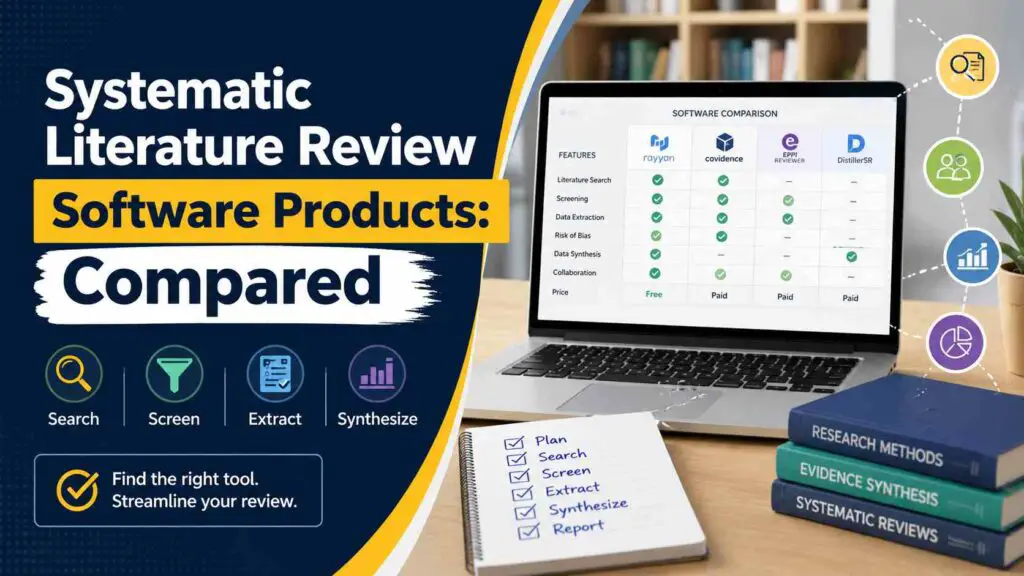
Systematic literature reviews are no longer limited to manual spreadsheets, folders of PDFs, and long email threads between reviewers. Today, researchers can use specialized software to manage citations, remove duplicates, screen studies, extract data, assess quality, and document every decision in a transparent workflow.
This matters because a systematic literature review must be more than a general summary of research. It must follow a clear method. Every search, inclusion decision, exclusion reason, and synthesis step should be traceable. The right software helps researchers work faster while protecting the rigor of the review.
What is Systematic Literature Review?
A systematic literature review is a structured review of existing research on a specific question. Instead of collecting sources casually, the reviewer follows a planned method to find, select, evaluate, and summarize relevant studies.
A systematic review usually begins with a research question. The reviewer then defines search terms, selects databases, sets inclusion and exclusion criteria, screens the results, extracts data, evaluates study quality, and synthesizes the findings.
The goal is to reduce bias. A normal literature review may depend heavily on the author’s judgment. A systematic literature review makes that judgment visible, consistent, and repeatable.
How Software Helps in Systematic Literature Review
Software plays a critical role in helping researchers manage the complexity, scale, and documentation requirements of a systematic literature review. Even a narrowly focused research question can generate hundreds or thousands of records from multiple databases. Managing these records manually can be time-consuming and increases the risk of errors, inconsistencies, and missing information.
One of the earliest challenges in a systematic review is organizing search results from different sources. Review software allows researchers to import citations from databases such as PubMed, Scopus, Web of Science, Embase, and Google Scholar into a single workspace. Many tools can automatically identify and remove duplicate records, saving significant time and reducing the likelihood of screening the same study multiple times.
Software is particularly valuable during the screening phase. Researchers can review titles and abstracts, apply inclusion and exclusion criteria, assign labels or tags, and document decisions in a structured manner. When multiple reviewers are involved, the software can track individual decisions, identify disagreements, and facilitate conflict resolution. This helps maintain consistency and transparency throughout the review process.
During full-text screening, systematic review platforms provide a centralized location for storing articles and recording reasons for exclusion. This is important because systematic reviews typically require researchers to document why studies were excluded at each stage. Having a clear audit trail makes the review more transparent and easier to reproduce.
Many platforms also support data extraction. Researchers can create standardized forms to collect information such as study design, sample size, interventions, outcomes, and key findings. Using structured extraction templates helps ensure that data are collected consistently across all included studies.
For larger projects, collaboration features are especially useful. Team members can work simultaneously, monitor progress, assign tasks, and communicate within the platform. This reduces reliance on spreadsheets, email chains, and separate document repositories, making the review process more efficient and organized.
Another important benefit is reporting and documentation. Many systematic review tools automatically generate screening statistics, reviewer logs, and PRISMA-compatible flow diagrams. These features help researchers meet reporting standards and provide clear evidence of how studies were identified, screened, included, and excluded.
In recent years, artificial intelligence and machine learning capabilities have become increasingly common in systematic review software. These features may help prioritize records for screening, identify potentially relevant studies, detect duplicates, classify articles, or predict which records are most likely to meet inclusion criteria. While these tools can significantly reduce workload, they should be viewed as decision-support systems rather than replacements for human judgment.
Ultimately, systematic review software helps researchers improve efficiency, maintain methodological rigor, enhance collaboration, and create a transparent record of the review process. By reducing administrative burdens and supporting consistent decision-making, these tools allow researchers to focus more attention on evaluating evidence and synthesizing findings.
Systematic Literature Review Software Products
Choosing systematic literature review software depends on the size of the project, the budget, the research field, the number of reviewers, and the level of methodological rigor required. Some tools are built for simple screening. Others support the full review lifecycle from search to synthesis.
Here are some of the top systematic literature review software products on the market today.
#1. Covidence
| Category | Details |
|---|---|
| Best Use Case | Covidence is a strong choice for academic, clinical, health sciences, and institutional review teams that want a guided systematic review workflow. |
| Screening Features | Covidence supports title and abstract screening, full-text screening, conflict resolution, and reviewer collaboration. It is especially useful for teams that need a structured review process. |
| Data Extraction | The platform includes data extraction tools that help reviewers collect study details in a consistent format. |
| Collaboration | Covidence is designed for multiple reviewers. It allows teams to divide work, compare decisions, and resolve disagreements. |
| Ease of Use | One of Covidence’s biggest advantages is its clean, guided workflow. It is easier for beginners than many advanced enterprise tools. |
| Best For | Covidence is best for universities, hospitals, research groups, and students who need a reliable all-in-one systematic review platform. |
#2. Rayyan
| Category | Details |
|---|---|
| Best Use Case | Rayyan is best for researchers who need fast title and abstract screening, especially when working with large citation sets. |
| Screening Features | Rayyan is known for its screening interface. It allows reviewers to label, include, exclude, and organize references efficiently. |
| AI Assistance | Rayyan includes AI-assisted features that can help prioritize records and speed up the screening process. |
| Collaboration | Rayyan supports collaborative review work, making it useful for teams as well as individual researchers. |
| Ease of Use | The interface is relatively simple. Researchers can get started quickly without a steep learning curve. |
| Best For | Rayyan is best for students, independent researchers, and teams that need flexible and efficient screening support. |
#3. DistillerSR
| Category | Details |
|---|---|
| Best Use Case | DistillerSR is best for organizations that conduct many systematic reviews and need a powerful enterprise-level platform. |
| Screening Features | DistillerSR supports advanced screening workflows, reviewer assignments, audit trails, and automation features. |
| Data Extraction | Its data extraction capabilities are highly developed. Teams can build custom forms and manage complex extraction processes. |
| Automation | DistillerSR includes automation and AI-assisted features that can reduce manual workload in large-scale reviews. |
| Collaboration | The platform is built for professional teams that require strong project control, compliance, and repeatable workflows. |
| Best For | DistillerSR is best for research organizations, pharmaceutical companies, health technology assessment teams, and institutions producing systematic reviews at scale. |
#4. EPPI-Reviewer
| Category | Details |
|---|---|
| Best Use Case | EPPI-Reviewer is best for researchers conducting detailed evidence synthesis, especially in education, social sciences, health, and policy research. |
| Screening Features | EPPI-Reviewer supports screening, coding, classification, and review management. |
| Data Extraction | The software includes robust tools for coding and extracting data from included studies. |
| Synthesis Support | EPPI-Reviewer is especially useful for complex reviews that require deeper coding, mapping, and synthesis. |
| Collaboration | It supports team-based work and structured review processes. |
| Best For | EPPI-Reviewer is best for experienced researchers who need a sophisticated evidence synthesis platform. |
#5. Nested Knowledge
| Category | Details |
|---|---|
| Best Use Case | Nested Knowledge is best for living systematic reviews, evidence mapping, and visual evidence synthesis. |
| Screening Features | The platform supports screening and study selection as part of a larger review workflow. |
| Evidence Visualization | Nested Knowledge stands out for its visual outputs, including evidence maps and interactive summaries. |
| Living Review Support | It is useful for reviews that need to be updated over time as new studies are published. |
| Collaboration | The software supports team workflows and transparent review documentation. |
| Best For | Nested Knowledge is best for teams that want to present evidence visually and maintain continuously updated reviews. |
#6. ASReview
| Category | Details |
|---|---|
| Best Use Case | ASReview is best for researchers who want open-source AI-assisted screening. |
| Screening Features | ASReview uses active learning to help prioritize the most relevant studies during screening. |
| AI Assistance | Its main strength is machine-learning-supported screening. The tool learns from reviewer decisions and brings likely relevant records forward earlier. |
| Transparency | Because ASReview is open source, it appeals to researchers who want more transparency and control over the review process. |
| Ease of Use | It may require more technical confidence than simpler web-based tools, but it is powerful for researchers comfortable with AI-assisted workflows. |
| Best For | ASReview is best for researchers who want a free, open-source, AI-supported screening tool. |
#7. RevMan
| Category | Details |
|---|---|
| Best Use Case | RevMan is best for researchers preparing Cochrane-style reviews and meta-analyses. |
| Screening Features | RevMan is not primarily a screening-first tool. It is more focused on review writing, analysis, and presentation. |
| Meta-Analysis Support | RevMan is strong for statistical synthesis and producing structured review outputs. |
| Reporting | The platform helps organize findings in a format suitable for systematic review reporting. |
| Ease of Use | It is useful when the review process requires structured synthesis rather than only citation screening. |
| Best For | RevMan is best for researchers conducting systematic reviews with meta-analysis, especially in health and medical research. |
#8. SysRev
| Category | Details |
|---|---|
| Best Use Case | SysRev is best for researchers interested in collaborative, AI-assisted evidence review. |
| Screening Features | SysRev supports screening, tagging, and structured review workflows. |
| AI Assistance | The platform includes machine-learning features that can help with classification and review efficiency. |
| Collaboration | SysRev supports distributed review work, making it useful for teams handling large evidence bases. |
| Flexibility | It can be adapted to different types of evidence review projects. |
| Best For | SysRev is best for researchers who want a flexible platform with AI-supported collaboration. |
Systematic Literature Review Software: Comparison Table
|
Software |
Best Use Case |
Screening Features |
AI Assistance |
Data Extraction |
Collaboration |
Key Strength |
|---|---|---|---|---|---|---|
|
Covidence |
Academic and clinical systematic reviews |
Title/abstract screening, full-text screening, conflict resolution |
Limited automation |
Yes |
Strong multi-reviewer support |
Guided end-to-end review workflow |
|
Rayyan |
Fast screening of large citation sets |
Efficient title and abstract screening |
Yes |
Limited |
Yes |
Speed and ease of screening |
|
DistillerSR |
Enterprise-scale systematic reviews |
Advanced screening workflows |
Yes |
Extensive and customizable |
Strong enterprise collaboration |
Automation and scalability |
|
EPPI-Reviewer |
Complex evidence synthesis |
Screening, coding, and classification |
Some automation |
Robust |
Yes |
Detailed coding and synthesis capabilities |
|
Nested Knowledge |
Living reviews and evidence mapping |
Screening and study selection |
Some AI-supported features |
Yes |
Yes |
Visual evidence synthesis and mapping |
|
ASReview |
Open-source AI-assisted screening |
Active-learning screening workflow |
Strong AI focus |
No dedicated extraction tools |
Limited compared to enterprise platforms |
Free and transparent AI-assisted screening |
|
RevMan |
Cochrane-style reviews and meta-analysis |
Limited screening functionality |
No |
Supports review synthesis |
Yes |
Meta-analysis and structured reporting |
|
SysRev |
Collaborative evidence review projects |
Screening, tagging, and classification |
Yes |
Structured extraction support |
Strong collaboration features |
Flexible AI-supported review workflows |
Closing Thoughts
The best systematic literature review software depends on the type of review being conducted. Covidence is a strong all-around choice for structured academic reviews. Rayyan is excellent for fast and flexible screening. DistillerSR is powerful for enterprise-level review teams. EPPI-Reviewer is well suited for complex evidence synthesis. Nested Knowledge is valuable for living reviews and evidence visualization. ASReview is a strong open-source option for AI-assisted screening.
No tool can replace careful research judgment. Software can organize the process, reduce repetitive work, and improve transparency, but the quality of the review still depends on a clear question, strong search strategy, consistent criteria, and thoughtful synthesis.
For most researchers, the right choice is the tool that fits the review’s scale, budget, and workflow. A small student project may only need Rayyan or ASReview. A large institutional review may need Covidence, DistillerSR, EPPI-Reviewer, or Nested Knowledge. The most important thing is to choose software that helps make the review more transparent, systematic, and reproducible.
The best systematic literature review software depends on the type of review being conducted. Covidence is a strong all-around choice for structured academic reviews. Rayyan is excellent for fast and flexible screening. DistillerSR is powerful for enterprise-level review teams. EPPI-Reviewer is well suited for complex evidence synthesis. Nested Knowledge is valuable for living reviews and evidence visualization. ASReview is a strong open-source option for AI-assisted screening.
No tool can replace careful research judgment. Software can organize the process, reduce repetitive work, and improve transparency, but the quality of the review still depends on a clear question, strong search strategy, consistent criteria, and thoughtful synthesis.
For most researchers, the right choice is the tool that fits the review’s scale, budget, and workflow. A small student project may only need Rayyan or ASReview. A large institutional review may need Covidence, DistillerSR, EPPI-Reviewer, or Nested Knowledge. The most important thing is to choose software that helps make the review more transparent, systematic, and reproducible.