
Literature reviews play a central role in academic research. They help researchers understand what has already been studied, identify knowledge gaps, and establish a foundation for new investigations. Whether used in dissertations, journal articles, or research proposals, literature reviews provide valuable context and support for scholarly work.
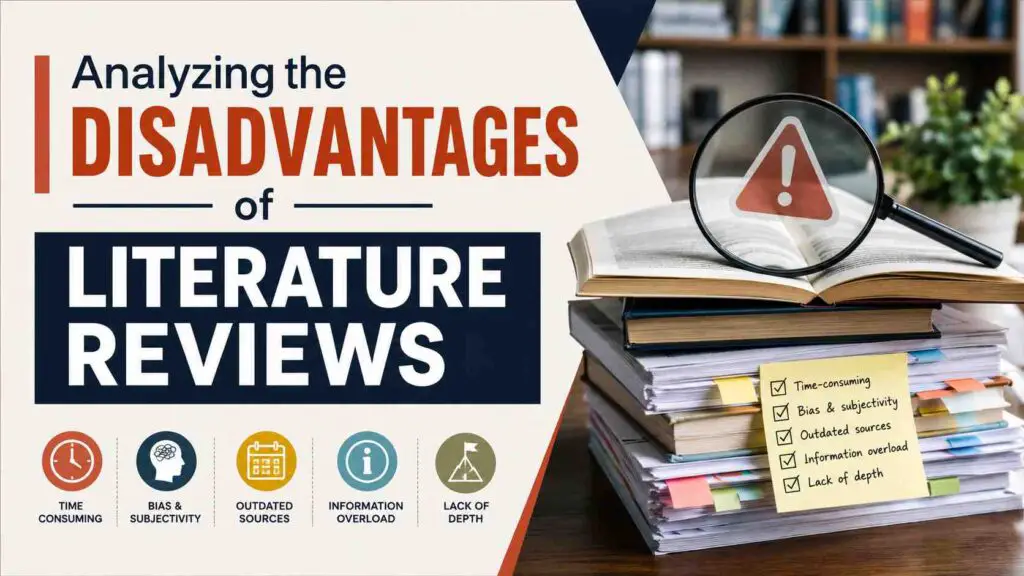
However, despite their importance, literature reviews are not without limitations. Researchers often face several challenges when conducting and relying on literature reviews. These disadvantages can affect the quality, accuracy, and usefulness of the research process. Understanding these drawbacks helps researchers approach literature reviews more critically and effectively.
What is a Literature Review?
A literature review is a systematic examination and evaluation of existing research, publications, books, and scholarly articles related to a specific topic. Its purpose is to summarize current knowledge, identify trends, compare findings, and highlight areas where further research is needed.
Researchers use literature reviews to gain a comprehensive understanding of a subject before conducting their own studies. By reviewing previous work, they can avoid duplicating existing research, refine their research questions, and build upon established findings.
Literature reviews can be broad or highly focused, depending on the objectives of the study. They may include qualitative analyses, quantitative assessments, or a combination of both. Regardless of the approach, literature reviews serve as a critical bridge between existing knowledge and new research contributions.
The Disadvantages of Literature Reviews
#1. Time-Consuming Process
One of the most significant disadvantages of literature reviews is the amount of time they require. Researchers often need to search through hundreds or even thousands of sources to find relevant studies.
The process involves locating articles, evaluating their quality, reading extensive material, and synthesizing findings into a coherent narrative. For large or complex topics, this can take weeks or even months. As a result, literature reviews can delay the overall research timeline and consume valuable resources.
#2. Risk of Selection Bias
Selection bias can occur when researchers unintentionally choose studies that support their existing beliefs or hypotheses. Since researchers decide which sources to include and exclude, personal preferences can influence the final review.
Even when researchers strive for objectivity, unconscious bias may affect their decisions. Consequently, the literature review may present an incomplete or skewed picture of the available evidence, reducing its reliability.
#3. Dependence on Available Research
A literature review can only analyze research that already exists. If few studies have been conducted on a topic, the review may provide limited insights.
This limitation becomes especially problematic in emerging fields where research is still developing. In such cases, researchers may struggle to draw meaningful conclusions because there is insufficient evidence available for analysis.
#4. Possibility of Outdated Information
Research fields evolve rapidly. New discoveries, technologies, and methodologies continuously reshape existing knowledge.
A literature review may quickly become outdated if significant studies are published after the review has been completed. As a result, readers may miss important developments that could change the interpretation of previous findings.
#5. Information Overload
Researchers often encounter an overwhelming amount of information during the review process. Popular topics may have thousands of published articles, making it difficult to determine which sources are most relevant.
Sorting through large volumes of literature can be mentally exhausting. Moreover, important studies may be overlooked simply because of the sheer quantity of available information.
#6. Variations in Study Quality
Not all research studies are created equal. Some studies use rigorous methodologies, while others may have significant flaws.
A literature review that includes low-quality studies can lead to inaccurate conclusions. Researchers must spend considerable time evaluating the credibility, validity, and reliability of each source. Even then, assessing study quality can be challenging, particularly when methodologies vary widely.
#7. Conflicting Findings
Many research topics contain studies that produce contradictory results. One study may support a particular conclusion, while another may reach the opposite outcome.
These inconsistencies can make it difficult for researchers to identify clear patterns or draw definitive conclusions. As a result, literature reviews sometimes highlight uncertainty rather than providing concrete answers.
#8. Limited Original Contribution
A literature review primarily focuses on existing research rather than generating new data. While it can offer valuable insights and synthesize information, it does not typically produce original findings.
Because of this limitation, some researchers may view literature reviews as less innovative than empirical studies. The value of the review depends largely on the quality of its analysis and interpretation rather than on new discoveries.
#9. Access Restrictions to Sources
Many scholarly articles are published behind paywalls or require institutional access. Researchers without access to academic databases may struggle to obtain important sources.
These restrictions can limit the comprehensiveness of a literature review. Consequently, researchers may be forced to rely on freely available studies, which may not fully represent the existing body of knowledge.
#10. Challenges in Synthesizing Diverse Evidence
Research studies often use different methodologies, sample populations, and measurement techniques. Combining findings from such diverse sources can be difficult.
Researchers must carefully interpret differences and determine how various studies relate to one another. This process requires significant analytical skill and can sometimes result in oversimplification or misinterpretation of complex evidence.
#11. Potential for Publication Bias
Publication bias occurs when studies with positive or statistically significant results are more likely to be published than studies with negative or inconclusive outcomes.
As a result, literature reviews may reflect only part of the available evidence. This imbalance can create a misleading impression about the strength or consistency of research findings.
#12. Difficulty Maintaining Objectivity
Researchers often develop opinions about a topic as they read more literature. While expertise is valuable, it can also make maintaining complete objectivity difficult.
Personal interpretations may influence how studies are summarized, compared, and discussed. Therefore, literature reviews can sometimes reflect the perspective of the reviewer rather than a purely neutral assessment of the evidence.
Closing Thoughts
Literature reviews remain an essential component of academic research because they provide valuable context, identify research gaps, and help researchers build upon existing knowledge. However, they also come with several disadvantages that should not be overlooked.
Challenges such as time requirements, selection bias, information overload, conflicting findings, and publication bias can affect the quality and usefulness of a literature review. Additionally, access restrictions and the rapid pace of new research can further complicate the process.
By recognizing these limitations, researchers can take steps to minimize their impact. A critical and systematic approach helps ensure that literature reviews remain reliable tools for understanding the current state of knowledge while supporting future research efforts.