
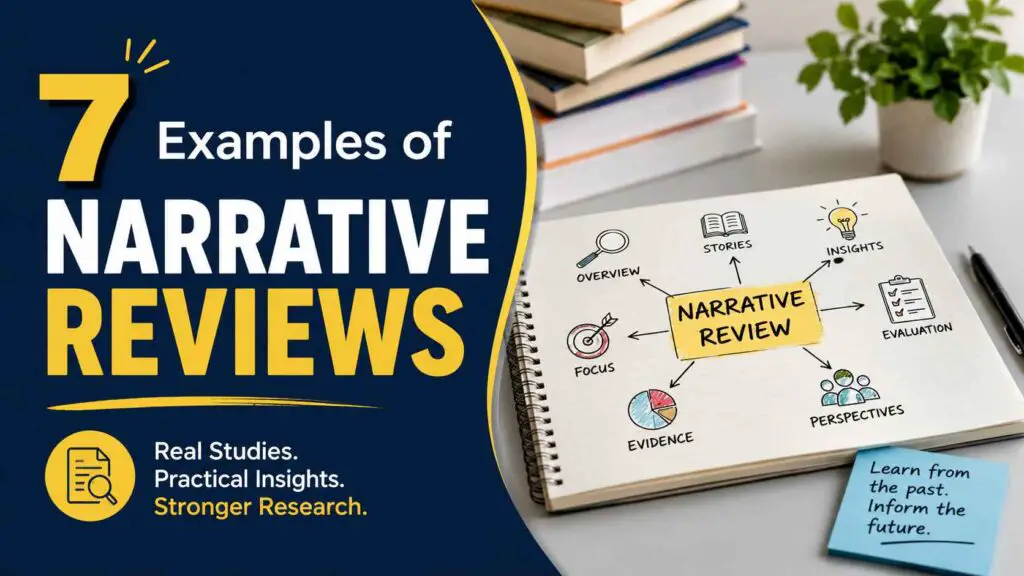
Narrative reviews are one of the most common forms of academic writing. They help readers understand a topic by summarizing, explaining, and interpreting existing research. Unlike systematic reviews, narrative reviews do not always follow a strict search method. Instead, they give the writer more room to discuss ideas, compare findings, and explain the broader meaning of the literature.
A good narrative review does more than list studies. It tells a clear story. It shows what researchers have already discovered, where they disagree, and what questions still remain. That is why students, researchers, healthcare professionals, and academic writers often use narrative reviews to explore complex topics.
Many people look for narrative review examples in PDF format because examples make the structure easier to understand. By studying completed samples, writers can see how introductions are framed, how literature is organized, and how conclusions are written.
7 Examples of Narrative Reviews
#1. Narrative Review on Mental Health
A narrative review on mental health usually explores research related to depression, anxiety, stress, trauma, or emotional well-being. This type of review may discuss causes, symptoms, risk factors, treatment methods, and social influences.
For example, a narrative review on adolescent depression may examine studies about family pressure, social media use, academic stress, sleep problems, and therapy options. The writer may not follow a strict systematic review method. However, they still need to present the literature in a clear and balanced way.
This type of narrative review works well because mental health topics are broad. The writer can connect medical research, psychological theories, and social factors into one readable discussion.
#2. Narrative Review on Nursing Practice
A nursing narrative review often focuses on patient care, clinical decision-making, hospital safety, or nursing education. It helps nurses understand what current literature says about a specific care issue.
For instance, a review may explore nurse burnout in intensive care units. The article may discuss workload, emotional exhaustion, staffing shortages, leadership support, and coping strategies.
This example is useful because it shows how narrative reviews can support professional practice. Instead of only summarizing research, the writer explains how the findings matter in real healthcare settings.
#3. Narrative Review on Education
Narrative reviews are also common in education. These reviews may cover teaching methods, student motivation, classroom technology, inclusive education, or online learning.
A narrative review on online learning, for example, may compare research on student engagement, digital tools, teacher feedback, and learning outcomes. The writer can organize the discussion by themes instead of presenting each study one by one.
This type of review helps readers see the bigger picture. It explains how different studies connect and what educators can learn from them.
#4. Narrative Review on Public Health
A public health narrative review may examine topics such as vaccination, obesity, smoking prevention, nutrition, disease control, or community health programs.
For example, a review on childhood obesity may discuss diet, physical activity, family habits, school programs, advertising, and socioeconomic factors. Since public health problems often have many causes, the narrative review format works especially well.
This example shows how a writer can combine evidence from medicine, sociology, policy, and education. As a result, the review gives readers a broad understanding of the issue.
#5. Narrative Review on Business and Management
Narrative reviews are not limited to health and education. They also appear in business, leadership, management, and organizational studies.
A narrative review on remote work may explore employee productivity, communication challenges, leadership styles, work-life balance, and company culture. The writer may compare different viewpoints and explain how the topic has changed over time.
This kind of review is helpful because business topics often evolve quickly. A narrative approach allows the writer to discuss trends, theories, and practical lessons in a flexible way.
#6. Narrative Review on Technology
A technology narrative review may focus on artificial intelligence, cybersecurity, digital transformation, educational technology, or social media.
For example, a narrative review on artificial intelligence in healthcare may discuss diagnosis, patient monitoring, medical imaging, ethical concerns, and data privacy. The writer can explain both the benefits and the limitations of AI.
This example is strong because technology topics often require explanation, not just summary. The review helps readers understand how the field is developing and why certain debates matter.
#7. Narrative Review on Social Sciences
A social science narrative review may explore topics in sociology, psychology, political science, anthropology, or social work.
For example, a narrative review on social inequality may discuss poverty, education, race, gender, employment, housing, and public policy. The writer may draw from different theories and studies to explain how inequality affects people and communities.
This type of review is valuable because social issues are complex. A narrative review allows the writer to connect research findings with real-world problems and broader social debates.
Closing Thoughts
Narrative reviews are powerful because they make research easier to understand. They do not simply collect information. Instead, they organize ideas, explain patterns, and help readers see the meaning behind the literature.
The best narrative review examples show clear structure, strong explanations, and thoughtful interpretation. They introduce the topic, group the research into themes, discuss important findings, and end with a meaningful conclusion.
For anyone writing a narrative review, PDF examples can be especially helpful. They show how academic writers present research in a polished and readable way. By studying different examples, writers can learn how to build stronger arguments, improve flow, and create a review that feels complete.