
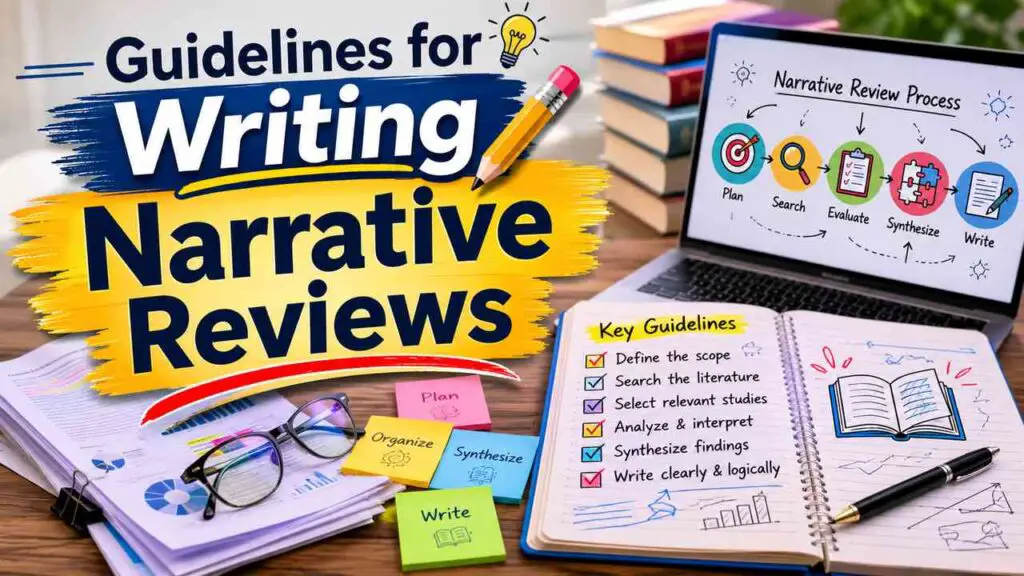
Narrative reviews play an important role in academic writing, professional research, and evidence-based discussion. They help readers understand a topic by bringing together existing ideas, studies, theories, and debates in a clear and meaningful way. Unlike systematic reviews, narrative reviews do not always follow a strict search protocol. Instead, they focus on interpretation, explanation, and synthesis.
That flexibility is useful. However, it also creates a challenge.
A narrative review can easily become too broad, too biased, or too descriptive if the writer does not follow clear guidelines. Therefore, strong planning matters. A good narrative review should have a clear purpose, a logical structure, credible sources, balanced discussion, and thoughtful analysis.
In this article, we will explore practical guidelines for writing narrative reviews that are clear, useful, and academically strong.
Narrative Review Guidelines
#1. Define the Purpose of the Review
Every strong narrative review begins with a clear purpose. Before writing, decide what the review is meant to achieve.
Are you explaining the development of a concept? Are you comparing different theories? Are you summarizing research on a topic? Are you identifying gaps in current knowledge?
This purpose will guide the entire review. It will help you decide which sources to include, which arguments to emphasize, and which areas to leave out.
Without a clear purpose, the review may become a loose summary of unrelated studies. However, with a focused aim, the review becomes easier to read and more valuable to the audience.
#2. Choose a Focused Topic
A narrative review should not try to cover everything. Instead, it should focus on a specific topic, question, problem, or debate.
For example, “mental health” is too broad. A better topic might be “the role of social support in adolescent mental health.” This gives the review a clearer direction.
A focused topic helps you stay organized. It also helps readers understand what they can expect from the review.
#3. Conduct a Careful Literature Search
Even though narrative reviews are more flexible than systematic reviews, they still require careful research.
Use academic databases, books, peer-reviewed journals, and credible professional sources. Look for important studies, influential theories, recent findings, and major debates.
Also, avoid relying only on sources that support one viewpoint. A strong narrative review should include a range of perspectives. This makes the discussion more balanced and trustworthy.
#4. Select Relevant and Credible Sources
Not every source belongs in a narrative review. Choose sources that are directly related to the topic and useful for the argument.
Give priority to peer-reviewed studies, respected scholars, major publications, and current research. However, older sources may also be important if they introduced key theories or shaped the field.
Relevance matters as much as credibility. A high-quality source that does not fit the review’s purpose should be left out.
#5. Organize the Review Logically
A narrative review needs a clear structure. Do not simply discuss sources one after another.
Instead, organize the review by themes, concepts, chronology, theories, methods, or debates. Choose the structure that best fits the topic.
For example, a review can move from early research to recent developments. Alternatively, it can compare different schools of thought. It can also group studies around major themes.
Good organization helps readers follow the argument without confusion.
#6. Synthesize Instead of Summarizing
One of the biggest mistakes in narrative reviews is writing a list of summaries.
A strong review does more than describe what each source says. It connects ideas. It compares findings. It shows patterns. It explains disagreements. It highlights what the literature reveals as a whole.
In other words, synthesis turns separate studies into a meaningful discussion.
Instead of writing, “Study A said this, Study B said that,” explain how the studies relate to each other and what they collectively suggest.
#7. Maintain a Balanced Perspective
A narrative review should not read like an opinion piece. It should present the literature fairly.
This means including different viewpoints, especially when scholars disagree. It also means acknowledging limitations in the research.
Balance does not mean treating every source as equally strong. Some studies may have stronger methods or clearer evidence. However, the writer should explain these differences carefully instead of ignoring opposing views.
#8. Use Clear and Direct Language
Academic writing does not need to be complicated. A good narrative review should be clear, direct, and readable.
Use active voice whenever possible. Avoid unnecessary jargon. Explain complex ideas in simple language. Also, use transition words to guide readers from one point to the next.
Clear writing makes the review more powerful because readers can focus on the ideas instead of struggling with the language.
#9. Identify Gaps in the Literature
A strong narrative review should show what is missing from current knowledge.
Perhaps the research focuses too much on one population. Maybe studies disagree on key findings. Maybe there are few recent studies. Or perhaps an important question remains unanswered.
Identifying gaps gives the review greater value. It shows that the writer is not only reporting existing research but also thinking critically about the field.
#10. End with Meaningful Conclusions
The conclusion should do more than repeat the main points. It should explain what the review shows overall.
Summarize the major insights. Highlight the importance of the topic. Mention key limitations in the literature. Then, suggest possible directions for future research or practice.
A strong ending leaves readers with a clear understanding of why the review matters.
Closing Thoughts
Writing a narrative review requires more than collecting sources and summarizing them. It requires focus, structure, judgment, and critical thinking.
A good narrative review explains the topic clearly. It connects ideas across the literature. It presents different viewpoints fairly. Most importantly, it helps readers understand what is known, what remains uncertain, and why the topic matters.
By following these guidelines, writers can create narrative reviews that are informative, balanced, and useful for academic or professional audiences.