
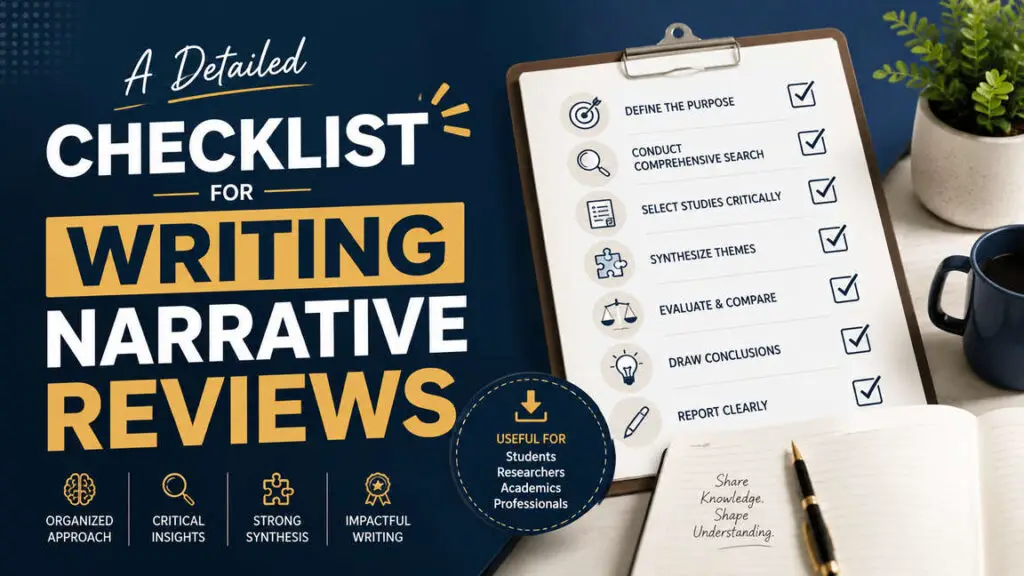
Narrative reviews are useful when a writer wants to explain, interpret, and connect existing research around a topic. Unlike systematic reviews, they do not always follow a rigid search and selection process. However, that does not mean they should be loose, vague, or poorly organized.
A strong narrative review still needs structure. It needs a clear purpose, reliable sources, balanced discussion, and thoughtful interpretation. It should help readers understand what is known, what remains uncertain, and why the topic matters.
Therefore, using a checklist can make the writing process easier and more disciplined. It gives the review direction from the beginning and helps prevent common problems, such as unclear scope, weak evidence, poor organization, or unsupported claims.
Narrative Review Checklist
#1. Define the Purpose of the Review
Start by deciding why the narrative review needs to be written. A clear purpose gives the entire article direction.
Ask what the review should accomplish. Should it explain the history of a topic? Should it compare different theories? Should it summarize current debates? Should it identify gaps in the literature?
Without a clear purpose, the review can become a scattered summary of unrelated studies. However, when the purpose is strong, every section has a reason to exist.
#2. Identify the Target Audience
Next, decide who will read the review. This matters because the audience affects the tone, depth, and language of the article.
For example, a review written for experts can use more technical terms. A review written for students or general readers should explain concepts more clearly.
Also, think about what the audience already knows. Then, build from that point. This makes the review more useful and easier to follow.
#3. Choose a Focused Topic
A narrative review should not try to cover everything. Instead, it should focus on a specific topic, question, theory, issue, or debate.
A broad topic can quickly become overwhelming. For instance, “mental health” is too wide. However, “the role of social support in adolescent mental health” is more focused.
A focused topic helps the writer select better sources, organize ideas more clearly, and avoid unnecessary details.
#4. Set Clear Boundaries
After choosing the topic, define what the review will include and exclude.
Boundaries may involve time periods, populations, regions, theories, disciplines, or types of research. For example, the review may focus only on studies published in the last ten years. It may also focus on adults, children, teachers, nurses, patients, or another specific group.
Clear boundaries keep the review manageable. They also help readers understand the scope of the discussion.
#5. Develop a Guiding Question
A narrative review does not always need a strict research question, but it should still have a guiding question.
This question acts like a compass. It keeps the review from drifting away from its purpose.
For example, the guiding question might be: “How has research explained the relationship between leadership style and employee motivation?” That question gives the review a clear direction.
#6. Search for Relevant Sources
A strong narrative review depends on good sources. Therefore, collect books, journal articles, reports, and other credible materials related to the topic.
Use academic databases, library catalogs, Google Scholar, and trusted institutional sources. Also, look at references inside important articles. This can lead to more useful studies.
Although a narrative review is often more flexible than a systematic review, the search process should still be thoughtful and responsible.
#7. Prioritize High-Quality Evidence
Not every source deserves equal attention. Some studies are stronger, clearer, and more reliable than others.
Give priority to peer-reviewed journal articles, major books in the field, influential theories, landmark studies, and recent research. Be careful with outdated, biased, or weak sources.
Good evidence makes the review more persuasive. It also protects the article from becoming an opinion piece.
#8. Organize the Literature by Themes
Do not simply summarize one source after another. Instead, organize the review around themes, patterns, debates, or developments.
For example, a review might include themes such as historical background, major theories, key findings, conflicting evidence, and future directions.
Thematic organization helps readers see the bigger picture. It also shows that the writer understands the literature, not just individual studies.
#9. Explain Key Concepts Clearly
Every narrative review should define important terms and concepts. This is especially important when the topic includes technical language.
Clear definitions prevent confusion. They also help readers follow the argument from beginning to end.
Do not assume that every reader understands the same terms in the same way. If a concept has multiple meanings, explain how the review will use it.
#10. Summarize the Main Findings
A narrative review should explain what the literature says. Summarize the major findings in a clear and balanced way.
Show where researchers agree. Then, show where they disagree. Also, mention any findings that appear especially strong, surprising, or influential.
However, avoid turning the review into a long list of study summaries. The goal is to synthesize, not just report.
#11. Compare Different Perspectives
Many topics include competing theories, methods, or interpretations. A good narrative review should compare these perspectives fairly.
Explain what each perspective argues. Then, discuss its strengths and weaknesses.
This gives the review depth. It also helps readers understand why the topic may still be debated.
#12. Identify Gaps in the Literature
A useful narrative review should point out what is missing from current research.
Perhaps there are too few studies on a certain group. Perhaps existing studies use weak methods. Perhaps researchers have ignored a particular region, theory, or practical problem.
Identifying gaps shows critical thinking. It also gives the review a stronger conclusion because it points toward future research.
#13. Maintain a Logical Flow
The review should move smoothly from one idea to the next. Each section should connect naturally to the previous one.
Use transition words and phrases such as “therefore,” “however,” “in addition,” “as a result,” and “on the other hand.” These help readers follow the argument.
Good flow matters because even strong research can feel confusing when the structure is weak.
#14. Use Critical Analysis
A narrative review should not only describe sources. It should also analyze them.
Ask questions such as: Which studies are most convincing? Which arguments are weak? Which findings appear consistent? Which claims need more evidence?
Critical analysis gives the review authority. It shows that the writer is not just repeating information but evaluating it carefully.
#15. Avoid Bias
Because narrative reviews are flexible, they can easily become biased. Writers may choose sources that support only one side of the issue.
To avoid this, include different viewpoints. Discuss conflicting evidence. Acknowledge limitations.
Balanced writing builds trust. It shows readers that the review is fair, not selective.
#16. Cite Sources Properly
Every claim based on research should be supported with a citation. This gives credit to original authors and allows readers to check the evidence.
Use the required citation style, such as APA, MLA, Chicago, or another academic format. Be consistent throughout the article.
Accurate citations also make the review look professional and credible.
#17. Write in a Clear Academic Style
A narrative review should sound informed, but it should not be unnecessarily complicated.
Use direct sentences. Prefer active voice. Avoid vague phrases. Explain difficult ideas in a simple and precise way.
Strong academic writing is clear, not confusing. It helps readers understand complex ideas without struggling through heavy language.
#18. Connect the Review to Its Larger Importance
A strong review explains why the topic matters. Do not only summarize research. Show its wider meaning.
Explain how the topic affects theory, practice, policy, education, healthcare, business, or society. This gives the review relevance.
Readers should finish the article understanding not only what the literature says, but also why it matters.
#19. Review the Structure Before Editing
Before editing sentences, look at the overall structure. Check whether the sections appear in the right order.
Ask whether the review has a clear beginning, middle, and end. Also, check whether each section supports the main purpose.
Structural editing should come before line editing. Otherwise, time may be wasted polishing paragraphs that later need to be removed.
#20. Revise for Clarity and Strength
Finally, revise the review carefully. Remove repetition. Strengthen weak transitions. Clarify vague points. Check grammar, spelling, citations, and formatting.
Also, make sure the conclusion matches the purpose of the review. The final version should feel complete, focused, and useful.
A polished narrative review does more than present information. It guides readers through a topic with confidence and insight.
Closing Thoughts
Writing a narrative review requires more than collecting sources and summarizing them. It requires purpose, structure, judgment, and careful explanation.
A checklist makes the process easier. It helps writers stay focused, evaluate evidence, organize ideas, and present the literature in a meaningful way.
Ultimately, a strong narrative review helps readers understand a topic more deeply. It explains where the field has been, where it stands now, and where it may need to go next.