
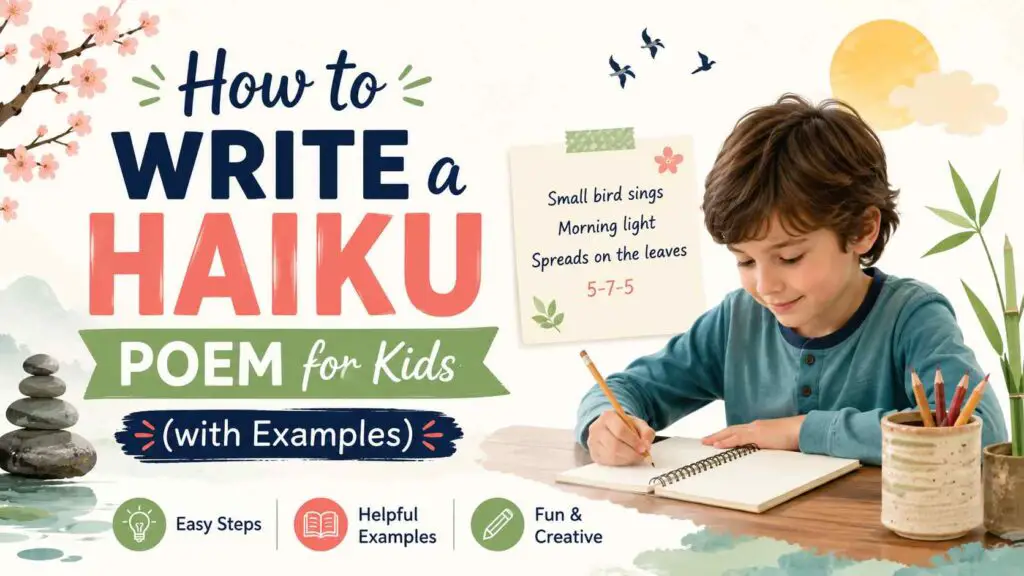
Learning how to write a haiku poem can be fun, simple, and creative for kids. A haiku is short, but it can say a lot. It helps children notice nature, seasons, animals, weather, and small moments around them.
Because haiku poems are only three lines long, kids can write them without feeling overwhelmed. However, a good haiku still needs careful thinking. Every word matters.
In this guide, we will look at what a haiku poem is, what to include in a haiku poem for kids, and how children can write their own haiku step by step.
What is a Haiku Poem?
A haiku poem is a short poem that comes from Japan. It usually has three lines.
The traditional haiku pattern is:
- Line 1: 5 syllables
- Line 2: 7 syllables
- Line 3: 5 syllables
This is called the 5-7-5 pattern.
A haiku often focuses on nature. It may describe a bird, tree, flower, river, snowflake, sunny day, or rainy afternoon. It usually captures one small moment.
For example:
Soft rain on the leaves
Tiny frogs jump through puddles
Spring sings in the grass
This haiku talks about rain, frogs, and spring. It paints a small picture using only a few words.
What to Include in a Haiku Poem for Kids
A Nature Theme
Most haiku poems are about nature. Kids can write about flowers, clouds, insects, animals, trees, seasons, or the weather.
For example, they might write about:
- A butterfly landing on a flower
- Snow falling on the ground
- A bird singing in the morning
- Leaves blowing in the wind
A nature theme gives the poem a clear focus.
A Small Moment
A haiku does not need to tell a big story. Instead, it should capture one small moment.
For example:
A squirrel climbing a tree
A raindrop sliding down a window
A bee buzzing near a flower
Small moments work well because haiku poems are short.
Simple Words
Kids should use clear and simple words. A haiku does not need big or difficult vocabulary.
Simple words can still create a strong picture.
For example:
Golden sun rises
Birds chirp softly in the trees
Morning wakes the world
The words are easy, but the image is clear.
The 5-7-5 Syllable Pattern
A traditional haiku has 17 syllables in total.
The pattern is:
Line 1: 5 syllables
Line 2: 7 syllables
Line 3: 5 syllables
Kids can clap the syllables to count them.
For example:
Cold snowflakes falling
White blankets cover the ground
Winter whispers soft
A Feeling or Mood
A haiku can make the reader feel calm, happy, curious, peaceful, or excited.
For example, a haiku about sunshine may feel cheerful. A haiku about snow may feel quiet. A haiku about thunder may feel powerful.
The feeling does not need to be explained. The words should help the reader feel it.
How to Write a Haiku Poem for Kids with Examples
#1. Choose a Nature Topic
First, choose something from nature. Pick one thing to write about.
Good topics include:
- Rain
- Snow
- Flowers
- Birds
- Butterflies
- Trees
- The moon
- The ocean
- Autumn leaves
For example, a child might choose “butterfly” as the topic.
#2. Notice the Details
Next, think carefully about the topic. What does it look like? What does it do? What sounds, colors, or movements come with it?
For a butterfly, a child might notice:
- It has colorful wings
- It flies gently
- It lands on flowers
- It moves quietly
These details help the poem feel real.
#3. Pick One Small Moment
Then, choose one small moment to describe.
Instead of writing about everything butterflies do, focus on one scene.
For example:
A butterfly lands on a flower.
That is enough for a haiku.
#4. Write Three Lines
Now, write the poem in three lines. Do not worry about making it perfect at first.
Example draft:
A butterfly flies
It lands on a pink flower
Then it flies away
This already sounds like a haiku. Next, the child can count the syllables.
#5. Count the Syllables
Now, check the 5-7-5 pattern.
A but-ter-fly flies = 5 syllables
It lands on a pink flow-er = 7 syllables
Then it flies a-way = 5 syllables
So the poem works.
Final haiku:
A butterfly flies
It lands on a pink flower
Then it flies away
#6. Make the Words More Colorful
After the first draft, kids can improve the poem by adding stronger details.
Instead of:
A butterfly flies
They might write:
Bright butterfly glides
This gives the poem more beauty and movement.
Example:
Bright butterfly glides
It rests on a pink flower
Then dances away
#7. Read the Haiku Aloud
Finally, read the poem out loud. This helps kids hear the rhythm.
If a line sounds too long or too short, they can change a word.
Reading aloud also helps children enjoy their poem. A haiku should feel smooth, simple, and complete.
Sample Haiku Poems for Kids
Spring Morning
Warm sunlight peeking
Birds sing high among branches
Flowers start to bloom
Snowy Day
Soft snowflakes drifting
White blankets cover the fields
Winter feels so still
Butterfly Dance
Bright butterfly glides
Over colorful flowers
Dancing with the breeze
Rainy Afternoon
Raindrops tap softly
Puddles shimmer on the path
Clouds drift slowly by
Ocean Waves
Blue waves roll ashore
Seagulls circle in the sky
Salt air fills the breeze
Closing Thoughts
A haiku poem is a wonderful way for kids to explore poetry. It is short, creative, and easy to understand. It also teaches children to observe the world closely.
To write a haiku, kids only need to choose a nature topic, notice small details, follow the 5-7-5 syllable pattern, and describe one special moment.
With practice, children can turn simple things like rain, flowers, birds, or sunshine into beautiful little poems.