
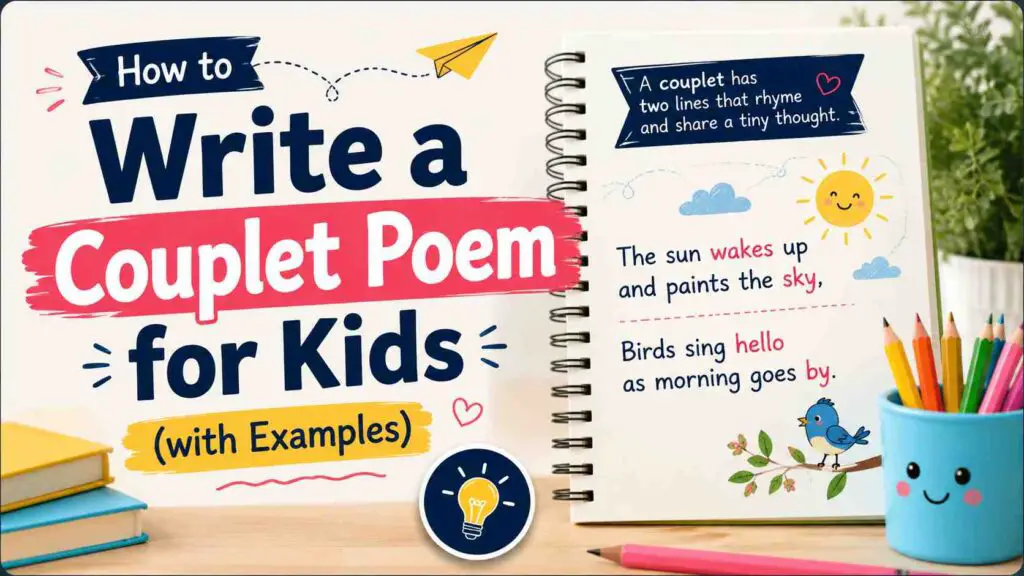
A couplet poem is one of the easiest poetry forms for children to learn. It is short, simple, and fun. Because it often uses rhyme, kids can quickly understand how the poem works and enjoy creating their own lines.
A couplet poem also helps children build confidence with words. They learn rhythm. They practice rhyme. Most importantly, they discover that poetry does not have to feel difficult or scary.
What is a Couplet Poem?
A couplet poem is a poem made of two lines. These two lines usually go together and often rhyme at the end.
For example:
The sun is bright, the sky is blue,
I love the day when I’m with you.
In this example, the words “blue” and “you” rhyme. The two lines also share one complete idea.
A couplet can stand alone as a short poem. However, several couplets can also be joined together to make a longer poem. This makes couplets a great starting point for kids who are learning how poetry works.
What to Include in a Couplet Poem for Kids
A Simple Topic
A good couplet poem for kids should begin with a simple topic. Children can write about animals, school, family, seasons, toys, food, or nature.
For example, a child might write about a cat, a rainy day, or a favorite snack. Simple topics help kids focus on the poem instead of struggling for ideas.
Two Connected Lines
A couplet poem must have two lines that belong together. The lines should talk about the same idea, scene, or feeling.
For example:
My puppy jumps and loves to play,
He chases butterflies all day.
Both lines are about the puppy. That makes the couplet clear and easy to understand.
Rhyming Words
Most couplet poems for kids use rhyme. The rhyming words usually come at the end of each line.
For example:
The little bird began to sing,
It flapped its wings and welcomed spring.
The words “sing” and “spring” rhyme. This gives the poem a musical sound.
Clear Language
Children’s couplet poems should use simple and clear language. The goal is not to sound fancy. The goal is to express an idea in a fun way.
Short words and familiar images work best. Kids should be able to read the poem aloud without getting confused.
A Fun or Meaningful Idea
A couplet poem can be funny, sweet, thoughtful, or imaginative. It should give the reader something to picture or feel.
For example, a poem about a frog jumping in the rain can be playful. A poem about helping a friend can be meaningful. Either way, the poem should have a small but clear idea.
How to Write a Couplet Poem for Kids
#1. Choose a Simple Topic
First, choose something easy to write about. Kids can pick a person, place, animal, object, or feeling.
Good topics include:
- A dog
- A rainbow
- A birthday
- A favorite toy
- A sunny day
- A funny monster
- A best friend
The topic should be something the child already understands. This makes writing easier and more natural.
For example, if the topic is “a rabbit,” the child can think about what rabbits do. They hop. They eat carrots. They have long ears. These details can become poem ideas.
#2. Think of Words About the Topic
Next, list words connected to the topic. This gives kids material to use in the poem.
For a rabbit, the word list might include:
- hop
- carrot
- ears
- soft
- grass
- fast
This step helps children avoid feeling stuck. Once they have a few words, they can start shaping their ideas into lines.
#3. Find Rhyming Words
After that, choose rhyming words that could fit the poem. Kids can start with easy rhymes.
For example:
- cat / hat
- sun / fun
- play / day
- light / bright
- blue / too
- run / done
Rhyming does not need to be perfect at first. The goal is to help children hear sounds and enjoy playing with language.
#4. Write the First Line
Now write the first line of the couplet. This line should introduce the idea.
For example:
My rabbit hops across the grass,
This line gives the reader a clear picture. It shows the rabbit doing something.
#5. Write the Second Line with a Rhyme
Next, write the second line. Try to end it with a word that rhymes with the last word of the first line.
For example:
My rabbit hops across the grass,
He moves so quickly as I pass.
The words “grass” and “pass” rhyme. The two lines also stay connected.
#6. Read the Couplet Aloud
Then, read the couplet out loud. This helps kids hear the rhythm and rhyme.
Ask simple questions:
Does it sound smooth?
Do the ending words rhyme?
Do both lines talk about the same idea?
Reading aloud is important because poetry is meant to be heard. If a line sounds awkward, the child can change a word or shorten the sentence.
#7. Make the Poem Clearer
After reading the poem, revise it. Kids can replace confusing words, fix the rhyme, or make the image stronger.
For example, this line is okay:
The dog is nice and likes the day,
But this line is more specific:
My happy dog runs out to play,
Specific words make the poem more interesting.
#8. Add More Couplets if Desired
A couplet poem can be only two lines. However, kids can also write several couplets to create a longer poem.
For example:
My happy dog runs out to play,
He barks and jumps throughout the day.
He rolls around upon the ground,
Then chases every funny sound.
Each pair of lines is a couplet. Together, they make a longer poem.
Sample Couplet Poems for Kids
Happy Puppy
My puppy loves to run and play,
He wags his tail throughout the day.
Bright Rainbow
A rainbow stretches in the sky,
Its colors shine so bold and high.
Busy Bee
A little bee flies near a flower,
It gathers nectar every hour.
Snowy Day
Soft snowflakes gently fall to the ground,
They cover rooftops all around.
Best Friend
My best friend always makes me smile,
We laugh and talk for quite a while.
Closing Thoughts
Writing a couplet poem is a simple and enjoyable way to introduce kids to poetry. It teaches rhyme, rhythm, word choice, and creative thinking without overwhelming them.
Start with an easy topic. Choose a few rhyming words. Then write two connected lines. With practice, children can turn everyday ideas into fun, memorable poems.
A couplet may be short, but it can still be full of imagination.