
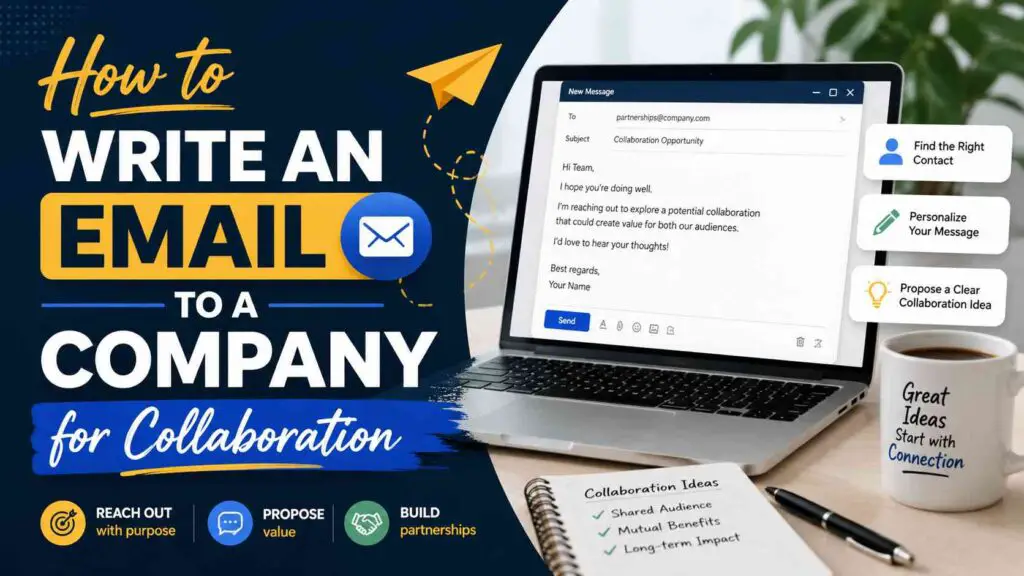
Writing an email to a company for collaboration can feel intimidating at first. You may know what you want to say, but turning that idea into a clear, professional, and persuasive message is not always easy.
A good collaboration email should do more than introduce yourself. It should show the company why the partnership makes sense, what value you bring, and what action you want them to take next.
Whether you are a blogger, influencer, business owner, freelancer, nonprofit leader, or brand representative, your email needs to be direct, respectful, and easy to understand. Companies receive many messages every day. So, your email must quickly answer one important question: why should they care?
In this guide, we will look at what to include in an email to a company for collaboration and how to write one step by step.
What to Include in an Email to a Company for Collaboration
A Clear Subject Line
Your subject line is the first thing the company will see. Therefore, it should be simple, specific, and professional.
Avoid vague subject lines like “Hello” or “Collaboration.” Instead, make the purpose clear.
For example:
“Collaboration Proposal with [Your Brand Name]”
“Partnership Opportunity for [Company Name]”
“Content Collaboration Idea for [Company Name]”
A clear subject line increases the chance that your email will be opened.
A Professional Greeting
Start your email with a polite greeting. If possible, use the person’s name. This makes the email feel more personal and less generic.
For example:
“Dear Sarah,”
“Hello Mr. Johnson,”
“Hi Marketing Team,”
If you do not know the person’s name, you can use a general greeting such as “Hello [Company Name] Team.”
A Brief Introduction
Next, introduce yourself clearly. Mention who you are, what you do, and why you are reaching out.
Keep this section short. The goal is not to tell your whole story. Instead, give the company enough context to understand who is contacting them.
For example, you can mention your website, business, social media platform, audience, or area of expertise.
The Reason for Collaboration
After introducing yourself, explain why you want to collaborate with that specific company.
This part is very important. Companies want to know that you have chosen them intentionally. So, mention something relevant about their brand, product, values, audience, or recent work.
This shows that your email is not a copied message sent to hundreds of companies.
The Value You Offer
A collaboration email should not focus only on what you want. It should also explain what the company will gain.
You may offer exposure, content creation, access to your audience, industry expertise, product promotion, backlinks, event support, or a joint campaign.
Be specific. Instead of saying, “I can help promote your brand,” explain how.
For example:
“I can feature your product in a detailed blog post for an audience interested in sustainable living.”
This makes your offer stronger and easier to evaluate.
A Specific Collaboration Idea
Companies are more likely to respond when your proposal is clear. Therefore, include a specific idea for the collaboration.
For example, you may suggest:
- A sponsored blog post
- A social media campaign
- A product review
- A giveaway
- A podcast interview
- A joint webinar
- A guest post exchange
- A brand partnership
A clear idea helps the company understand what you are proposing and how the collaboration might work.
Relevant Proof or Credentials
You should also include proof that you can deliver value. This may include your website traffic, social media following, email list size, audience demographics, past collaborations, testimonials, portfolio, or professional experience.
However, do not overwhelm the reader with too many details. Choose the most relevant proof.
For example:
“My website receives 40,000 monthly visitors, mainly from small business owners and marketing professionals.”
This kind of detail makes your proposal more credible.
A Clear Call to Action
End your email by telling the company what you want them to do next.
You can ask if they are open to discussing the idea, scheduling a call, reviewing your proposal, or receiving more details.
For example:
“Would you be open to discussing this collaboration further?”
This makes it easier for the company to respond.
A Polite Closing
Close your email professionally. Thank the reader for their time and include your contact details.
You can use closings such as:
“Best regards,”
“Kind regards,”
“Sincerely,”
“Thank you,”
A polite closing leaves a positive final impression.
How to Write an Email to a Company for Collaboration
#1. Research the Company First
Before writing the email, research the company carefully. Visit their website, read about their products or services, and check their social media pages.
This step matters because a strong collaboration email should feel personal. If your message sounds generic, the company may ignore it.
Look for details such as their target audience, brand values, recent campaigns, content style, and current partnerships. Then, use this information to shape your message.
For example, if the company focuses on eco-friendly products, you can explain how your audience is interested in sustainable living. This creates a natural connection between your platform and their brand.
#2. Find the Right Contact Person
Next, try to find the best person to contact. This may be someone from marketing, partnerships, public relations, influencer relations, or business development.
Sending your email to the right person increases your chances of getting a reply.
You can check the company website, LinkedIn, press pages, or contact page. If you cannot find a specific person, you can still email the general company address. However, a named contact is usually better.
#3. Write a Strong Subject Line
Your subject line should tell the reader what the email is about. Keep it short and professional.
A good subject line might be:
“Collaboration Proposal for [Company Name]”
“Partnership Opportunity with [Your Brand Name]”
“Brand Collaboration Idea for [Company Name]”
Avoid sounding too pushy or unclear. The goal is to make the company curious enough to open the email.
#4. Start with a Personal Greeting
Begin with a respectful greeting. If you know the person’s name, use it.
For example:
“Hi Amanda,”
“Dear Mr. Lewis,”
“Hello Partnership Team,”
This small detail helps your email feel more thoughtful. It also shows that you made an effort to contact the right person.
#5. Introduce Yourself Briefly
After the greeting, explain who you are. Keep your introduction short and relevant.
Mention your name, your brand or business, and what you do. If useful, include one strong detail that helps establish credibility.
For example:
“My name is Daniel, and I run a food blog that helps busy families find simple, healthy meal ideas.”
This tells the company who you are and why your message may be relevant.
#6. Explain Why You Are Contacting Them
Now, clearly state why you are reaching out. Mention that you are interested in a possible collaboration.
Also, explain why their company caught your attention. This could be because of their products, mission, audience, or reputation.
For example:
“I have followed your brand for some time and appreciate your focus on practical, eco-friendly home products.”
This makes your message more personal and shows genuine interest.
#7. Present Your Collaboration Idea
Then, describe your collaboration idea. Be clear and specific.
Instead of simply saying, “I would like to collaborate,” explain what kind of collaboration you have in mind.
For example:
“I would love to create a detailed product review and feature your product in an upcoming blog post about sustainable home essentials.”
This helps the company quickly understand the opportunity.
#8. Highlight the Benefit for the Company
After presenting your idea, explain how the company will benefit.
This is one of the most important parts of the email. Companies are more likely to respond when they see a clear value.
You may mention exposure to a relevant audience, content creation, increased brand awareness, website traffic, leads, sales, or community engagement.
For example:
“This collaboration would introduce your product to an audience already interested in practical and sustainable home solutions.”
This connects your offer directly to their business goals.
#9. Add Proof of Your Value
Next, include evidence that supports your proposal.
Depending on your situation, you can mention website traffic, social media engagement, email subscribers, audience demographics, previous partnerships, professional experience, or examples of your work.
For example:
“My blog receives over 25,000 monthly visitors, and most of my readers are women between 25 and 45 who are interested in home organization and simple living.”
This helps the company understand the reach and relevance of your platform.
#10. Keep the Email Short and Focused
A collaboration email should be complete, but it should not be too long. Busy professionals may not read a long message.
Use short paragraphs. Avoid unnecessary details. Stay focused on the main purpose of the email.
Your email should answer these questions:
- Who are you?
- Why are you contacting them?
- What collaboration are you proposing?
- What value can you offer?
- What should they do next?
If your email answers these questions clearly, it is strong enough to send.
#11. End with a Clear Call to Action
Before closing the email, ask for a response. Make your next step simple.
For example:
“Would you be open to discussing this collaboration further?”
“May I send over a more detailed proposal?”
“Would this be something your team is interested in exploring?”
A clear call to action makes it easier for the company to reply.
#12. Proofread Before Sending
Finally, proofread your email carefully. Check for spelling mistakes, grammar errors, unclear sentences, and incorrect company names.
This step is simple, but it matters. A poorly written email can make you seem careless or unprofessional.
Also, make sure your contact information is included. If you have a website, portfolio, media kit, or social profile, add the most relevant link.
Sample Emails to Companies for Collaboration
Collaboration Proposal from a Blogger
Subject: Collaboration Opportunity with [Company Name]
Dear [Name],
My name is [Your Name], and I run [Blog Name], a website focused on [Topic]. I have been following your company for some time and appreciate the quality of your products and the value you provide to your customers.
I am reaching out to explore a potential collaboration. I believe your products would be a great fit for my audience, and I would love to feature them in an upcoming blog post and social media campaign.
My website receives approximately [Number] monthly visitors, and my audience consists primarily of [Target Audience]. I believe this partnership could help introduce your brand to a highly relevant group of potential customers.
If this sounds interesting, I would be happy to discuss ideas in more detail.
Thank you for your time and consideration.
Kind regards,
[Your Name]
[Website]
[Email Address]
Social Media Influencer Collaboration Request
Subject: Brand Partnership Opportunity
Hello [Name],
I hope you are doing well.
My name is [Your Name], and I create content for an audience of [Audience Description] across platforms including [Platform Names]. I recently came across your brand and was impressed by your commitment to [Specific Quality or Value].
I would love to collaborate with your company through sponsored content, product reviews, and social media promotion. I believe my audience would find your products highly relevant and engaging.
Currently, I have over [Number] followers and maintain strong engagement rates across my content. I would be happy to share additional audience insights if needed.
Please let me know if your team would be interested in discussing a potential partnership.
Thank you for your consideration.
Best regards,
[Your Name]
[Social Media Links]
[Email Address]
Business-to-Business Collaboration Email
Subject: Partnership Opportunity Between Our Companies
Dear [Name],
My name is [Your Name], and I am the founder of [Company Name]. We specialize in [Industry or Service].
I am reaching out because I believe there may be an opportunity for our organizations to collaborate in a way that benefits both companies. Our businesses serve similar audiences, and I see potential for a mutually beneficial partnership.
Some possible areas of collaboration include joint marketing initiatives, co-created content, webinars, and cross-promotional opportunities.
I would welcome the opportunity to discuss ideas and explore whether there is a good fit between our organizations.
Thank you for your time. I look forward to hearing from you.
Sincerely,
[Your Name]
[Company Name]
[Contact Information]
Product Review Collaboration Email
Subject: Product Review Collaboration Inquiry
Hello [Name],
I hope this email finds you well.
My name is [Your Name], and I create content focused on [Niche]. I recently discovered your products and believe they would be highly relevant to my audience.
I would like to discuss the possibility of reviewing your product on my website and social media channels. My goal would be to provide an honest and detailed review while introducing your brand to readers who are actively interested in products like yours.
My audience consists of [Audience Description], and my platform receives approximately [Number] monthly visitors.
If you are interested, I would be happy to provide additional details about my audience and content strategy.
Thank you for your consideration.
Best regards,
[Your Name]
[Website]
[Contact Information]
Event or Campaign Collaboration Request
Subject: Collaboration Opportunity for Upcoming Campaign
Dear [Name],
My name is [Your Name], and I am currently organizing an upcoming [Event, Campaign, or Project Name].
Because of your company’s reputation and expertise in [Industry], I believe there is a strong opportunity for us to work together on this initiative. I feel that our shared audiences and goals align well and could create significant value for both parties.
Potential collaboration opportunities include sponsorship, content partnerships, promotional activities, or joint participation in campaign-related events.
I would be grateful for the opportunity to discuss this idea further and explore ways we can work together.
Thank you for your time and consideration.
Kind regards,
[Your Name]
[Organization Name]
[Contact Information]
Closing Thoughts
Writing an email to a company for collaboration becomes much easier when you follow a clear structure. Start with research. Then, introduce yourself, explain your idea, show the value you offer, and end with a simple call to action.
The best collaboration emails are professional, personal, and focused. They do not beg for attention. Instead, they present a clear opportunity that benefits both sides.
Before sending your email, ask yourself one question: does this message make it easy for the company to understand why this collaboration is worth considering?
If the answer is yes, your email is ready to send.