
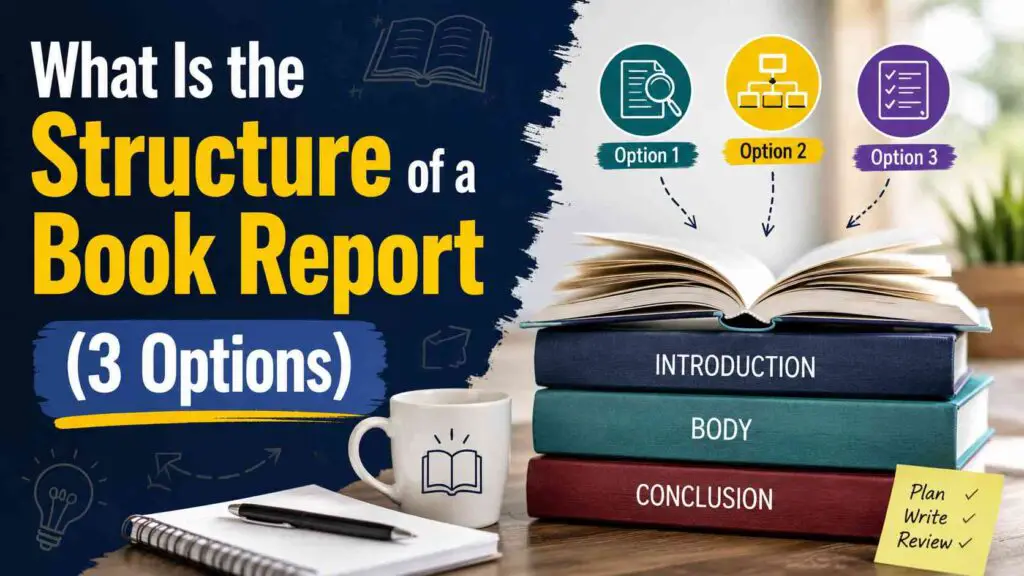
Book reports are a common academic assignment that helps readers demonstrate their understanding of a book. Whether assigned in elementary school, high school, or college, a book report allows students to summarize key details, analyze themes, and share their opinions about what they have read. While there is no single format that every teacher requires, most book reports follow a logical structure that presents information in a clear and organized way. Choosing the right structure can make the writing process easier and help readers follow the report more effectively. Below are three common ways to structure a book report.
Structures of a Book Report: 3 Possibilities
#1. Traditional Summary Structure
Introduction
Begin your book report by introducing the book.
Include:
- The title of the book
- The author’s name
- The genre (fiction, nonfiction, mystery, fantasy, biography, etc.)
- The publication year (if required)
- A brief statement about the book’s main subject or story
Example:
“The Giver” by Lois Lowry is a science fiction novel that explores a society where all choices and emotions are carefully controlled. The story follows a young boy named Jonas as he begins to discover the truth about the world around him.
Body Paragraph 1: Setting
Describe where and when the story takes place.
Consider answering:
- What is the location of the story?
- Is it set in the past, present, or future?
- How does the setting influence the events?
Example Topics to Cover:
- The community where Jonas lives
- The futuristic nature of society
- How the controlled environment affects the characters
Body Paragraph 2: Main Characters
Introduce the important characters.
For each major character, explain:
- Who they are
- Their role in the story
- Their personality traits
- How they change throughout the book
You do not need to describe every character. Focus on the most important ones.
Body Paragraph 3: Plot Summary
Summarize the major events of the book.
A useful approach is to explain:
- The beginning
- The rising action
- The climax
- The resolution
Avoid retelling every detail. Focus on the events that move the story forward.
Body Paragraph 4: Main Conflict
Explain the central problem in the story.
Discuss:
- What challenge the main character faces
- Who or what creates the conflict
- How the conflict develops
- How it is resolved
Conclusion
Finish your report by sharing your thoughts about the book.
Include:
- Whether you enjoyed the book
- What you learned from it
- Who might enjoy reading it
- Whether you would recommend it
This concluding section should summarize your overall impression without introducing new information.
#2. Analytical Structure
Introduction
Begin with basic information about the book and end with an analytical thesis statement.
Include:
- Title
- Author
- Genre
- Brief overview of the book
- Main argument or interpretation
Example Thesis:
Through Jonas’s experiences, Lois Lowry demonstrates the importance of freedom, individuality, and human emotion.
This thesis gives your report a clear focus.
Body Paragraph 1: Theme Analysis
Identify one of the book’s major themes.
Common themes include:
- Friendship
- Courage
- Freedom
- Family
- Identity
- Justice
- Love
Explain:
- What the theme is
- How it appears in the story
- Specific examples that support it
A strong analytical report includes evidence from the text to support each point.
Body Paragraph 2: Character Analysis
Choose one major character and analyze them in depth.
Discuss:
- Their motivations
- Their strengths and weaknesses
- Important decisions they make
- How they develop throughout the story
Instead of merely describing the character, explain why their actions are significant.
Body Paragraph 3: Author’s Purpose and Message
Consider what the author wanted readers to learn or think about.
Questions to answer include:
- Why was this book written?
- What ideas does the author emphasize?
- What lessons can readers learn?
Support your observations with examples from the story.
Body Paragraph 4: Literary Techniques
Analyze how the author tells the story.
You might discuss:
- Symbolism
- Foreshadowing
- Imagery
- Point of view
- Tone
- Dialogue
Explain how these techniques help communicate the book’s themes or messages.
Conclusion
Summarize your analysis.
Include:
- The most important themes
- Your evaluation of the author’s success
- The significance of the book
- The impact it may have on readers
Your conclusion should reinforce your thesis and provide a final assessment of the work.
#3. Question-and-Response Structure
Introduction
Start with basic information about the book.
Include:
- Title
- Author
- Genre
- Brief summary of the story
Keep this section concise since the main report will be organized through questions and answers.
Question 1: Who Are the Main Characters?
Answer by identifying the important characters.
Explain:
- Their roles in the story
- Their relationships with one another
- Important traits and characteristics
Provide enough detail for readers to understand each character’s importance.
Question 2: Where and When Does the Story Take Place?
Describe the setting.
Discuss:
- The location
- The time period
- How the setting influences events
Include details that help readers visualize the story’s environment.
Question 3: What Is the Main Conflict?
Explain the central problem.
Describe:
- The challenge facing the protagonist
- Obstacles encountered
- The importance of the conflict
This section should clearly show what drives the story forward.
Question 4: What Are the Most Important Events?
Summarize the key moments.
Focus on:
- Events that change the direction of the story
- Turning points
- The climax
- The resolution
Avoid listing every event and instead emphasize the most significant ones.
Question 5: What Lesson Does the Book Teach?
Discuss the book’s message.
Consider:
- Moral lessons
- Themes
- Life lessons
- Ideas readers may take away
Support your answer with examples from the story.
Question 6: What Was the Most Interesting Part?
Share your personal response.
Explain:
- Which part stood out
- Why it was memorable
- How it affected your reading experience
This allows you to include your own perspective.
Conclusion
Conclude by summarizing your overall opinion of the book.
Include:
- Whether you enjoyed it
- What you learned
- Who might benefit from reading it
- Whether you recommend it
A brief concluding paragraph helps bring all of your answers together into a complete report.
Closing Thoughts
The structure of a book report can vary depending on the assignment, grade level, and purpose of the report. A traditional summary structure is ideal for presenting the main details of a book, while an analytical structure encourages deeper examination of themes and literary elements. The question-and-response structure offers an easy-to-follow format that helps writers stay organized. By selecting the structure that best matches the assignment requirements, students can create clear, informative, and engaging book reports that effectively communicate their understanding of the book.