
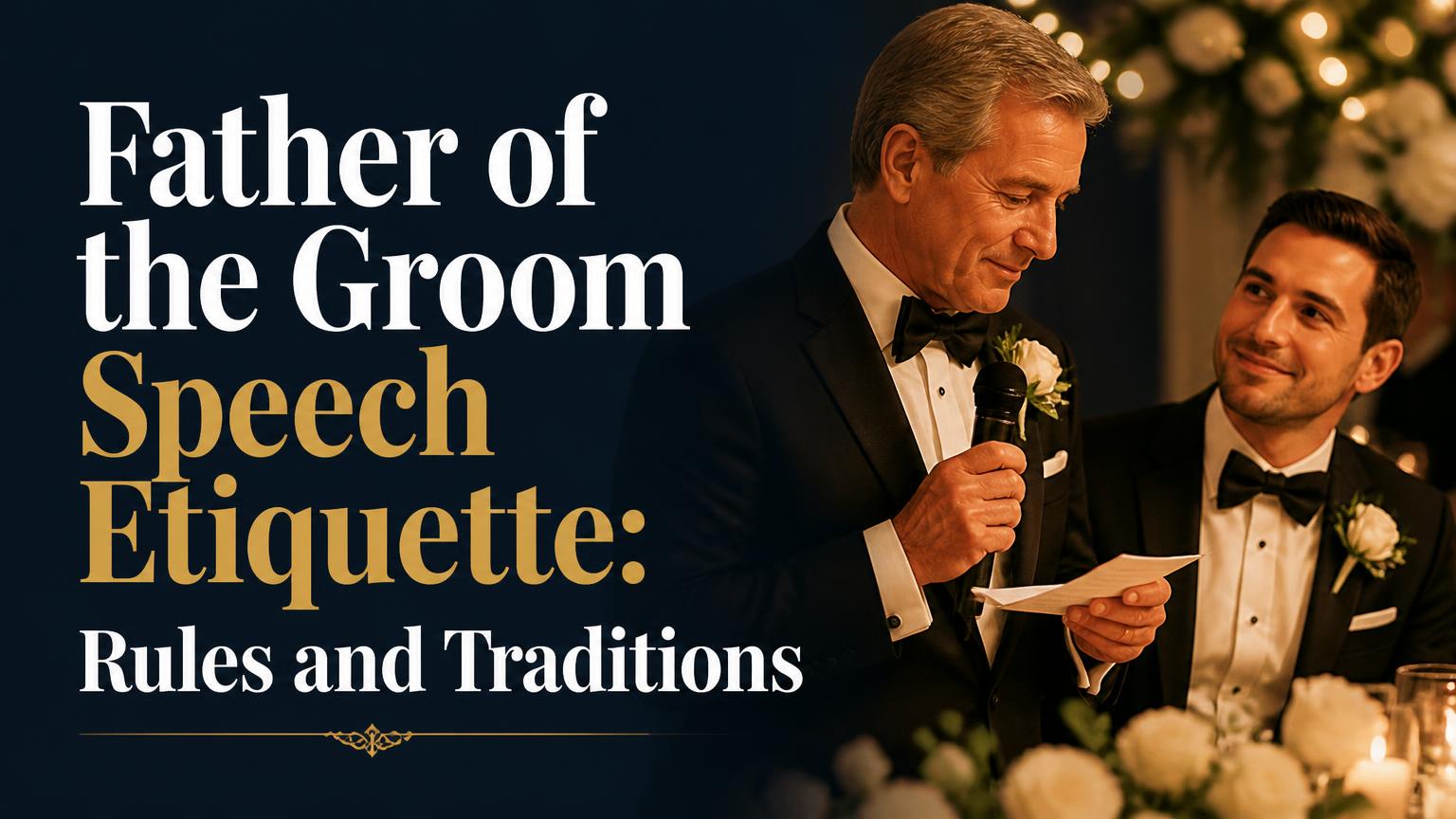
If you are the father of the groom, your wedding speech is usually an opportunity to welcome guests, recognize the couple, share a meaningful perspective on your son, and offer a warm toast to their future. There is no single set of rules that applies to every wedding. Traditions differ by family, culture, religion, venue, and the couple’s preferences. The most reliable etiquette is to coordinate with the couple, keep the speech focused and considerate, and make both partners feel respected.
Father of the Groom Speech Etiquette and Expectations
The father of the groom traditionally gives a warm, relatively brief speech during the wedding reception. In many weddings, he welcomes guests, thanks those who helped make the celebration possible, speaks affectionately about his son, acknowledges the other partner and their family, and ends with a toast. These are common elements rather than fixed obligations.
Before writing, ask the couple what they want. They may prefer several short speeches, no formal speeches, a speech before dinner, or a toast later in the evening. Confirm the speaking order, approximate time limit, microphone arrangements, and whether certain family members or topics should be included or avoided.
Know Your Role in the Wedding
Your role is not to deliver a history of your entire family or to compete with the best man, maid of honor, or other speakers. You are offering a particular perspective: that of a parent or parent figure who has watched the groom grow and is welcoming the couple’s marriage.
That perspective works best when it supports the celebration rather than taking it over. Speak about your son with affection, but keep the couple at the center. If you are a stepfather, adoptive parent, grandfather, mentor, or another important father figure, use the relationship that genuinely reflects your place in the groom’s life.
Confirm the Format and Order
Wedding speeches may take place during a reception, at a rehearsal dinner, before the meal, between courses, or during a separate celebration. Some couples follow a familiar order, while others create a schedule that suits their families and culture. The person coordinating the event can tell you when to stand, where to go, and how long to speak.
Do not assume that tradition determines your place on the program. Ask the couple or master of ceremonies whether you are expected to give a full speech, a short welcome, or only a toast. Knowing the format prevents repetition and helps you avoid mentioning something another speaker has already covered.
Keep the Speech Concise
A father of the groom speech often works well at approximately three to five minutes, unless the couple has requested something shorter or longer. At an ordinary speaking pace of about 120 to 140 words per minute, that is roughly 360 to 700 words. Emotional pauses, laughter, and applause can make a speech last longer than its written word count suggests.
A concise speech is easier for guests to follow and leaves room for other speakers, dinner, dancing, and the couple’s own plans. Choose one central message and two or three supporting moments rather than trying to include every achievement, family memory, or childhood story.
Welcome and Thank the Guests
A brief welcome is a traditional and useful beginning. Acknowledge the people who have gathered, especially those who traveled a long distance or helped organize the wedding. You may also thank the venue staff, wedding party, or families if doing so fits the couple’s preferences.
Keep these thanks specific and proportionate. A long list of names can make the opening feel administrative, and failing to pronounce someone’s name correctly can create unnecessary discomfort. If formal acknowledgments have already been planned, limit your remarks to the people and contributions the couple particularly wants recognized.
Honor Both Partners and Families
The groom may be the person you know best, but the speech should clearly celebrate the couple. Speak directly about what you appreciate in the other partner, such as their kindness, steadiness, humor, generosity, or the way they bring out a valued quality in your son. Use their name and address them as an equal part of the marriage.
Acknowledge the other family warmly without making assumptions about family roles, finances, religion, or future arrangements. “We are delighted to welcome you into our family” may be appropriate, but a more inclusive phrase such as “We are grateful that our families are becoming connected” may better suit the couple.
Share Personal Stories With Care
A personal story gives the speech character, but it should illuminate the groom rather than embarrass him. Choose a brief memory that reveals a quality still visible today: loyalty, determination, thoughtfulness, curiosity, patience, or a sense of responsibility.
Avoid stories involving intoxication, sexual behavior, former partners, family conflicts, private medical information, financial difficulties, or anything the couple has not approved. If you are unsure whether a story is appropriate, ask the groom or his partner before including it. A story is successful when guests learn something affectionate and relevant, not when the speaker gets the biggest reaction.
End With a Clear Toast
The ending should tell guests what you want them to do next. After a final wish for the couple, invite everyone to raise a glass to their health, happiness, and life together. Keep the toast simple enough for the whole room to follow.
You do not need an elaborate quotation or a grand prediction about the future. A sincere closing in your own words is usually stronger: express gratitude for the day, offer your support to the couple, and state the hope you are celebrating. Wait until glasses are raised before delivering the final line.
Traditional Elements of a Father of the Groom Speech
Many father of the groom speeches contain familiar ingredients, but tradition should serve the couple rather than control the event. Some weddings include formal parental speeches; others give equal speaking time to friends, siblings, grandparents, or chosen family. In some cultures, parents have specific ceremonial responsibilities, while in others, speeches are informal or not part of the celebration at all.
Treat the following elements as options. Include the ones that feel authentic, fit the schedule, and respect the couple’s wishes. A speech does not become more meaningful simply because it contains every traditional component.
Opening With a Warm Welcome
Begin by greeting the guests and expressing your pleasure at being part of the day. You might say that it is wonderful to see two families and groups of friends gathered together, or that the occasion has special meaning for everyone who loves the couple.
The opening does not need to be clever. A calm, direct beginning helps you settle into the speech and helps guests understand your purpose. Introduce yourself if many guests do not know who you are, and use the couple’s names early so the focus is immediately clear.
Acknowledging Parents and Guests
It is common to thank guests for attending and to recognize people who have traveled, contributed time, or supported the couple. Depending on the event, you may mention parents, grandparents, the wedding party, or close friends who played an important role.
Be attentive to the family’s circumstances. Not every parent is present, and not every family relationship is simple. Ask the couple whether particular people should be acknowledged, omitted, or described in a specific way. A thoughtful acknowledgment is more important than following a conventional list.
Speaking About Your Son
This is your opportunity to describe the groom from a personal point of view. Select qualities that are concrete rather than relying only on broad praise. For example, you might explain how he looks after people quietly, approaches difficult work, remains loyal to friends, or has learned to listen.
Avoid presenting him as flawless or suggesting that marriage has transformed him into a different person. The most convincing praise connects a quality from his earlier life with the partner and husband he is becoming. A short, specific example will usually communicate more than a series of adjectives.
Welcoming the Other Partner Into the Family
A traditional father of the groom speech often includes a welcome to the bride or groom’s partner and their family. Make this personal rather than ceremonial. Mention a quality you value, a moment when you realized the relationship mattered, or the happiness you have seen in your son.
Use language that reflects the couple’s identity and relationship. If “son-in-law” or “daughter-in-law” is not how the couple describes their family, do not impose it. You can express welcome, respect, and affection without using a formal family title.
Mentioning the Couple’s Future
A forward-looking section can express your hopes for the couple without pretending to know exactly what their life will be like. Wish them patience during difficult seasons, delight in ordinary days, and the confidence to support each other as their plans develop.
Avoid giving unsolicited instructions about children, finances, home ownership, gender roles, or how a marriage should work. The couple may have private plans that they do not wish to discuss publicly. Keep the focus on your support and good wishes rather than on expectations they must meet.
Offering a Toast
The toast is the speech’s traditional conclusion, but it does not need to be formal or religious. You might wish the couple a long and joyful marriage, continued curiosity about each other, or a home filled with friendship and laughter.
If the event has a religious or cultural tradition involving a particular blessing, ask whether the couple wants it included and use language appropriate to the gathering. Otherwise, a broadly welcoming toast ensures that guests with different beliefs can participate comfortably.
How to Prepare a Father of the Groom Speech
Good wedding speeches are usually prepared rather than improvised. Preparation does not mean making the speech stiff; it gives you enough familiarity with the words to look up, pause, and respond naturally. Start early enough to discuss sensitive topics with the couple and to revise the speech after reading it aloud.
The following process can help you create a speech that sounds personal without becoming too long or emotionally overwhelming.
Step 1. Ask the Couple for Their Preferences
Before drafting, find out what the couple expects. Ask about the desired length, tone, speaking order, audience, and any subjects they would rather not hear. They may welcome humor, prefer a more formal style, or want the speech to focus on gratitude rather than family history.
Also ask whether other speakers will tell similar stories. This prevents repetition and gives you a clearer role. A five-minute conversation with the couple can save you from writing a speech that is unsuitable for the venue, schedule, or family situation.
Step 2. Gather Specific Material
Make a private list of memories, qualities, and observations connected to the groom and the couple. Look for moments that show character rather than merely stating it. A memory of him helping a younger sibling, staying committed to a difficult goal, or making room for someone else may provide useful material.
Choose details you can tell accurately and comfortably in public. You do not need to reveal private information to make the speech personal. One carefully chosen story, paired with a sincere observation about the couple, is often enough to create a distinctive tribute.
Step 3. Choose One Central Message
A central message gives the speech direction. It might be that the groom has always shown quiet loyalty, that the couple brings out the best in one another, or that their relationship has connected two families in a meaningful way.
Use the message to decide what belongs in the draft. If a story is amusing but does not support the purpose of the speech, remove it. This discipline keeps the remarks from becoming a collection of unrelated memories and makes the ending easier to write.
Step 4. Build a Simple Structure
A practical structure is a welcome, a brief acknowledgment of the day, one or two observations about the groom, a story or reflection about the couple, a welcome to the other partner and family, and a toast. You can adjust the order to suit the wedding, but the progression should feel easy to follow.
Write short transition sentences between sections. Phrases such as “That same thoughtfulness is something I see in his relationship with [Name]” can connect a childhood memory to the couple’s present life. Clear transitions are especially helpful when you become emotional while speaking.
Step 5. Write for the Ear
Read each paragraph aloud while drafting. Spoken language usually needs shorter sentences, familiar words, and more breathing space than written prose. Replace formal phrases that you would never say in conversation, and remove repeated compliments that sound impressive on the page but awkward aloud.
Mark places where you want to pause for laughter, applause, or emotion. If a sentence requires several attempts to say smoothly, rewrite it. The goal is not to memorize literary language; it is to make the speech easy for you to deliver and easy for guests to understand.
Step 6. Edit for Time and Sensitivity
Use a timer while reading the speech at a calm, natural pace. If it runs over the agreed limit, cut repeated ideas first, then secondary stories and unnecessary explanations. Do not rush through the final toast to preserve material that should have been removed earlier.
Review every joke and personal reference from the couple’s perspective. Ask whether the story could embarrass anyone, create tension between families, or distract from the marriage being celebrated. A speech can be honest and warm without revealing everything you know.
Step 7. Rehearse With Practical Notes
Practice the speech aloud several times, ideally once in front of someone who can comment on timing and clarity. Use a printed copy or note cards with large type, generous spacing, and clear paragraph breaks. Mark names, transitions, and the final toast so they are easy to find.
You do not have to memorize every word. Familiarity with the structure is often more useful than perfect memorization because it allows you to recover if you lose your place. Rehearse standing up if possible, and practice holding the notes while making occasional eye contact.
Etiquette Questions Fathers of the Groom Often Ask
Wedding speech etiquette is often less about rigid rules than about avoiding surprises and showing consideration. The couple’s instructions should take priority over assumptions based on films, older family weddings, or a particular cultural tradition. When in doubt, ask the person coordinating the reception rather than making a last-minute decision.
These common questions address situations that can affect the tone and comfort of the entire celebration.
Should the Father of the Groom Thank the Other Parents?
You may thank the other parents for their welcome, support, hospitality, or contribution to the couple’s lives, provided the wording reflects the actual situation. A sincere acknowledgment can help the families feel connected and appreciated.
Do not assume that one family paid for the wedding, that both sets of parents have the same role, or that every parent wants public recognition. If financial contributions are private or complicated, leave them out. Thank people for their presence and support rather than turning the speech into an accounting of expenses.
Should You Mention Wedding Costs or Gifts?
Usually, it is best to avoid discussing the wedding budget, the price of the venue, expensive gifts, or who paid for specific elements. Even when intended as humor, financial remarks can embarrass the couple or make guests feel that their contributions are being compared.
You may thank people generally for helping create the celebration, but keep the focus on relationships rather than money. If the couple has requested a specific acknowledgment of practical support, use the language they approve and do not add details that were meant to remain private.
Is Humor Appropriate?
Gentle humor can make a father of the groom speech feel natural, especially when it comes from an affectionate and recognizable family moment. The safest jokes are directed at your own habits, the harmless realities of parenting, or a situation in which the groom can comfortably share the laugh.
Avoid jokes about divorce, former partners, infidelity, drinking, sex, appearance, weight, money, fertility, or the couple’s private disagreements. Do not use humor to test how much embarrassment the groom will tolerate. If a joke needs a long explanation or depends on a guest feeling uncomfortable, remove it.
What If Parents Are Divorced or Relationships Are Complicated?
Do not pretend that every family is close or uncomplicated. Speak with the couple about how they want parents, stepparents, former spouses, or absent relatives described. You can offer a warm speech without making claims about family unity that do not reflect reality.
If necessary, keep acknowledgments neutral and focus on the couple. Phrases such as “Thank you to everyone who has supported them” can be inclusive without assigning a role that feels inaccurate. Respect the couple’s boundaries, particularly if a family conflict is known to them but not to all the guests.
Should You Mention the Couple’s Past?
Only mention past relationships, difficult periods, or private history if the couple has explicitly approved the reference and it genuinely serves the speech. In most cases, there is no benefit in bringing up former partners or old mistakes at a wedding reception.
You can tell a story about how the couple met or how their relationship developed without revealing information they would prefer to keep private. When describing the past, choose details that explain what you admire about them now rather than inviting guests to judge earlier decisions.
What If You Become Emotional?
Emotion is entirely acceptable in a wedding speech, and you do not need to apologize for caring deeply about the occasion. Pause, take a breath, look down at your notes, and drink some water if your voice becomes unsteady. A quiet moment is usually more comfortable than trying to force the words through tears.
Tell the couple or the event coordinator in advance that you may need a moment. Keep your notes easy to read, and identify a trusted person who can take the microphone if you cannot continue. There is no requirement that you deliver a speech at all if the emotional pressure feels too great.
Delivery Etiquette for the Wedding Day
A well-written speech still depends on practical delivery. Wedding receptions can be noisy, brightly lit, tightly scheduled, and emotionally busy. You may be speaking after a meal, during a transition, or in a room where guests are still finding their seats. Planning the physical details can make the experience calmer.
The couple, venue staff, or master of ceremonies should be able to explain the microphone and timing arrangements. Your responsibility is to follow those instructions while keeping your attention on the guests and the couple.
Coordinate With the Master of Ceremonies
Confirm who will introduce you, where you should wait, and whether you should bring the microphone from a stand or receive it from someone else. If the event has a coordinator, provide the correct pronunciation of names and tell them if your speech includes a pause or a planned toast.
Do not assume the schedule will unfold exactly as planned. Meals, photographs, weather, and vendor timing can cause delays. Stay flexible, but do not allow last-minute changes to pressure you into speaking without your notes or exceeding the agreed time.
Use Notes That Support Eye Contact
A full manuscript is perfectly acceptable, particularly for an emotional occasion. Print it in a large, readable font and separate paragraphs clearly. Avoid holding pages so close to your face that guests cannot see your expression, and do not use a phone unless the couple and venue are comfortable with it.
Look up at the couple and the room at natural points, especially after a personal story and before the final toast. You do not need continuous eye contact. A balance of notes and glances will help you remain accurate while still sounding connected to the audience.
Manage the Microphone and Pace
Hold a handheld microphone a short distance from your mouth, or speak toward a fixed microphone without leaning away from it. Ask the venue staff about the equipment before the speech begins if you are uncertain. Do not tap or blow into the microphone to test it in front of the guests.
Speak slightly more slowly than you do in ordinary conversation. Pause after a meaningful sentence, allow laughter to finish, and give guests time to raise their glasses at the end. Clear pacing matters more than projecting an overly dramatic voice.
Respond to Interruptions Calmly
Guests may laugh, applaud, move through the room, or speak while you are delivering the speech. Pause when necessary rather than trying to compete with the noise. If a phone rings or a small disruption occurs, allow the room to settle and continue without drawing unnecessary attention to it.
If you lose your place, glance at the next paragraph or move to the final section. Guests rarely know which sentence you intended to say. A calm transition such as “The most important thing I want to say is…” can help you regain your direction.
Respect the Couple’s Boundaries
The wedding day is not the time to reveal a surprise that the couple did not approve, settle a family disagreement, or make a public announcement about future plans. Even a well-intentioned comment can place pressure on the couple or shift attention away from the celebration.
Review the speech one final time with privacy in mind. Remove any detail that could expose confidential information or make someone feel targeted. Your role is to add warmth and meaning to the occasion, not to use the microphone as a platform for unresolved matters.
Finish Before the Audience Is Ready to Move On
End decisively when the speech has achieved its purpose. State your final wish, invite the toast, raise your glass, and then stop. Do not continue adding thoughts after the toast, even if the audience responds warmly.
A clean ending helps the master of ceremonies continue the program and gives the couple a memorable final moment. It also prevents the common problem of repeating the same congratulations several times because the speaker is reluctant to sit down.
Closing Thoughts
Father of the groom speech etiquette is ultimately about consideration: coordinate with the couple, respect the families involved, keep private matters private, and make the marriage—not the speaker—the focus. Traditional elements such as welcoming guests, sharing a meaningful memory, honoring both partners, and offering a toast can provide a useful framework, but they should be adapted to the wedding’s culture and the couple’s wishes. A sincere, well-prepared speech does not need to be perfect; it needs to sound genuine, appropriate, and supportive.