
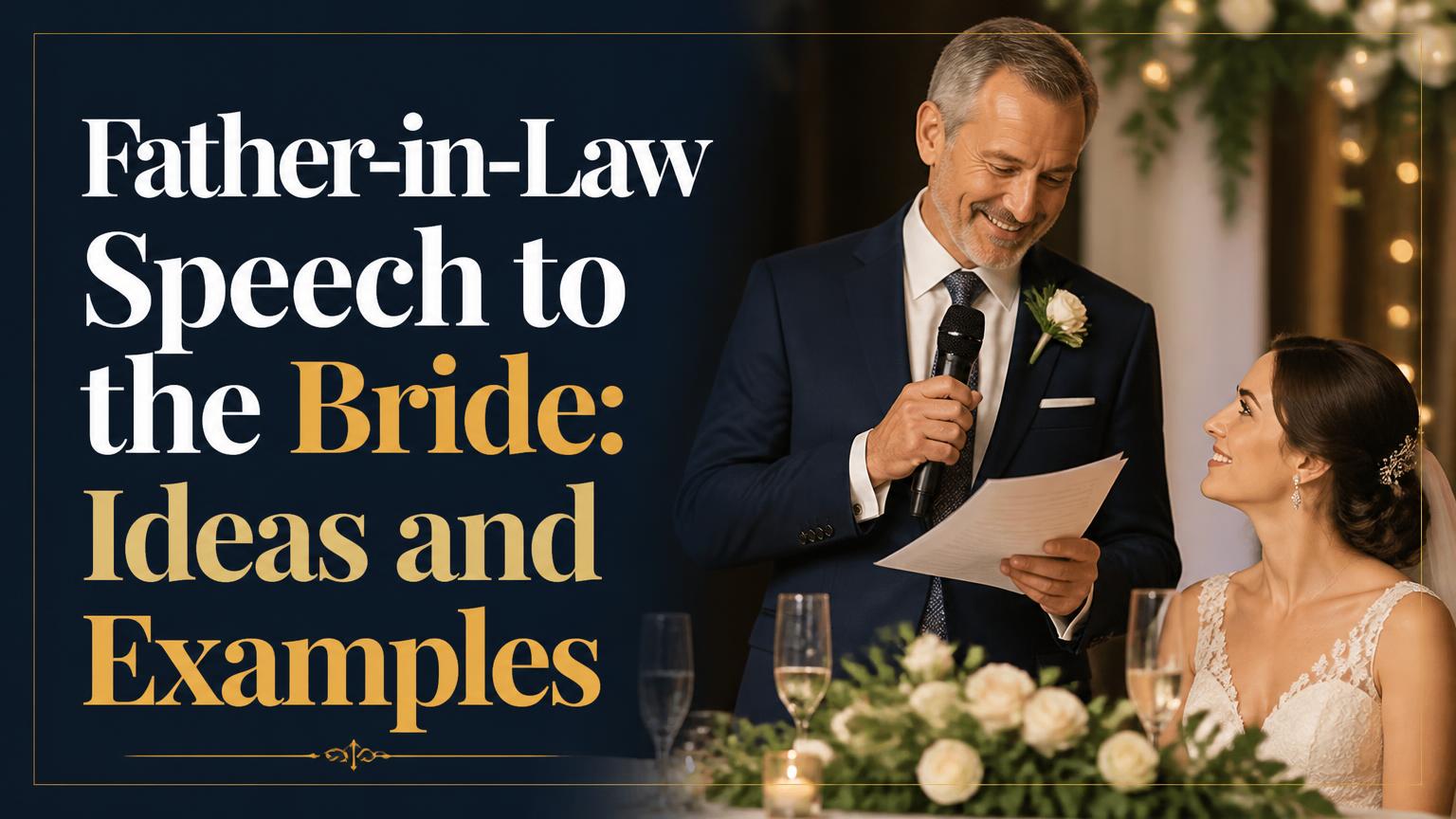
A father-in-law speech to the bride should make her feel respected, welcomed, and genuinely seen—not as someone being assessed by her new family, but as an equal partner in the marriage. The strongest speeches speak directly to the bride while also honoring the relationship she shares with the groom. Below, you’ll find practical ideas for writing your speech, followed by two complete examples with different tones: one heartfelt and formal, the other warmer and lightly humorous.
Father-in-Law Speech to the Bride: How to Write It
A successful speech from the groom’s father usually combines a personal welcome, a meaningful observation about the bride, appreciation for the couple’s relationship, and a sincere wish for their future. You do not need to tell every family story or list every achievement. One truthful memory and a clear message will usually be more effective than a long collection of compliments.
Remember that the bride is the central person you are addressing, but the entire wedding audience is listening. Speak to her directly, include the groom and both families where appropriate, and choose words that will still feel comfortable when heard years from now.
Clarify Your Role and Main Message
Before writing, decide what you most want the bride to understand. Your message might be, “You are warmly welcomed,” “I admire the way you and my son support each other,” or “I am grateful for the happiness you have brought into his life.” Choosing one central idea prevents the speech from becoming a disconnected list of compliments.
Your role is not to judge whether the bride is suitable for your family or to present yourself as the authority on marriage. You are offering a personal welcome and sharing your perspective as someone who loves the groom. That distinction helps the speech feel generous rather than possessive.
Speak Directly to the Bride
Use the bride’s name and address her throughout the speech. Phrases such as “I want you to know,” “I have always admired,” and “We are grateful to have you with us” create a personal connection. They also ensure that the speech is truly for the bride rather than simply being another speech about the groom.
Choose qualities you can honestly describe. Perhaps she is thoughtful under pressure, curious, patient, determined, or generous with her time. Avoid broad praise that could apply to anyone. A specific observation, even a small one, will sound more sincere than several exaggerated compliments.
Choose One Meaningful Memory
A short memory gives the speech a human center. It might be the first time you met the bride, a conversation that revealed her character, or an ordinary moment when you saw how well she and the groom worked together. The memory does not need to be dramatic. A quiet, accurate detail is often more touching than an elaborate story.
If you use a humorous memory, make sure the bride is comfortable being the subject of it and that the story does not embarrass either partner. Avoid private information, past relationships, family disagreements, or stories that require a long explanation. The purpose of the memory is to illustrate a quality, not to take over the speech.
Honor the Couple’s Partnership
A father-in-law speech should welcome the bride without suggesting that she is being absorbed into the groom’s family. Marriage joins two people with their own histories, values, and relationships. Acknowledge that the couple is creating something together rather than presenting the bride as someone who has simply entered an existing family structure.
You can mention how the couple listens to each other, handles decisions, brings out one another’s strengths, or remains connected during demanding times. Keep the focus on partnership rather than claiming that one person “completed” the other. A respectful description of their relationship will feel more mature and authentic.
Welcome Her Without Claiming Her
Words of welcome are meaningful, but they should leave room for the bride’s identity and her connection to her own family. Instead of saying that she now belongs exclusively to your family, explain that you hope she feels comfortable, respected, and supported among the people gathered there.
You might thank her family for the qualities and experiences that helped shape her, or recognize that the wedding brings two families into closer contact. This approach expresses affection without erasing where the bride comes from. It also shows the audience that your welcome is based on respect, not merely on the fact that she has married your son.
Set the Right Tone and Length
For most wedding receptions, a father-in-law speech works well at around three to five minutes, depending on the schedule and the number of speakers. A shorter speech can be just as meaningful as a long one. Aim for a clear opening, one or two developed ideas, and a memorable closing rather than trying to cover the couple’s entire history.
The tone should suit the bride, groom, venue, and audience. Gentle humor can make a speech feel relaxed, but do not use jokes that depend on embarrassment, stereotypes, alcohol, or criticism of marriage. If the event is formal, choose polished language; if the reception is informal, conversational wording will usually sound more natural.
Write a Toast That Feels Personal
End by returning to the bride and groom as a couple. A good closing might express your gratitude, offer a hope for their life together, and invite the guests to raise their glasses. Keep the final words simple enough to say clearly, especially if you expect to become emotional.
Write the toast in language you would actually use. Read it aloud several times and remove sentences that feel too formal or too elaborate. Mark natural pauses, underline the names you need to remember, and keep a printed copy or discreet note card available. Preparation allows you to look up, speak slowly, and give the bride your full attention.
Father-in-Law Speech to the Bride Examples
The following examples are written for a groom’s father addressing the bride at a wedding reception. They use a few adaptable details so you can replace them with something true about your family. Personalize the bracketed wording with a brief memory or quality rather than adding several unrelated stories.
#1. A Heartfelt Welcome to the Bride
Good evening, everyone. I’m [Groom’s Name]’s father, and I’m grateful for the opportunity to say a few words to [Bride’s Name] on this wonderful day.
[Bride], a wedding can make it seem as though two families are meeting for the first time. But today is really the beginning of a relationship that will continue to grow through ordinary days as well as important ones—through shared meals, difficult decisions, celebrations, and all the small moments that make a life together.
When I think about what I admire in you, I think of [a specific quality or true memory]. It may have been a simple moment, but it showed something important about you. You bring thoughtfulness, steadiness, and warmth to the people around you. Those qualities are easy to notice, but even more meaningful to experience.
I have also been grateful to see the way you and [Groom’s Name] treat each other. You listen to one another. You make room for each other’s opinions. You can be serious when life requires it, and you can still find reasons to laugh together. That kind of partnership is not built in a single day. It is created through patience, honesty, and daily choices.
I want you to know that you do not have to prove anything to us or become anyone’s idea of what a daughter-in-law should be. You are already valued for who you are. We are not asking you to leave your own family or your own history behind. We hope simply to become people you can trust, rely on, and feel comfortable beside.
Thank you for loving [Groom’s Name], for seeing the person he is, and for building this life with him. We are also grateful to your family for the love and guidance that helped shape you.
[Bride] and [Groom], may your marriage be filled with patience on difficult days, laughter on ordinary ones, and enough courage to keep choosing each other as life changes. Please raise your glasses with me—to a wonderful couple and to the life they are beginning together. Cheers.
#2. A Warm and Lightly Humorous Welcome
Good evening, everyone. I was told that a father-in-law’s wedding speech should be warm, brief, and free of anything that might be repeated at a family dinner. I’m going to do my best to manage at least two of those three.
More importantly, I want to speak directly to [Bride’s Name]. [Bride], when you marry someone, you do not simply gain a spouse. You also gain a collection of relatives, traditions, opinions, and people who will occasionally offer advice when no one has asked for it. I hope you will always feel free to take the useful parts and ignore the rest.
What matters most to me is not that you fit into our family in some particular way. It is that you and [Groom’s Name] have created a relationship that belongs to both of you. You have your own sense of humor, your own ways of solving problems, and your own understanding of what makes a good life.
One of the things I appreciate most about you is [specific quality]. I saw it clearly when [brief true memory of the bride or the couple]. You handled that moment with [patience, kindness, determination, or humor], and it told me something about the kind of person you are. More than that, I have seen how comfortable [Groom’s Name] is being himself with you. That is a precious gift.
I hope you know that our welcome is not based only on the fact that you have married our son. It comes from the person you are and from the life you and [Groom’s Name] are building together. We are happy to stand beside both of you, to celebrate your successes, and to support you through the less perfect days too.
[Groom’s Name], you have chosen someone with a generous heart and a strong spirit. [Bride], thank you for bringing so much happiness into his life and for allowing us to share in this day.
To both of you: may you keep talking when life is complicated, keep laughing when life is too serious, and remember that the best parts of marriage are often found in the ordinary days. Please raise your glasses—to [Bride] and [Groom], and to many happy years ahead. Cheers.
Closing Thoughts
The best father-in-law speech to the bride is personal without being possessive, affectionate without becoming exaggerated, and memorable without turning into a performance. Speak directly to her, include one genuine detail, recognize the couple’s partnership, and offer a welcome that respects both families. Once the words are written, read them aloud, shorten anything that sounds unnatural, and let your sincere appreciation carry the speech.