
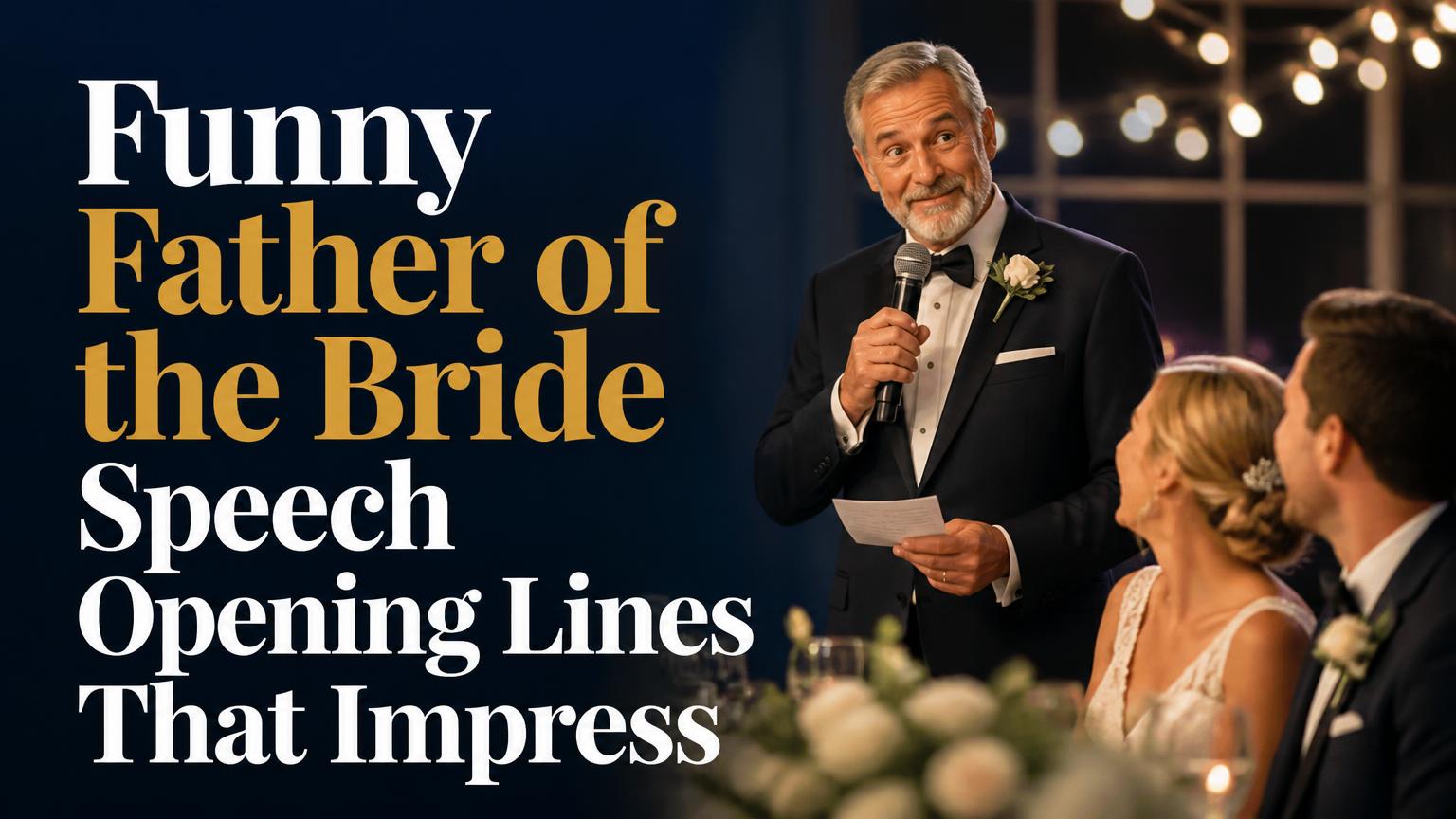
A funny opening can make a father of the bride speech feel relaxed from the first sentence, but the humor should support the couple rather than compete with them. The best lines are warm, brief, and easy to deliver in front of family, friends, and guests who may not share the same sense of humor. Below, you’ll find ready-to-use opening lines for different personalities, along with practical advice for choosing a joke that earns a laugh and leads naturally into a heartfelt speech.
Funny Father of the Bride Speech Opening Lines
The strongest opening lines combine a small joke with genuine affection. Choose one that sounds like something you would actually say, then replace the placeholders with the couple’s names or a harmless detail from the wedding day. Each line is designed to create an easy laugh before you move into your welcome, memories, or congratulations.
Gentle Self-Deprecating Openers
Self-deprecating humor is often a safe choice because the joke is aimed at the speaker rather than the couple. It helps you appear approachable and can reduce the pressure of making the perfect first impression. Keep the joke mild and believable; you want guests to see your personality, not worry that you are uncomfortable.
- “Good evening, everyone. I was asked to keep this speech short, which is excellent news for the guests and a significant personal challenge for me.”
- “I’m very happy to be here tonight, although I understand there will be questions later about why I was trusted with a microphone.”
- “When I was asked to give this speech, I felt honored. When I saw the time limit, I realized [Bride] was still managing the event.”
- “I’ve prepared some thoughtful remarks, and I’ve also prepared a shorter version in case the photographer notices people checking the dessert table.”
- “Please relax. I promise to keep this speech brief enough that nobody will have to pretend they suddenly need to check their phone.”
These lines work especially well if you are nervous or not naturally theatrical. Deliver one with a smile, pause for the reaction, and then thank everyone for joining the celebration. The humor becomes an invitation for the audience to settle in with you.
Openers About Being Asked to Speak
A joke about the speech itself gives you an easy way to acknowledge the occasion without launching into a long story. It also signals that you understand guests are ready to celebrate, eat, dance, and spend time with the couple. These lines are particularly useful when you want a modern, conversational tone.
- “I was told that a father of the bride speech should be sincere, meaningful, and no longer than the attention span of someone waiting for the bar to open.”
- “Apparently, this is the part of the evening when I share wisdom. I’m still looking for the receipt, but I’ll do my best.”
- “I have been given a microphone, a time limit, and a very clear instruction not to tell certain stories. So, naturally, I’m feeling completely prepared.”
- “They say every great speech has a beginning, a middle, and an end. I’m aiming for the beginning and end, with only a brief visit to the middle.”
- “I’m delighted to make this speech tonight. It’s one of the few occasions when being emotional, overdressed, and slightly confused is completely acceptable.”
After one of these openings, move quickly to the reason everyone has gathered: celebrating [Bride] and [Partner]. A self-aware joke is most effective when it opens the door to something sincere rather than becoming the main subject of the speech.
Warm Father-Daughter Openers
A father-daughter joke can be affectionate without becoming embarrassing. Focus on the change from childhood to adulthood, your pride in her, or the fact that she has always known how to get your attention. Avoid jokes that suggest you are losing ownership of your daughter or that her marriage is a transaction.
- “I’ve spent many years giving [Bride] advice, most of which she ignored. Tonight, I’m delighted to see that she has finally made one decision I completely agree with.”
- “When [Bride] was little, I thought my job was to protect her from the world. Then she grew up, became remarkably capable, and started protecting me from my own opinions.”
- “I always knew [Bride] would grow into an extraordinary woman. I just didn’t realize she would also become the person who organizes an event this large without letting me change the seating plan.”
- “Being [Bride]’s father has given me many proud moments. Standing here tonight is one of them, although I’m still waiting for the moment when she asks me to stop talking.”
- “I’ve watched [Bride] grow from a little girl with big ideas into a woman with even bigger ones. Fortunately, [Partner] seems to understand that this is not a phase.”
These openings work best when followed by a specific, respectful memory. Mention a quality you have seen in your daughter over the years, such as determination, generosity, curiosity, or loyalty. The laugh gets attention; the personal observation gives the speech emotional weight.
Openers That Welcome the Partner
Including [Partner] early helps the speech feel like a celebration of the couple rather than a farewell to the bride’s single life. A light joke about welcoming a new member of the family can be warm and memorable, provided it does not imply that the partner is being tested, judged, or reluctantly accepted.
- “We are very pleased to welcome [Partner] to the family. The application process was extensive, but the reference checks came back beautifully.”
- “When [Partner] first joined our family gatherings, we knew there was something special. Anyone willing to sit through our stories deserves both admiration and a formal welcome.”
- “I’m delighted that [Bride] has found someone who makes her so happy—and equally delighted that [Partner] has agreed to learn how our family group chat works.”
- “Please join me in welcoming [Partner] to the family. We hope you’ll feel at home, although I should warn you that ‘at home’ includes strong opinions about dessert.”
- “From the moment we met [Partner], it was clear that [Bride] had chosen someone kind, patient, and wonderfully good at pretending to understand our family traditions.”
Follow the joke with a sincere welcome. A line such as “We are genuinely grateful to have you with us” ensures that the humor is understood as affection, not a test the new spouse must pass.
Playful Formal Openers
A mock-formal opening gives the speech a polished feel while allowing you to make fun of the seriousness of the occasion. This style suits a speaker who enjoys a measured delivery and can keep a straight face for a few seconds. The joke should be clear enough that guests do not wonder whether you are making an actual announcement.
- “Ladies and gentlemen, members of the family, honored guests, and anyone who came primarily because they heard there would be cake: welcome.”
- “As father of the bride, I have been given several responsibilities tonight. I’m pleased to report that I have successfully arrived, dressed appropriately, and found the microphone.”
- “On behalf of the family, I’d like to thank everyone for being here, especially those who traveled a long way and those who came from the next room.”
- “This is a very important evening, so I will begin with the traditional father-of-the-bride statement: I am extremely proud, slightly emotional, and unsure where to stand.”
- “Welcome, everyone. Tonight we celebrate love, commitment, and the remarkable ability of two people to agree on one seating plan.”
Pause after the final phrase so guests have time to respond. Then shift into a genuine welcome or a short reflection about what makes the couple work well together. The contrast between formal language and a gentle punchline creates a natural, confident opening.
Short One-Liners for Nervous Speakers
A short line may be the best option if you are uncomfortable speaking in public or expect to become emotional. You do not need to perform a long comedy routine. One clean joke, followed by a sincere sentence, can establish a relaxed tone and give you a manageable beginning.
- “I’ll keep this brief, because [Bride] has already made one beautiful decision today and I don’t want to challenge it.”
- “I’m here to say a few words about the happy couple, and I promise most of them will be appropriate.”
- “Tonight proves that [Bride] and [Partner] have excellent taste—and very patient families.”
- “I was told to speak from the heart, so if I lose my place, that is where I’ll be looking.”
- “Let’s begin with the most important fact of the evening: [Bride] looks wonderful, and I remembered to write everything down.”
- “I’m honored to be speaking tonight, although I’m beginning to understand why people prefer sending a card.”
These lines do not require dramatic timing or a complicated story. Read the sentence slowly, look at the couple, and follow it with something heartfelt, such as “In all seriousness, I could not be happier for you both.” A simple opening often sounds more natural than an ambitious joke.
Customizable Openers With a Personal Detail
A personalized line is usually more memorable than a generic one because it belongs to this couple and this day. Choose a harmless detail that most guests can understand, such as the weather, the venue, the couple’s planning style, or a familiar habit. Avoid private references that leave half the room confused.
- “We knew this wedding would be special when [Bride] and [Partner] managed to agree on [wedding detail]—a decision that deserves its own celebration.”
- “I’ve known [Bride] for [number] years, and tonight is the first time I’ve seen her arrive early, look this calm, and allow someone else to hold the schedule.”
- “The weather may have changed, the seating plan may have evolved, and [specific wedding detail] may have required negotiation, but one thing has been clear from the start: these two belong together.”
- “Anyone who has spent time with [Bride] and [Partner] knows that they share three important qualities: kindness, patience, and a remarkable ability to turn [shared habit] into a full evening.”
- “When I saw [Bride] and [Partner] together at [specific memory or place], I understood what everyone else eventually noticed: they make each other laugh, and they make ordinary moments matter.”
Replace the bracketed detail with something true and recognizable. The best personal joke is not an inside joke; it is a small observation that gives guests a glimpse of the couple while keeping the focus on their relationship.
How to Choose and Deliver a Funny Opening
A funny first line is only useful if it suits the couple, the audience, and your own speaking style. The goal is not to produce the biggest laugh of the wedding. It is to create comfort, show affection, and make the transition into the meaningful part of your speech feel natural.
Match the Humor to Your Personality
Choose a line you can say comfortably in your normal voice. If you are calm and understated, a dry observation may work better than an exaggerated performance. If you are naturally lively, you can use a more playful opening, but avoid trying to sound like a professional comedian. Audiences respond well to sincerity, especially when the speaker appears relaxed and genuine.
Read the line aloud several times. If you find yourself changing the wording each time, simplify it. A joke that looks clever on the page may sound stiff when spoken. The best opening is one you can remember, pronounce easily, and deliver without rushing.
Think About the Entire Audience
A wedding audience often includes several generations, relatives from different backgrounds, coworkers, and guests who have never met one another. Choose humor that everyone can understand without knowing a private family history. Observations about the speech, the celebration, or your own nerves are usually more inclusive than jokes based on obscure references.
Consider the venue and tone as well. A formal wedding may call for a polished, gentle line, while a relaxed reception may welcome something more conversational. When in doubt, choose warmth over edge. You can always make a speech more personal after you have established a respectful tone.
Make the Couple the Focus
The opening should lead toward the couple, not leave the audience wondering what the joke has to do with them. After one or two funny sentences, mention [Bride] and [Partner] by name and state what you are celebrating. This keeps the humor connected to the purpose of the speech.
For example, you might follow a joke with: “But honestly, seeing how happy these two are makes every part of today worth celebrating.” That simple transition turns a laugh into an expression of affection and makes the speech feel intentional rather than improvised.
Keep the Joke Safe and Affectionate
Avoid humor about divorce, infidelity, former partners, heavy drinking, money, family conflict, or private disagreements. Even if a story seems funny to you, the wedding reception may not be the right setting for it. The couple should never feel exposed or criticized during a speech intended to honor them.
Do not use jokes that suggest the bride is being handed over, controlled, or rescued. It is also wise to avoid remarks that treat the partner as an outsider who must earn acceptance. A warm welcome is more gracious and leaves a better impression on the couple and their guests.
Create a Natural Transition
The opening joke should take up only a small part of the speech. Once guests respond, move into a welcome, a personal memory, or a statement about the couple. A useful pattern is: joke, pause, sincere observation, then the main story.
For example: “I was asked to keep this brief, so I’ll begin with the one thing I know for certain: [Bride] and [Partner] have made an excellent decision. In all seriousness, watching them together has shown me how naturally they bring out the best in one another.” The transition does not need to be elaborate; it simply needs to guide the audience from laughter to meaning.
Rehearse the Pause and the Pace
Do not rush through the punchline because you are nervous. Say the line clearly, stop for a moment, and allow guests to react. If they laugh, wait until the sound has faded before continuing. If the response is quiet, do not apologize or repeat the joke; calmly move into your next sentence.
Practice with notes that show the opening line and your transition. You do not need to memorize every word, but you should know the first few sentences well. A confident beginning makes the rest of the father of the bride speech easier to deliver.
Funny Opening Mistakes to Avoid
The opening sets the audience’s expectations for everything that follows. A joke that feels mildly awkward in conversation can become much riskier when delivered through a microphone in front of the couple’s entire family. The safest approach is to test every line against one question: will this make the couple feel celebrated?
Avoid Embarrassing Childhood Stories
A funny opening is not the place for a story that reveals a private habit, an embarrassing photograph, or a childhood incident the bride has asked you not to share. Even an affectionate story can feel uncomfortable if the person at the center of it did not expect it. Save detailed memories for moments you know she will welcome.
If you use a childhood reference, keep it brief and kind. Focus on a recognizable quality, such as determination or imagination, rather than a humiliating event. The story should help guests appreciate the woman she has become.
Be Careful With Jokes About Wedding Costs
Comments about the price of the wedding, who paid for what, or how much the couple has spent can create discomfort quickly. They may also make guests wonder whether the family is resentful about the celebration. If you want to mention the planning, joke about harmless details such as the number of schedules, lists, or decisions—not the financial side.
A gentle line about the seating plan or the number of cake tastings can be amusing because it is relatable without assigning blame. Keep the focus on the joy of the day rather than the effort or expense required to create it.
Leave Former Relationships Out
References to ex-partners, old romantic mistakes, or the bride’s dating history rarely improve a wedding speech. Even when the speaker intends a harmless joke, the remark can embarrass the couple or make guests uncomfortable. The wedding is a celebration of the relationship in front of you, not an opportunity to review the relationships that came before it.
If you want to show that [Partner] is a particularly good match, describe what you admire about them together. Mention kindness, respect, shared humor, steadiness, or the way they support one another.
Do Not Turn the Partner Into the Punchline
A new son-in-law, daughter-in-law, or partner may expect a little playful teasing, but a public speech should make them feel welcomed rather than examined. Avoid jokes about whether they asked permission, passed a test, or have been accepted only provisionally. Those lines can sound possessive or hostile even when delivered with a smile.
A better approach is to tease yourself or the family while offering the partner a sincere welcome. Humor lands more generously when the person who is new to the family knows they are being invited in, not put on trial.
Keep the Opening Brief
A funny opening should usually take no more than a few sentences. If the joke requires a long explanation, several characters, or a detailed history, it belongs later in the speech—or may not belong at all. Guests should understand the point quickly and know where you are going next.
End the humorous opening while the audience is still enjoying it. A short laugh followed by a heartfelt statement is more effective than several similar jokes in a row. Your role is to honor the couple, not compete with the evening’s entertainment.
Closing Thoughts
The best father of the bride speech funny opening lines are brief, affectionate, and easy for you to deliver naturally. Choose humor that includes the whole room, welcomes the couple as a team, and avoids embarrassing anyone. After the laugh, move promptly into the sincere part of your speech: what you admire about your daughter, what you appreciate about her partner, and why their marriage deserves celebration. A gentle opening can make the entire speech feel more relaxed and memorable.