
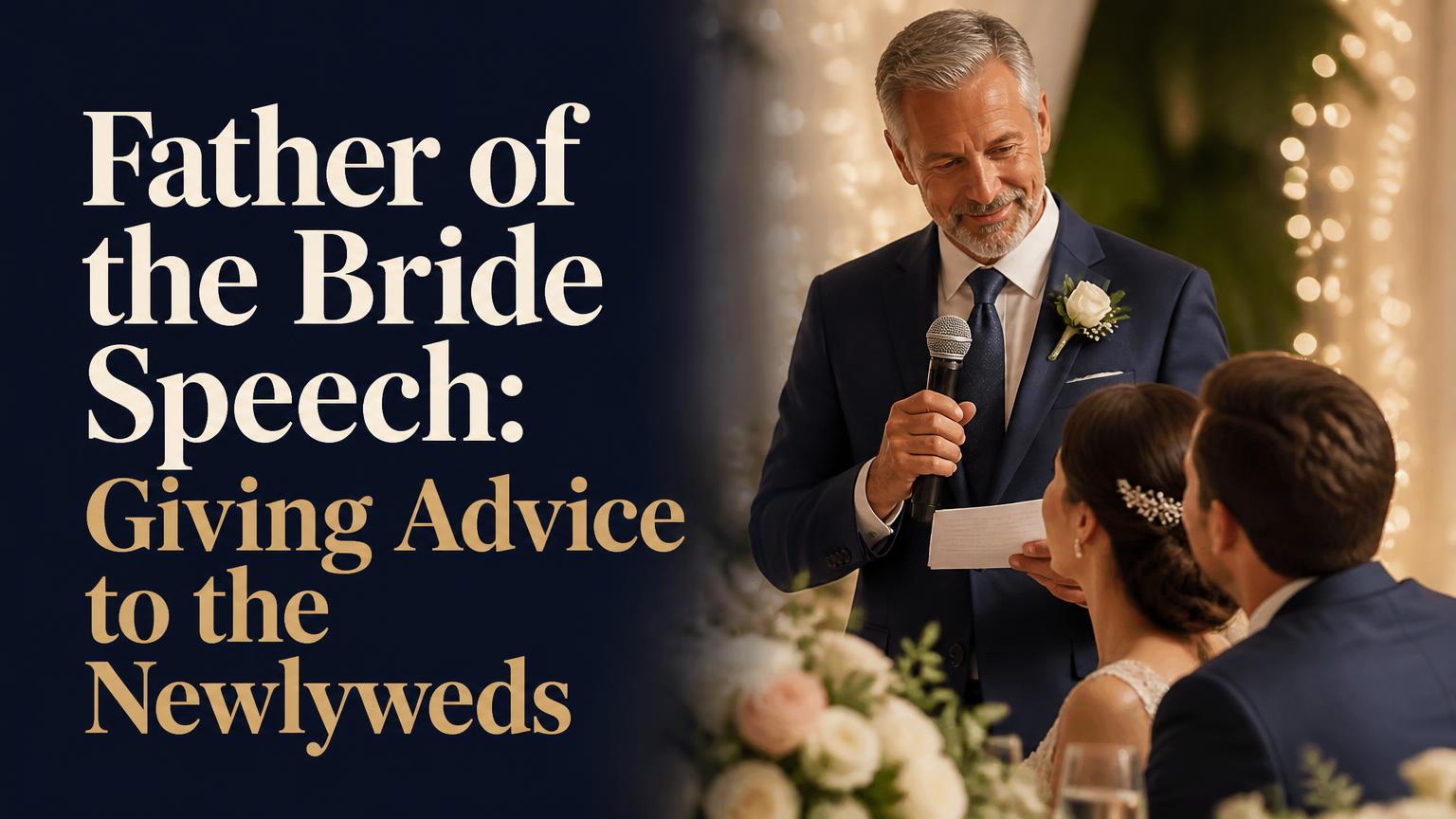
A father of the bride speech often includes a few words of advice for the newlyweds, but the most effective advice feels personal rather than preachy. Your role is not to deliver a lecture on marriage or tell the couple how to live. It is to offer one or two thoughtful observations, drawn from love and experience, while honoring both partners equally. The guidance below will help you choose meaningful advice, shape it into a natural part of the speech, and deliver it with warmth, restraint, and confidence.
Father of the Bride Speech Advice to Newlyweds
The best advice to newlyweds is brief, sincere, and connected to the couple you are celebrating. Rather than listing rules for a successful marriage, choose a principle you genuinely believe in and explain why it matters. You might speak about protecting time together, handling difficult conversations with respect, appreciating ordinary days, or continuing to support each other’s individual goals.
Address both newlyweds, not only your daughter. A father of the bride speech should welcome the bride’s spouse as part of the family while recognizing that marriage is a partnership between equals. Your words will feel more generous and relevant when they are directed to the couple’s shared future instead of focusing exclusively on your relationship with your daughter.
Clarify the Purpose Before Writing
Before drafting, decide what you want the newlyweds to remember after the celebration. Your purpose might be to offer encouragement, pass along a lesson, welcome the new spouse, or express confidence in the couple’s future. A clear purpose prevents the advice from becoming a collection of unrelated sayings.
Write your purpose in one sentence, such as, “I want to remind them that a strong marriage is built in ordinary moments,” or, “I want to welcome [Partner’s Name] and encourage them to keep choosing kindness.” Use that sentence as a test for every story and idea you include. If a line does not support the central purpose, remove it.
Speak to Both Newlyweds
Although you are the bride’s father, the advice should belong to both people standing before you. Use “you both,” “your marriage,” and “the life you build together” more often than language that places your daughter at the center and her spouse at the edge. This creates a tone of welcome rather than inspection.
You can still include a personal reference to your daughter, especially when describing what you admire about her. Follow it by connecting that quality to the couple: perhaps her thoughtfulness strengthens their home, or her determination is matched by her partner’s steadiness. Make room for the spouse’s character as well, even if you know that person less intimately.
Choose One Central Lesson
One memorable idea is usually more effective than five separate pieces of advice. Consider the qualities you have observed in the couple: patience, humor, loyalty, curiosity, generosity, or the ability to work through differences. Then turn that observation into a simple lesson they can carry into married life.
For example, you might say, “Make room for the small joys,” or, “Talk honestly before a small concern becomes a large one.” A central lesson gives your speech direction and makes the ending easier to write. It also keeps the advice from sounding like a checklist of expectations placed on the newlyweds.
Ground the Advice in Experience
Advice becomes more credible when it grows out of a real observation rather than a general statement. You could describe a moment when the couple handled an inconvenience with patience, supported one another through a demanding season, or made people around them feel welcome. The story does not need to be dramatic; an ordinary moment may reveal more than a grand event.
If you draw on your own marriage or life experience, present it as perspective rather than authority. Phrases such as “One thing I have learned,” “What has helped me,” or “I hope you will remember” sound generous. Avoid suggesting that your experience is the only model for a successful marriage, since every couple must find its own way.
Balance Practical and Emotional Guidance
The strongest advice often combines a practical action with an emotional reason. Instead of saying only, “Communicate,” explain what that might look like: talk before resentment builds, listen without preparing a rebuttal, and make time for important conversations even when they are uncomfortable. Instead of saying only, “Stay close,” suggest protecting a regular ritual or making space for one another after a difficult day.
Choose advice that can be remembered and practiced. “Never go to bed angry” may sound familiar, but it is too absolute for every couple and every situation. A more flexible idea might be, “Do not let pride prevent you from returning to a difficult conversation with care.” Thoughtful qualifications make advice more realistic and respectful.
Phrase Advice Without Sounding Like a Lecture
The tone should be affectionate and conversational, not commanding. Replace rigid instructions such as “You must always” or “You should never” with language that offers support: “Try to,” “It may help to,” “Make time for,” or “Remember that.” This is especially important when speaking to adults who are beginning their own household and making their own decisions.
You can also soften advice by including humility. A line such as, “I am still learning this myself, but I have found that…” sounds more honest than a declaration that you possess the complete answer to marriage. Your authority comes from your love for the couple and your willingness to share something useful, not from presenting yourself as an expert.
End With a Toast and Forward-Looking Wish
Advice should lead naturally into a warm conclusion. After sharing your central lesson, connect it to your hopes for the couple: a home filled with laughter, the courage to face hard seasons together, or the freedom to grow without losing their connection. Keep the wish specific enough to feel personal, but broad enough to suit their future.
Then raise your glass and invite the guests to join you. A simple ending is often strongest: “Please raise your glasses to [Bride’s Name] and [Partner’s Name—to a marriage filled with patience, joy, and many ordinary days worth celebrating.” The toast gives the speech a clear finish and returns the focus to the couple.
Delivery and Etiquette for a Father of the Bride Speech
Good advice can lose its effect if it is delivered too quickly, runs too long, or sounds as though the couple is being corrected in public. Common wedding-speech practice favors a concise contribution, often around three to five minutes, although the couple, venue, and schedule may call for something shorter or longer. At a speaking pace of approximately 120 to 140 words per minute, that is roughly 360 to 700 words. Confirm the expected length rather than assuming a universal rule.
Your speech should also fit the wedding’s atmosphere. A formal ceremony, an informal outdoor celebration, and a multicultural reception may have different expectations about humor, religious language, family roles, and the order of toasts. Ask the couple or coordinator if you are unsure. The following details can help you make the advice respectful and easy to hear.
Keep the Advice Brief and Memorable
A short section of advice is usually enough. If the entire speech is devoted to instructions, guests may feel that the celebration has turned into a public lesson, and the couple may struggle to remember any individual point. Aim for one central message supported by one story or observation.
Read the advice aloud and listen for repetition. If you make the same point in three different ways, keep the clearest version. You can preserve warmth without adding length by choosing concrete verbs and specific images. “Make time for one another when life becomes busy” is more memorable than several paragraphs about the general importance of commitment.
Use Inclusive and Respectful Language
Avoid language that suggests your daughter is being handed over, that her spouse must earn the family’s approval, or that marriage requires one partner to perform a fixed role. Even when such phrases are traditional in some settings, they may not reflect the couple’s values or family structure. Speak about partnership, mutual respect, shared decisions, and the life they are creating together.
If the wedding brings together different cultures, religions, or family traditions, be attentive to the language you use. Do not assume that one custom represents everyone in the room. A neutral, heartfelt toast can honor the couple without making claims about what marriage must look like for every family.
Choose Humor That Includes, Not Embarrasses
Light humor can make advice feel natural, but the joke should never depend on humiliating the bride, her spouse, or a family member. Avoid stories about past relationships, private arguments, drinking, intimate matters, or anything the couple has not clearly approved. A laugh that creates discomfort is not worth the risk.
Gentle humor about your own learning, the practical surprises of family life, or the effort required to agree on everyday decisions is usually safer. If you are uncertain whether a story is appropriate, leave it out or ask the couple privately. Wedding speeches are public, recorded, and often shared with people you have never met.
Prepare for Emotion Without Apologizing Repeatedly
It is natural to become emotional while speaking about your daughter and the person she has chosen. Plan for that possibility by marking a few pauses in your notes and keeping water nearby. Short sentences are easier to deliver when your voice is unsteady, so do not write a long, complicated paragraph for the most important part of the speech.
If you need a moment, pause and breathe. You can say, “This means a great deal to me,” and continue when ready. There is no need to apologize several times or make the audience manage your emotions. A quiet pause often communicates sincerity more effectively than trying to force yourself through every word without stopping.
Rehearse for Pace and Clarity
Practice aloud, not only in your head. Reading aloud reveals sentences that are too formal, transitions that feel abrupt, and places where you run out of breath. Time yourself once or twice, but do not become so focused on the clock that the speech sounds rushed.
Mark the names of the couple in large, clear type and highlight the sentence that leads into the toast. Use a printed page or small cue cards with generous spacing. Rehearse while standing if possible, and practice looking up at the couple rather than keeping your eyes fixed on the page. Familiarity will make the delivery feel more personal.
Confirm the Venue and Family Expectations
Ask who will introduce you, where you should stand, whether you will use a microphone, and when the toast is expected. Some celebrations have a formal sequence of speeches; others are more spontaneous. Knowing the plan prevents you from repeating remarks already made by another speaker or taking time needed for an important part of the reception.
It is also wise to check sensitive details with the couple. Confirm the pronunciation of names, whether religious references are welcome, which stories are off-limits, and whether the newlyweds want specific family members acknowledged. These conversations are not signs of overcaution. They are part of respecting the people whose celebration you are helping to shape.
Common Mistakes to Avoid
A father of the bride speech should strengthen the celebration, not place the couple in the position of defending their choices or reassuring the audience. Most problems arise when the speaker forgets that advice is an offering rather than an order. The goal is to honor the couple’s independence while sharing something that may genuinely encourage them.
Review your draft for tone as carefully as you review it for grammar. Ask whether the advice sounds like something you would say privately with affection, whether it includes both newlyweds, and whether it leaves the audience with confidence in their future. The following mistakes are common and easy to correct.
Turning Advice Into Rules
Statements such as “Always do this” and “Never do that” can sound absolute, even when you intend them kindly. Marriage involves different personalities, circumstances, cultures, and practical arrangements, so advice should leave room for the couple to decide what works for them.
Instead of presenting a rule, share a principle and its value. Say, “Make space to talk honestly, especially when the conversation is difficult,” rather than “You must discuss everything immediately.” This approach remains meaningful while recognizing that timing, privacy, and personal boundaries matter.
Focusing Only on Your Daughter
A speech that talks almost entirely about the bride can unintentionally make her spouse feel like a guest in the family. It may also suggest that the marriage is primarily an extension of the father-daughter relationship rather than a new partnership.
Include a welcome, a specific quality you appreciate in the spouse, or an observation about how the couple works together. You do not need to pretend you know the spouse as deeply as your daughter. A sincere acknowledgment of their kindness, steadiness, humor, or care is enough to show that you see and value both people.
Sharing Embarrassing or Private Stories
A story may be funny in a family kitchen but uncomfortable in a reception hall filled with colleagues, relatives, and friends. Avoid childhood incidents that embarrass the bride, jokes about the spouse’s habits, and private details about the couple’s relationship. Public consent matters more than your personal memory of the event.
Choose stories that reveal character without exposing vulnerability. A moment of generosity, determination, patience, or shared laughter can give guests a vivid sense of the couple. If a story requires a long explanation or a warning that “you had to be there,” it probably does not belong in the speech.
Relying on Clichés Instead of Personal Meaning
Familiar sayings about marriage may be easy to write, but they rarely sound memorable unless you connect them to the couple. Advice about communication, compromise, and laughter becomes stronger when it is illustrated by something you have actually observed.
Replace a general phrase with a personal reflection. Instead of saying, “Marriage takes work,” you might say, “I have noticed that the two of you do not wait for perfect circumstances to show up for each other.” This makes the idea feel earned rather than borrowed.
Forgetting the Celebration and the Toast
Advice is only one part of a father of the bride speech. If you spend too much time teaching, you may neglect the joy of the occasion, the gratitude you feel toward guests, or the welcome you want to extend to the new spouse and their family.
Include a clear celebration of the day and finish with a toast. The final mood should be generous and forward-looking. Even if your advice mentions difficult seasons, do not leave the room focused on problems. End by expressing confidence in the couple and inviting everyone to celebrate them.
A Short Model of Advice for the Newlyweds
The following passage is an illustration, not a complete father of the bride speech. It shows how a personal observation, a practical suggestion, and a warm wish can fit together without sounding like a lecture. Replace the general details with something you have genuinely noticed about the couple.
A Sample Passage You Can Personalize
One thing I hope you will remember is that a marriage is built not only in the important decisions, but in the ordinary minutes between them. Make time to ask about each other’s day. Notice when the other person needs encouragement. Celebrate the small victories that no one else sees.
You will not always agree, and you will not always have the same amount of energy or patience. When that happens, try to remember that you are not opponents trying to win an argument. You are two people on the same side, working out how to care for the life you are building together. I have great confidence in both of you, and I hope your home is filled with honesty, laughter, and the kind of kindness that continues long after the wedding day.
Closing Thoughts
The most meaningful father of the bride speech advice to newlyweds is advice the couple can recognize as true to them. Choose one thoughtful lesson, support it with an authentic observation, and speak to both partners with respect. Keep your guidance generous rather than absolute, rehearse enough to sound comfortable, and let the final words become a toast to the life ahead. Your role is not to provide every answer, but to offer love, confidence, and a perspective the newlyweds will be glad to remember.