
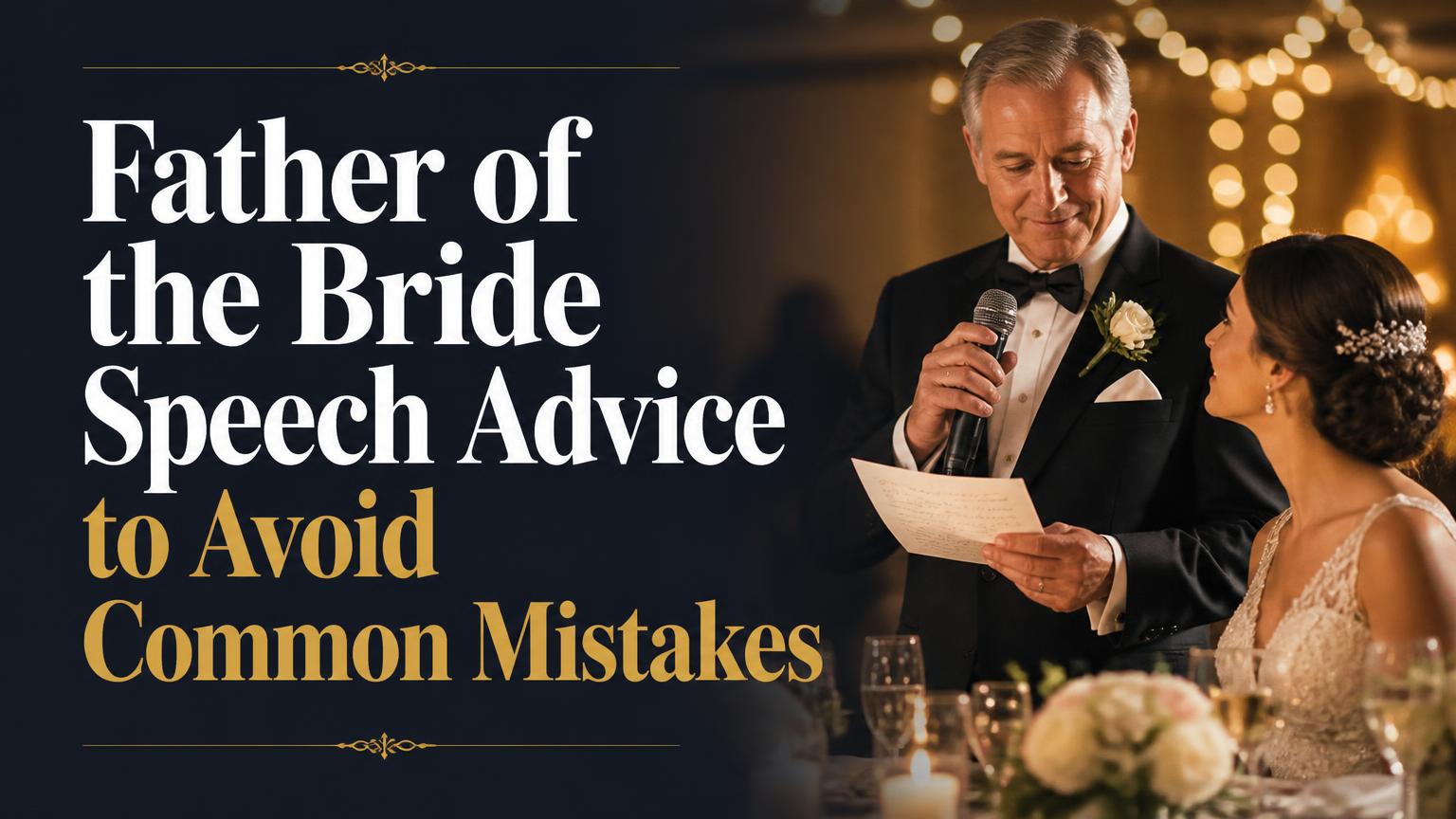
A father of the bride speech should feel personal, generous, and appropriate for the whole wedding audience. The strongest speeches share genuine affection for the bride while welcoming her partner and recognizing the significance of the day. The most common problems are usually avoidable: speaking for too long, telling embarrassing stories, relying on tired jokes, or making the speech sound like a private conversation. The advice below will help you write a thoughtful toast, protect the couple’s privacy, and deliver your words with confidence.
Father of the Bride Speech Advice for Avoiding Common Mistakes
The father of the bride often has an important ceremonial role, but there is no single required format. At some weddings, he welcomes guests and offers a toast; at others, he gives a more personal tribute or shares the speaking role with family members. Ask the couple what they expect, how long they would like you to speak, and whether there are subjects they would prefer you to leave out.
Your speech should ultimately do three things: express your love for your daughter, recognize the person she has chosen, and honor the couple’s future together. Keep those purposes in view as you choose stories, jokes, and advice.
Understand Your Role and Audience
You are speaking as the bride’s father, but the audience includes both partners, their families, friends, and often people you have never met. A speech focused entirely on your memories of your daughter may be touching, yet it can feel incomplete if it barely acknowledges her spouse or the shared celebration.
Think of the speech as a bridge between your family and the couple’s new life together. Share something meaningful about your daughter, then connect that quality to the person she is marrying or to the relationship they have built. This allows the audience to understand your pride without making the occasion feel like a farewell from one family to another.
Choose One Clear Message
A speech becomes easier to write when you decide what you most want people to remember. Your central message might be that your daughter has always brought warmth to the people around her, that her partner has become a valued part of the family, or that their relationship is grounded in mutual respect.
Once you have chosen that message, select stories and observations that support it. Do not try to include every childhood milestone, school achievement, family holiday, and amusing incident. A focused speech usually feels more sincere than a complete biography. If a story does not strengthen your main point or suit the wedding audience, save it for a private conversation.
Open With Welcome and Gratitude
Begin by acknowledging the occasion and welcoming the guests. You might thank everyone for being present, recognize those who traveled, or express appreciation to the families and people who helped create the celebration. Keep this opening warm and brief rather than turning it into a list of every contributor.
A simple beginning gives the audience confidence that the speech is purposeful. For example, you might say, “Thank you all for being here to celebrate [Bride] and [Partner]. Seeing so many people they love gathered in one room is a wonderful reminder of how much support surrounds them.” From there, move naturally into your personal connection with the bride and the couple.
Tell a Specific Story About Your Daughter
Choose one or two memories that reveal character rather than simply proving that you have known your daughter for a long time. A story about her patience, determination, generosity, curiosity, or sense of responsibility will give the audience a clearer picture of who she is.
The story does not need to be dramatic. A small, specific moment can be more effective than an impressive but vague list of accomplishments. Explain what happened, why you remember it, and what it shows about her. If the memory involves childhood, connect it to the adult she is today so the story feels relevant to the wedding rather than detached from it.
Include Her Spouse and Both Families
The bride’s partner should be more than a name mentioned in the final toast. Say something genuine about the qualities you respect, the way the couple treats one another, or the welcome you hope the new spouse has felt within the family. If you do not know the partner deeply, do not invent intimacy. Speak honestly about what you have observed.
It is also considerate to recognize both families when appropriate. A brief welcome can help the speech feel inclusive: “We are grateful to [Partner’s] family for the love and support they have given this couple, and we are delighted that our families are now connected.” Adjust the wording to suit the family relationships and the couple’s preferences.
Use Humor Without Making Anyone Uncomfortable
Gentle humor can make a father of the bride speech feel relaxed, but the joke should never depend on embarrassment, humiliation, or private information. Avoid stories about drunkenness, dating history, former partners, bodily functions, family arguments, or moments when the bride or her spouse looked foolish.
A useful test is to ask whether the person at the center of the joke would be happy to hear it repeated in front of everyone they respect. If the answer is uncertain, leave it out. Self-deprecating humor or a light observation about your own nerves is generally safer than making the couple the target. Humor should support affection, not compete with it.
Leave Out Sensitive or Private Material
Wedding speeches are public, recorded, and often shared online. Do not reveal information about health, finances, family conflict, past relationships, private disagreements, or personal decisions unless the couple has clearly approved it and the subject is genuinely appropriate for the occasion.
This is especially important when family relationships are complicated. You do not need to pretend that every history is simple, but the speech is rarely the right place to settle old grievances or explain difficult circumstances. If a subject could make someone feel exposed, excluded, or pressured, choose a different story. Respect is more important than producing a dramatic moment.
Avoid Turning the Speech Into a Lecture
A few sincere observations about marriage may be welcome, but the father of the bride speech should not sound like a set of instructions delivered to the newlyweds. Avoid presenting yourself as the authority on how they must communicate, manage money, solve disagreements, or organize their future.
Instead of giving commands, offer a brief reflection drawn from your own experience. “I have learned that listening carefully matters just as much as speaking clearly” feels more generous than “You must always do this.” Keep any advice short, specific, and optional. The focus should remain on celebrating the couple, not evaluating whether they are prepared for marriage.
How to Structure a Father of the Bride Speech
A dependable structure helps you sound natural without making the speech feel rigid. You do not need to announce each section aloud, and the order can be adjusted to suit your relationship and the wedding traditions. In most cases, a brief welcome, a personal reflection, recognition of the couple, and a toast provide enough shape for a complete speech.
Aim for a progression rather than a collection of unrelated memories. Each part should lead naturally to the next: welcome the guests, talk about your daughter, explain what you value in the relationship, and end by raising a glass to the couple.
Begin With the Occasion
The opening should establish why everyone is gathered. Welcome the guests, express your pleasure at seeing the couple married, and acknowledge the emotional importance of the day. If the couple has requested a particular form of thanks or recognition, include it early so it does not become an afterthought.
Avoid beginning with a long apology such as “I am not good at speeches” or “I have no idea what to say.” A small admission of nerves can be endearing, but too much self-deprecation makes the audience focus on your discomfort. Start with a clear sentence of welcome and let your genuine feeling carry the opening.
Move Into Your Relationship With the Bride
After welcoming everyone, explain your connection to your daughter through a concise reflection or memory. You might describe a quality you noticed in her early in life, a moment when you saw her grow in confidence, or an experience that captures the relationship you share.
This section should reveal something rather than merely list facts. Instead of saying that she has always been kind, describe a moment when her kindness was visible. Avoid turning the speech into a chronological history. The audience needs a meaningful glimpse, not every chapter.
Connect the Memory to the Present
The transition from childhood or family memory to the wedding day is important. Explain how the quality you described appears in your daughter’s life now, particularly in her relationship with her spouse. This gives the speech emotional movement and prevents the personal story from feeling disconnected from the celebration.
For example, a story about your daughter caring for others might lead into an observation about the consideration she and her partner show one another. The connection does not need to be elaborate. One or two thoughtful sentences can show that you are celebrating the person she has become, not only remembering the child she was.
Speak About the Couple Together
Reserve a distinct part of the speech for the relationship itself. Mention something you admire about the way the couple supports, challenges, or brings joy to one another. If you have witnessed a meaningful moment in their relationship, describe it briefly without revealing anything private.
Try to use language that includes both people. “They make one another laugh” or “They approach difficult decisions with patience” keeps the focus on their partnership. Even if your relationship with the spouse is still developing, you can sincerely express gratitude for the happiness and companionship they share with your daughter.
Welcome the New Family Connection
A wedding often brings together people from different backgrounds, and a short acknowledgment can make the speech more generous. Thank the other family for raising and supporting the person your daughter has married, or welcome them into your family if that language suits the couple and their circumstances.
Do not assume that every family uses the same traditions or considers marriage a simple merging of households. Some couples have close friends, chosen family, blended families, or relatives who cannot attend. Use inclusive wording that reflects the people actually present and respects the couple’s wishes.
End With a Hopeful Toast
The final paragraph should gather the speech’s main feeling and direct it toward the couple’s future. Offer a wish for companionship, patience, laughter, resilience, or continued curiosity about one another. Keep the tone hopeful without making claims about what their life will certainly be like.
Then invite the guests to raise their glasses. A straightforward ending is often strongest: “Please raise your glasses to [Bride] and [Partner]. May your life together be filled with understanding, laughter, and many good years ahead. To the happy couple.” Practice the final lines so you do not trail off after the emotional part.
Timing, Rehearsal, and Delivery Advice
A father of the bride speech commonly works well at around three to five minutes, though the couple, venue, and event schedule should guide the final decision. At an ordinary speaking pace of roughly 120 to 140 words per minute, that is approximately 360 to 700 words. Pauses, laughter, and emotion can make a speech take longer than it does when read silently.
A shorter speech is not automatically less meaningful. Guests are more likely to remember a focused story and a sincere toast than a long series of loosely connected memories. Read the speech aloud several times, and time it while speaking at a comfortable pace rather than rushing through it to meet a word count.
Write for the Ear, Not the Page
Sentences that look elegant on paper may be awkward when spoken. Use shorter paragraphs, clear transitions, and language you would actually say to the people in the room. Replace formal phrases with natural ones when they do not sound like your voice.
Read each sentence aloud and listen for crowded wording, repeated ideas, or places where you run out of breath. If you stumble over a phrase twice, rewrite it. Spoken clarity matters more than literary polish, especially when the room is large or the audience is emotional.
Prepare Notes Instead of Memorizing Everything
You do not have to memorize the entire speech. A printed copy in large type or a set of cue cards can help you stay oriented while allowing you to look up and connect with the audience. Mark important pauses, names, and the exact wording of the toast.
Avoid writing in tiny type or placing too many words on one page. Number the pages and use clear paragraph breaks so you can recover easily if they shift. If you prefer bullet points, make sure they contain enough detail to remind you of the story rather than leaving you to improvise the whole speech.
Rehearse the Difficult Sections
Practice the opening, transitions, and final toast especially carefully. These are the parts most likely to become unclear if nerves affect your concentration. Rehearse the names of the couple and any family members you plan to mention so you pronounce them confidently.
If you expect to become emotional when discussing your daughter, say that section aloud several times. The goal is not to eliminate feeling; it is to become familiar enough with the words that you can pause, breathe, and continue. Ask a trusted person to listen once and identify any part that sounds too long, unclear, or potentially uncomfortable.
Plan for Emotion
It is perfectly possible to become emotional during a father of the bride speech. Build in pauses rather than treating emotion as a failure. Keep a glass of water nearby, breathe slowly, and look down at your notes for a moment if you need to regain your place.
You can also prepare a simple sentence to use if your voice catches, such as, “This is a very meaningful day for me, so I may need a moment.” There is no requirement to force yourself through a public speech if you do not feel able to give one. Discuss alternatives with the couple, including a shorter toast, a co-speaker, or a written message.
Check the Microphone and Speaking Position
Before the reception begins, find out whether you will use a handheld microphone, a stand microphone, or a sound system at your table. If possible, test the volume and ask where you should stand. Hold a handheld microphone close enough to be heard, but do not cover the head of it or wave it toward the audience.
Speak toward the room rather than turning completely toward the couple. Make eye contact with different parts of the audience, especially during the welcome and toast. If you need to look at your notes, pause first so the words do not disappear into the page.
Coordinate With the Couple and Other Speakers
Find out who is speaking before and after you, how the speeches will be introduced, and whether there are time limits. The couple may have specific requests about names, family acknowledgments, religious language, humor, or subjects that should remain private.
Coordination also prevents repetition. If another speaker plans to tell a well-known story about the bride, choose a different memory or refer to it briefly rather than retelling it. Good planning makes the entire reception feel smoother and helps you deliver a speech that fits the celebration instead of competing with it.
A Final Mistake-Prevention Checklist
Before you finalize the speech, read it once as a member of the audience. Does the opening make clear why you are speaking? Does the bride receive affectionate, specific attention without being treated as a child? Does the speech welcome and respect her spouse? Are both families or the important people present acknowledged in a way that feels natural? If the answer to any of these questions is no, revise before worrying about clever wording.
Then check the practical details. Remove stories that require a long explanation, jokes that depend on embarrassment, references that only three people will understand, and advice that sounds like a warning. Confirm every name and pronunciation, time the speech aloud, enlarge your notes, and practice the ending. Most importantly, make sure the words sound like you. A sincere, well-prepared three-minute toast will usually serve the couple better than an elaborate performance that does not reflect your relationship with them.
Closing Thoughts
The best father of the bride speech is not the funniest, longest, or most polished speech in the room. It is the one that sounds honest and makes space for the whole couple. Choose a few specific memories, connect them to the people they are today, welcome the person your daughter has married, and finish with a clear toast. With thoughtful editing and a little rehearsal, you can speak warmly without oversharing, offer advice without lecturing, and give the newlyweds a moment they will be glad to remember.