
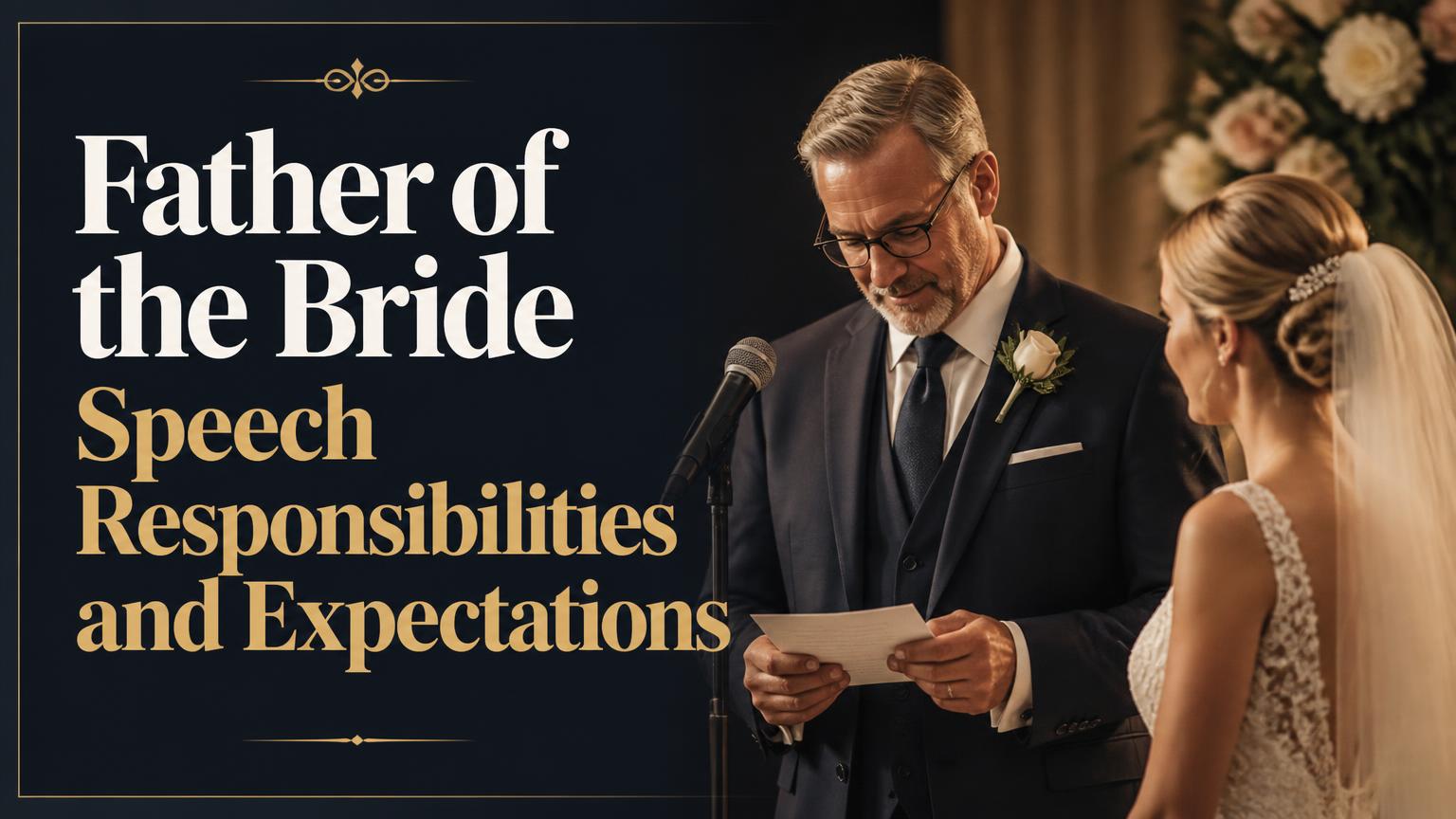
The father of the bride often has a meaningful speaking role, but the responsibilities are more flexible than tradition may suggest. He may welcome guests, thank the people who made the celebration possible, share a few personal reflections about his daughter, acknowledge her partner, and invite everyone to celebrate the couple’s future. The speech should support the wedding rather than take it over. The couple’s preferences, family relationships, culture, faith, and venue should guide the final tone and content.
Father of the Bride Speech Responsibilities
A father of the bride speech usually combines hospitality, personal tribute, gratitude, and good wishes. Traditionally, the father may speak near the beginning of the reception, but the couple can place the speech wherever it fits their schedule. In some weddings, another parent, relative, or friend may share these responsibilities, while some couples choose to omit formal speeches altogether.
The role is not to tell the complete story of the wedding, make major announcements, or speak on behalf of every family member. Your responsibility is to contribute something personal and generous: help guests feel welcomed, honor your daughter, respect her partner, and offer a sincere toast to their marriage.
Welcome the Wedding Guests
One of the father of the bride’s first responsibilities is to acknowledge and welcome the people gathered to celebrate. This does not require a long list of names or an elaborate formal greeting. A simple expression of appreciation is often enough, especially for guests who have traveled or made special efforts to attend.
You might mention how meaningful it is to see family members, close friends, and loved ones together. If guests have come from different places, a brief acknowledgment can make the opening feel inclusive. Keep the welcome warm and efficient so the speech begins with hospitality rather than ceremony for its own sake.
Thank the Hosts and Contributors
Depending on the wedding arrangements, the father of the bride may thank the people who hosted, organized, funded, or supported the celebration. This might include both sets of parents, the couple’s families, the wedding party, venue staff, or anyone whose practical help made the day possible.
Do not assume that the bride’s family alone hosted the wedding or paid for it. Modern weddings are organized and financed in many different ways. Ask the couple whom they would like recognized, and avoid turning the speech into an itemized acknowledgment list. Mention the most important contributors naturally and sincerely.
Honor Your Daughter
A central responsibility is to speak about your daughter as a whole person, not only as a bride. Share a quality you admire, a meaningful stage of her life, or a brief memory that reveals her character. The strongest material is usually specific enough to feel personal but appropriate for everyone in the room.
You do not need to describe her childhood in detail or claim that she has always been perfect. A thoughtful observation about her kindness, determination, humor, creativity, loyalty, or growth will feel more genuine than a string of broad compliments. Focus on what you truly know and what the audience can appreciate.
Acknowledge Her Partner
The speech should give the bride’s partner more than a passing mention. Welcome them into the family or community in language that reflects the actual relationship. If you have known the partner for some time, you may describe a quality you value or a moment when you saw their compatibility with your daughter.
If the relationship is newer or complicated, remain gracious without inventing intimacy. You can express happiness that the couple has chosen each other and recognize the care, respect, or joy they share. Speak about the partner as an individual rather than treating them merely as an addition to the bride’s life.
Reflect on the Couple’s Relationship
The father of the bride can help guests see what makes the couple well suited to one another. This might involve a small observation about how they support each other, handle challenges, make one another laugh, or bring their families together.
Keep the focus on the couple rather than presenting yourself as an authority on marriage. You are offering a loving perspective, not delivering a lecture. Avoid predicting exactly what their life will be like or suggesting that marriage is simple. A few honest, encouraging thoughts will have more impact than a collection of instructions.
Offer Good Wishes for the Future
A father of the bride speech normally includes sincere wishes for the couple’s future. These may involve hopes for patience, friendship, shared adventures, resilience, laughter, and a home filled with mutual respect. You can make this part personal by connecting your wishes to qualities you already see in the couple.
Avoid making the future sound like a test they must pass or implying that difficulties are inevitable in a grim way. The purpose is to offer encouragement, not pressure. A short statement expressing confidence in the couple and gratitude for being included in their celebration is often sufficient.
Propose a Toast
The closing toast gives the speech a clear ending. Invite guests to raise their glasses, if appropriate for the setting, and offer a concise wish for the couple. You might toast their health, happiness, partnership, or the life they are beginning together.
A toast does not need to be clever or poetic. It should be easy for guests to hear and understand. Finish with the couple’s names and a direct invitation such as, “Please raise your glasses to [Name] and [Name].” Once the toast is complete, sit down and allow the celebration to continue.
How to Write a Father of the Bride Speech
Writing the speech is easier when you decide what the audience needs from you before choosing individual stories. The goal is not to include every memory or thank every person equally. Select a small amount of material that creates a clear emotional movement: welcome, appreciation, personal reflection, recognition of the couple, and a toast.
A speech of about three to five minutes is common, although the couple’s schedule and local customs may differ. At an ordinary speaking pace, that is roughly 360 to 700 words, with pauses included if you become emotional. The following steps will help you build a speech that sounds personal without becoming overwhelming.
Step 1. Clarify the Purpose of Your Speech
Begin by writing one sentence that describes what you want the speech to accomplish. For example: “I want to welcome the guests, honor my daughter’s character, and express my happiness about her marriage to [Name].” This sentence becomes a filter for every story, joke, and thank-you you consider.
If a detail does not support that purpose, remove it or save it for a private conversation. A clear purpose prevents the speech from becoming a biography, wedding-planning report, or collection of unrelated memories. It also helps you maintain an appropriate balance between speaking as a parent and speaking as a host.
Step 2. Consider the Audience and Setting
Think about who will hear the speech and what they already know. A story that works with close family may be confusing or embarrassing in a room filled with colleagues, distant relatives, and friends from different parts of the couple’s lives. Choose material that most guests can understand without lengthy background information.
Also consider the setting. A formal evening reception may call for more polished language, while a relaxed outdoor celebration may suit a conversational tone. The venue, microphone, meal service, cultural traditions, and order of events can all affect how long and formal the speech should be.
Step 3. Choose Two or Three Meaningful Details
Make a private list of memories, qualities, and observations connected to your daughter and the couple. Then select only two or three details that reveal something important. A small moment—such as the way your daughter cared for someone, pursued a goal, or welcomed her partner—can be more effective than a long chronology of childhood events.
Choose stories with a clear point. Before including one, ask yourself what it shows about the person or relationship. If you cannot explain why the audience needs to hear it, it may not belong in the speech. Keep private, painful, or potentially embarrassing material out of a public celebration.
Step 4. Build a Simple Speech Outline
A practical outline might begin with a welcome, move to gratitude, turn toward your daughter, introduce your thoughts about her partner and the couple, and finish with good wishes and a toast. This structure is familiar enough to guide the audience but flexible enough to sound natural.
Write one or two notes under each part rather than drafting every sentence immediately. This lets you see whether one section is taking over. For example, if the childhood memories fill most of the outline while the partner receives only one sentence, the balance needs attention before you begin polishing the language.
Step 5. Write for the Ear, Not the Page
Use language you would actually say aloud. Shorter sentences, familiar words, and clear transitions are usually easier to deliver than formal written prose. Read each paragraph out loud as you draft it. If you run out of breath, lose your place, or feel unnatural saying a phrase, revise it.
Include pauses where emotion or emphasis may arise. Replace long lists with one representative example. Avoid stacking several compliments without evidence; one specific observation can carry more weight. A spoken speech should sound like a thoughtful person addressing the room, not like an essay being read at a lectern.
Step 6. End With a Clear Toast
Do not allow the speech to fade into repeated good wishes. Write the final two or three sentences deliberately. Express your hope for the couple, thank everyone for sharing the day if appropriate, and invite the guests to raise their glasses.
The ending should be easy to recognize, especially if you are nervous. Using the couple’s names in the final line gives the speech a natural sense of completion. Once you have delivered the toast, stop. A concise ending is generally stronger than adding several last-minute thoughts.
Father of the Bride Speech Etiquette and Expectations
Etiquette for a father of the bride speech is based more on consideration than on rigid rules. Families, cultures, religions, and couples differ in how they organize wedding speeches and who is expected to speak. Some weddings follow a traditional order, while others distribute speaking roles among parents, friends, siblings, or the couple themselves.
Before writing, ask the couple about timing, content, people they want acknowledged, and subjects they would prefer you avoid. This is particularly important when family circumstances are complex, when parents are separated, or when the wedding includes blended families. A speech that respects the couple’s wishes will feel more generous than one that follows tradition at their expense.
Keep the Speech Within Its Allotted Time
A father of the bride speech does not need to fill every available minute. Three to five minutes is often enough to welcome guests, share a personal reflection, recognize the couple, and propose a toast. If the couple or venue has given you a specific limit, treat it as part of your responsibility.
Time yourself while standing and speaking at a comfortable pace. Nervous speakers often rush, while emotional pauses can make a written speech take longer than expected. Edit repeated ideas and unnecessary background first. Protect the final toast by leaving enough time for it rather than ending abruptly because earlier sections ran long.
Use Humor With Care
Gentle humor can make a speech warm and memorable, but it should never depend on embarrassment. Avoid stories about dating history, drunken behavior, private arguments, appearance, money, former partners, or anything the couple would not want repeated to every guest. If a joke requires explanation, it may not belong in the speech.
The safest humor is affectionate and inclusive. You might acknowledge your own nervousness, describe a harmless family habit, or refer to a universally recognizable part of wedding planning. Test questionable material with someone who understands the audience and will give an honest answer, not merely encourage you.
Recognize Both Families Respectfully
If the wedding brings together two families, the speech can help create a sense of welcome. Mention the partner’s family when appropriate, thank them for their presence, and acknowledge the relationships that matter to the couple. Avoid suggesting that one family is more important or that the bride is being “given away” if that language does not suit the couple.
Be attentive to family structures. A parent, stepparent, guardian, sibling, or close family friend may hold an important place in the bride’s life. Use the names and descriptions the couple prefers. Thoughtful inclusion matters more than following a traditional list of family roles.
Respect Cultural and Religious Differences
Wedding customs vary widely, and there is no universal rule about who must speak, what a toast should include, or whether alcohol should be part of the celebration. Some ceremonies and receptions have specific protocols concerning faith, language, family acknowledgments, or gender roles.
Ask rather than assume. If the event includes religious or cultural traditions unfamiliar to you, follow the couple’s guidance and the venue’s instructions. Keep your wording compatible with the occasion without presenting your own customs as the standard. A respectful speech can honor difference without attempting to explain or represent traditions you do not fully understand.
Manage Emotion Without Hiding It
It is entirely acceptable to become emotional during a father of the bride speech. Sincerity does not require perfect composure. Prepare by marking natural pauses in your notes and keeping water nearby. If your voice breaks, stop briefly, breathe, and continue when you are ready.
You can also decide in advance which sentence you are willing to omit if it becomes too difficult to say. Practicing the opening and closing especially well gives you stable points to return to. If public speaking feels too demanding, discuss alternatives with the couple, such as having someone read your words or sharing a private message instead.
What to Avoid in a Father of the Bride Speech
A successful speech is shaped as much by what you leave out as by what you include. The reception is not the right setting to settle family disagreements, reveal confidential information, or test material that may divide the audience. Even a story that seems amusing in private can feel very different when told through a microphone in front of relatives and friends.
Review the speech from the couple’s perspective. Ask whether each detail honors them, serves the audience, and fits the occasion. If a section mainly makes you look clever, proves a point, or revisits an old conflict, it probably needs to be removed.
Do Not Make the Speech Only About Yourself
Your experiences as a parent matter, but the speech should ultimately serve the couple. A long account of your own sacrifices, achievements, or feelings about the wedding can make the occasion feel centered on you rather than on your daughter and her partner.
Personal reflection is appropriate when it helps the audience understand your daughter or your relationship with her. Keep the emphasis on what you have observed, learned, or appreciated—not on claiming ownership of her success. The speech should show love without suggesting that her marriage is an event primarily happening to her family.
Do Not Treat the Bride as a Child
Childhood memories can be touching, but a wedding speech should recognize the bride as an adult making her own decisions. Avoid language that implies she is being transferred from a parent’s care to a partner’s control. Do not describe marriage as permission granted by the family.
You can honor the history you share while acknowledging her independence. Speak about the qualities she brings to her marriage and the choices she has made. This approach respects the past without allowing childhood stories or traditional language to overshadow the person she is now.
Do Not Give Marriage Instructions
A brief piece of wisdom may be welcome, but a father of the bride speech is not a seminar on how the couple should live. Avoid issuing rules about money, children, household roles, conflict, or whose opinion should prevail. Even well-meant advice can sound intrusive in front of guests.
If you want to offer guidance, frame it as a personal hope rather than a command. For example, you might wish that the couple continues to listen carefully to one another and makes room for laughter. Keep the focus on mutual respect rather than presenting yourself as the expert on their future.
Do Not Read a Long List of Thank-Yous
Gratitude is an important part of the role, but an extended list can slow the speech and make guests feel as though they are listening to announcements. Some people may also be unintentionally omitted, creating discomfort that the list was meant to prevent.
Thank the key contributors identified by the couple, then use a broad expression of appreciation for everyone else who helped. If many people need individual recognition, the couple may be able to include names in a program, welcome message, or separate acknowledgment. The speech should remain personal rather than administrative.
Do Not Improvise the Ending
Many speakers prepare a strong opening and several memories but reach the end without knowing how to finish. This can lead to repetition, nervous apologies, or a sudden “That’s all I have to say.” Write the final toast in full and practice it until it feels familiar.
A prepared ending is especially useful if you become emotional. You can pause, look at the couple, and deliver the final wish without searching for words. Once the guests have raised their glasses and you have named the couple, allow the speech to end confidently.
Preparing to Deliver the Speech
Good preparation is not about memorizing every sentence perfectly. It is about becoming familiar enough with the structure that you can look up, connect with the audience, and recover if you lose your place. Print the speech in a readable size, use generous spacing, and mark pauses or emphasis where helpful.
Practice standing rather than silently reading at a desk. Speak into a phone or recorder if that helps you notice rushing, repetition, or phrases that sound unlike you. If another speaker is scheduled nearby, coordinate with the person managing the microphone or reception so you know when to stand and where to go.
Keep notes available even if you hope not to use them. A few cue cards can provide reassurance, but do not reduce the entire speech to isolated words unless you have practiced speaking from them. Look at the couple and the wider audience during important lines, then return to your notes as needed. The goal is connection, not performance perfection.
Closing Thoughts
The father of the bride speech responsibilities are best understood as an opportunity rather than a rigid obligation. Welcome the guests, express appropriate gratitude, honor your daughter, acknowledge her partner, and offer good wishes for the marriage. Then shape those elements around the couple’s preferences, family circumstances, and the tone of the wedding. A speech does not need elaborate language or a perfect performance to be meaningful; it needs honesty, consideration, and a clear sense of whom it is celebrating.