
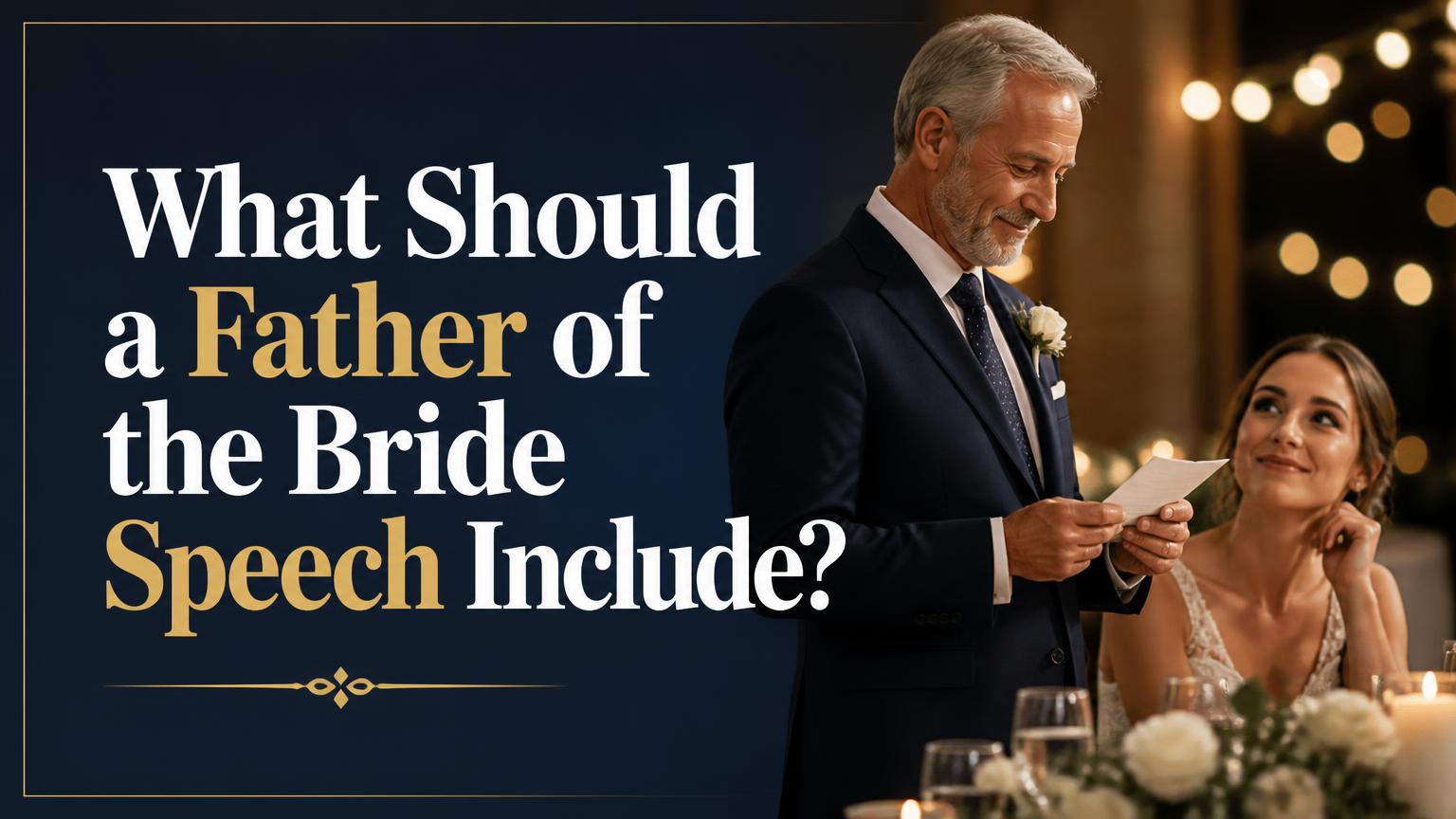
A father of the bride speech should welcome the guests, celebrate the bride, acknowledge her partner, recognize the families and friends who made the day meaningful, and end with a sincere toast to the couple. The best speeches are personal without becoming private, warm without becoming overly sentimental, and brief enough to keep the celebration moving. The guidance below explains what to include, how to organize it, what to avoid, and how to deliver it with confidence while respecting the couple’s wishes and the customs of their wedding.
What Should a Father of the Bride Speech Include? A Practical Guide
A strong father of the bride speech usually combines five elements: a gracious welcome, genuine appreciation for the bride, a meaningful story or observation, a warm acknowledgment of the couple and their families, and a clear closing toast. These elements are common rather than compulsory. Wedding traditions differ, and the couple may have specific preferences about who is thanked, what is mentioned, and how formal the speech should be.
Your central purpose is not to give a biography of your daughter or perform for the room. It is to help mark the transition from the wedding ceremony into the celebration by speaking with affection, perspective, and good judgment. The following components will help you build a speech that sounds like you and honors both partners.
Establish Your Purpose and Central Message
Before writing, decide what you most want the couple and guests to feel when you finish. Your message might be pride in the woman your daughter has become, gratitude for the people gathered, appreciation for her partner, or confidence in the life they are beginning together. Choose one main idea rather than trying to cover every achievement, memory, and family story.
A clear purpose makes the speech easier to shape. If your message is “I am proud of the person she has become, and I am happy to welcome her partner into our family,” each story and sentence should support that thought. This prevents the speech from becoming a long collection of unrelated memories.
Welcome the Guests and Thank the Hosts
Begin by acknowledging the people who have gathered to celebrate the marriage. A simple welcome helps settle the room and gives you a natural opening. You may thank relatives and friends who traveled, the people who helped organize the wedding, or the hosts who made the celebration possible. Include only acknowledgments that fit the couple’s arrangements and family circumstances.
Keep this section focused. A long list of names can make guests feel as though they are listening to an attendance register, and you may accidentally leave someone out. If the couple has asked particular people to be recognized, follow their guidance. Otherwise, a sincere general expression of thanks is usually more graceful than an exhaustive list.
Celebrate Your Daughter as the Adult She Is
The emotional center of the speech is often your appreciation for your daughter, but speak about her as the adult she is today. Mention qualities you genuinely admire, such as her loyalty, determination, generosity, humor, patience, creativity, or ability to make people feel welcome. Specific qualities are more meaningful than broad statements that could apply to anyone.
A short story can show those qualities in action. Choose a memory that reveals something about her character and is appropriate for the entire audience. Avoid stories that embarrass her, expose private information, or make her seem incapable of making her own decisions. The goal is to honor her growth, not to suggest that marriage is the first important step of her life.
Welcome and Respect Her Partner
A father of the bride speech should make room for the person your daughter is marrying. Address the partner by name and express genuine happiness that the two of them have found each other. You might describe a quality you have noticed in the partner or explain how the relationship has brought out something positive in your daughter.
Avoid sounding as though the partner is being examined, approved, or reluctantly admitted into the family. Marriage is a partnership between two adults, not a transfer of responsibility from one parent to another. If you do not know the partner well, you can still speak honestly about the happiness, steadiness, or companionship you have seen in their relationship without inventing familiarity.
Include One or Two Meaningful Stories
A personal story gives the speech a voice and helps guests understand the people behind the formal occasion. Select one or two memories that have a clear connection to your message. The story might show your daughter’s kindness, determination, sense of humor, or willingness to support someone she loves. It could also be a brief observation about the couple together.
Keep each story compact and make its point clear. Give enough context for guests who were not present, then move to what the memory means to you now. Do not rely on private family shorthand, old arguments, embarrassing childhood incidents, or jokes that require a long explanation. A story should deepen the celebration, not make the couple manage an uncomfortable moment.
Acknowledge Both Families and the Wider Community
A wedding brings together more than two individuals, so it can be appropriate to recognize the families, friends, and communities that have supported the couple. You may welcome the other family, express gratitude for the friendships surrounding the couple, or mention the shared circle that made the day possible.
This does not require a formal roll call. Focus on connection rather than listing every relative. If the family structure includes stepparents, blended families, guardians, close friends, or people who have taken on parental roles, use the names and descriptions the couple prefers. Be especially thoughtful when referring to someone absent, estranged, deceased, or involved in a complicated relationship.
Offer Wishes Rather Than Instructions
A short reflection on marriage can add depth, but it should sound like a generous wish rather than a lecture. You might wish the couple patience during difficult seasons, laughter in ordinary days, the courage to communicate honestly, or the ability to keep making room for one another’s hopes. If you offer advice, make it concise and relevant to the couple rather than presenting your own experience as a universal rule.
Avoid turning this section into a list of commands. The wedding is not the time to warn the couple about finances, household duties, children, or past mistakes unless they have specifically invited that kind of conversation. A father’s perspective is most effective when it communicates trust in the couple’s judgment and hope for the life they will build together.
End With a Clear and Sincere Toast
The conclusion should tell guests that the speech is coming to an end and give the celebration a natural lift. Restate your happiness for the couple in a fresh sentence, offer a brief wish for their future, and invite everyone to raise a glass. If alcohol is not being served, simply invite guests to raise their glasses or join you in celebrating the couple.
A strong final line is usually straightforward: “Please raise your glasses to [Name] and [Name], and to a lifetime of love, friendship, and shared adventures.” You can make it more personal, but do not introduce a new story or complicated thought at the end. Finish with the couple’s names and a clear toast so there is no uncertainty about when to applaud.
A Simple Structure for Organizing the Speech
A practical father of the bride speech can follow this order: opening welcome, thanks, personal reflection on the bride, one or two stories, acknowledgment of her partner and both families, a brief wish or piece of advice, and the final toast. This structure creates a natural progression from the gathering as a whole to the bride, then to the couple and their future.
You do not need to announce each section or follow the order mechanically. A story about meeting the partner might fit naturally before your reflection on your daughter, while a family acknowledgment may belong near the beginning. What matters is that the speech has a recognizable beginning, middle, and ending. Write the transitions as you would speak them: “That memory reminds me of the person she has become,” or “And seeing the two of them together, I understand why they are so happy.”
Draft the speech in full before cutting it down. Reading it aloud will reveal repeated ideas, long sentences, and phrases that look polished on the page but feel unnatural in your mouth. Keep the details that help guests see the bride and couple clearly, and remove anything included only because you feel it ought to be there.
How Long Should a Father of the Bride Speech Be?
There is no universal required length, but three to five minutes is a practical range for many wedding receptions. At an average speaking pace of roughly 120 to 140 words per minute, that is approximately 360 to 700 words, with pauses and emotion affecting the total time. A shorter speech can be equally meaningful, particularly when several people are expected to speak.
Ask the couple, wedding planner, or master of ceremonies whether a specific schedule has been arranged. If there are many speeches, aim for the shorter end of the range. If yours is the only formal welcome, you may have a little more room, but avoid using extra time simply because it is available. Rehearse with a timer, and remember that laughter, applause, and pauses will make the live speech longer than the draft.
Tone, Etiquette, and Delivery
The right tone is affectionate, composed, and appropriate for the audience. Gentle humor can work well when it is directed at your own harmless experiences or at a universally recognizable situation, but never make the bride or her partner the target of a joke. Avoid references to former partners, private disagreements, sexual matters, heavy drinking, or stories that could make guests question whether you have the couple’s confidence.
Wedding customs vary by culture, religion, family, and venue. Some fathers traditionally welcome guests or offer a formal blessing; others share the speaking role with another parent, guardian, or close relative. Do not assume that one family’s practice is a requirement for every wedding. Confirm what the couple wants mentioned, how they would like family members described, and whether any religious or cultural language is appropriate.
For delivery, use notes with keywords or short phrases rather than trying to memorize every sentence. Look up regularly, slow down at emotional points, and pause after a joke or important thought. Hold the microphone close enough for the audience to hear without gripping it tightly. If you become emotional, stop, breathe, take a sip of water, and continue when ready. A sincere pause is less distracting than rushing through a meaningful sentence.
Common Mistakes to Avoid
One common mistake is making the speech entirely about the bride’s childhood. A few well-chosen memories can be touching, but the occasion celebrates a marriage, not only a parent-child relationship. Balance your pride in your daughter with respect for her partner and attention to the life they are beginning together. Similarly, avoid describing the bride as though she is being “given away” unless that language genuinely reflects the couple’s chosen tradition.
Another mistake is trying to thank everyone or include every important event from the family’s history. Long lists, inside jokes, and unexplained references can leave other guests disconnected. Choose details that reveal character and serve the speech’s central message. Do not repeat what another speaker has already said unless you have a distinct personal perspective to add.
Finally, do not improvise the entire speech simply because the occasion feels personal. Emotion can make it difficult to remember what you intended to say, and a written draft helps you protect the couple from accidental remarks. At the same time, do not read so quickly or rigidly that the speech loses its conversational quality. Prepare carefully, then speak to the room rather than at the page.
Closing Thoughts
A father of the bride speech should be personal, generous, and centered on the couple’s happiness. Include a welcome, a sincere reflection on your daughter, an appropriate memory, a respectful acknowledgment of her partner and families, and a clear toast. The most successful speech is not the one with the grandest language; it is the one that sounds truthful, suits the wedding, and gives the couple a moment they will be glad to remember.